

Automated Vision Test
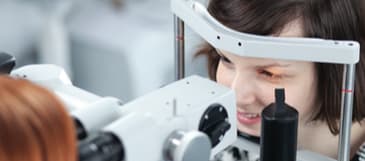 The traditional test for visual acuity requires the patient to look and report which letters they see. A new invention provides an automated system to estimate visual acuity based on objective measurements of the eye optics and wavefront aberrations. A typical measurement consists of a list of numbers that constitute the coefficients of the polynomials. The algorithm converts the list of numbers into an estimate of the visual acuity of the patient.
Hybrid Architecture Active Wavefront Sensing & Control
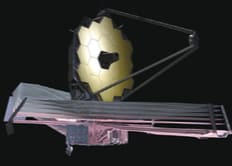 This system provides a method for performing high-speed wavefront sensing and control to overcome thermal instabilities in a segmented primary mirror telescope. This method utilizes the onboard fine guidance sensor that is already needed to maintain pointing of the telescope. Applications include ground segmented observatories using a laser guide star or other similar scheme.
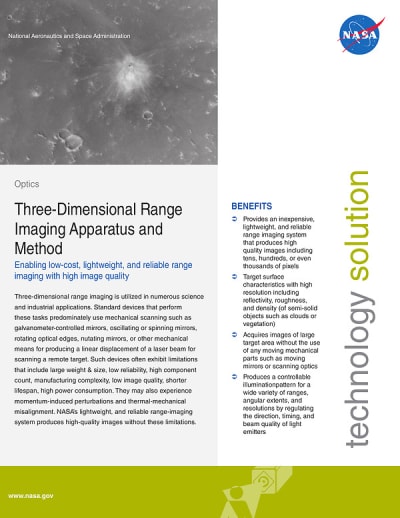
Three-Dimensional Range Imaging Apparatus and Method
 A lightweight and reliable, three-dimensional range-imaging system involves providing a modulated light signal, forming a fixed fiber array with ends of optical fibers, switching the modulated light signal successively into multiple optical fibers to form a pixel pattern at the fixed fiber array, and projecting the pixel pattern onto a target.
Smart Optics Material Characterization System
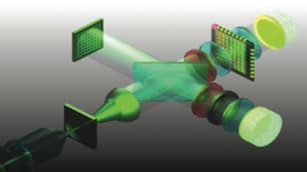 An adaptable and powerful interferometric test platform enables multi-parameter evaluation of smart optical materials. The characterization system was created to measure the dynamic optical response of smart optical materials, while external stimuli are applied to the material. Uses include 2D/3D displays, nonlinear and liquid crystal switching and waveguide device testing, precision and adaptive optics, and sensors and detectors.
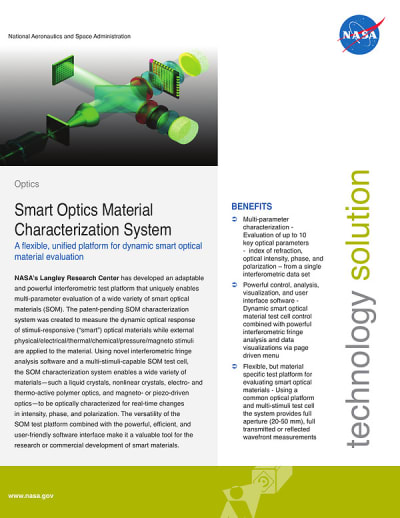
Electrochemically Enhanced Mechanical Polishing of Optics
 Astrophysicists are developing better instruments to measure high-energy x-rays in space when viewed from above the Earth’s atmosphere. A novel method for material removal and superpolishing was applied to the mandrel fabrication of an advanced x-ray telescope. Other applications include search, surveillance, and detection; reflective optics; high-quality, low-cost communications devices; and optical components for UV solar blind detectors.
Nested Focusing Optics for Compact Neutron Sources
Neutron grazing incidence optics for use with small-scale, portable neutron generators enable the use of commercially available neutron generators for applications requiring high flux densities, including high-performance imaging and analysis. Nested grazing incidence mirror optics maximize neutron flux from diffuse sources for imaging and testing applications.
Overview
The document discusses NASA's development of novel neutron grazing incidence optics designed to enhance the performance of compact neutron sources for imaging and analytical applications. Traditional neutron beam experiments require high fluxes typically available only at large research facilities with reactor sources. However, this new technology allows for the production of focused neutron beams from smaller, commercially available sources, significantly increasing neutron flux concentrations.
The optics utilize a unique design involving nested parabolic and hyperbolic mirrors that reflect neutrons at small angles, creating beams that can be divergent, parallel, or convergent. By concentrically nesting mirrors with the same focal length and curvature, multiple neutron beams can converge at a single focal point, resulting in a substantial increase in flux. This technology is particularly beneficial for non-destructive testing, imaging, and materials analysis.
The fabrication of these grazing incidence neutron optic mirrors employs an electroformed nickel replication technique developed in collaboration with the Harvard-Smithsonian Center for Astrophysics. The process involves creating a super-polished aluminum mandrel, which is then plated with a highly reflective nickel-cobalt alloy. This method eliminates residual stresses that could warp the mirrors, ensuring a deformation-free surface. The mirrors produced can be 0.5 meters or 1.0 meters in size.
The benefits of this technology include improved performance, allowing the use of smaller neutron sources; increased flexibility with removable mirrors for easy flux adjustments; reduced costs through a novel replication technique; and enhanced collection efficiency compared to traditional neutron focusing guides and Kirkpatrick-Baez mirrors.
Applications of this technology span various fields, enabling compact radiation sources for non-destructive inspection of jet-engine turbine blades, fuel cells, archaeological artifacts, and welds. It also supports advanced analytical techniques such as small angle neutron scattering (SANS), time-of-flight spectroscopy, convergent beam crystallography, and inelastic scattering instruments.
Overall, NASA's technology transfer program aims to maximize the benefits of this research for U.S. citizens by fostering partnerships and licensing agreements with industry, ensuring that these innovations contribute to economic growth, job creation, and improved quality of life.







