

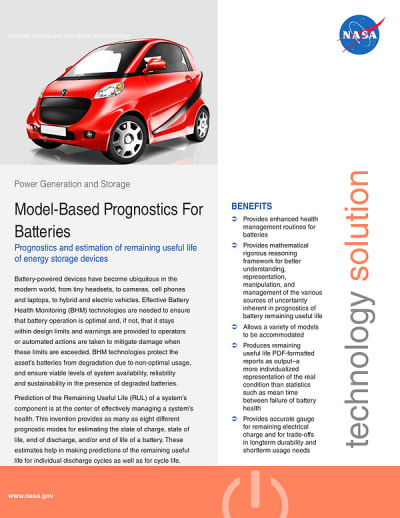
Model-Based Prognostics For Batteries
 Effective Battery Health Monitoring (BHM) technologies are needed to ensure that battery operation is optimal and, if not, that it stays within design limits. BHM technologies protect the asset’s batteries from degradation due to non-optimal usage, and ensure viable levels of system availability, reliability, and sustainability in the presence of degraded batteries.
Method and Apparatus for In-Situ Monitoring of Solar Cells
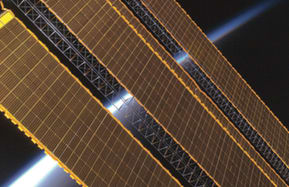 This method is radiation-hard, consumes few system resources, and uses commercially available components. It operates at temperatures from -55 to 225 °C, allowing it to reside close to the array in direct sunlight. Originally developed for space, the technology can be adapted for use in terrestrial solar power generation systems.
Battery Charge Equalizer System
 A battery charge equalizer provides individual cell charging in multi-cell battery strings using a minimum number of transformers. By effectively keeping all the cells in a multi-cell string at the same charge state, this technology maximizes the battery’s life and performance. It achieves equalization without wasting energy or creating excess heat and manages lithium-ion batteries used in electric vehicles.

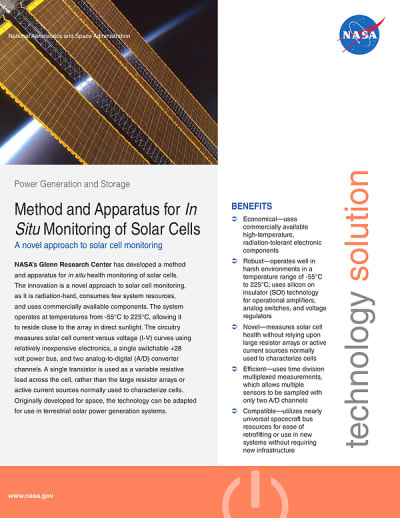
Battery Management System
 This system monitors and balances the charge of individual battery cells that are in series, and provides fault detection of individual cells in parallel within a battery pack of hundreds of cells. It offers a safe and potentially low-cost management system for high-voltage battery systems, including lithium-ion (Li-ion) battery systems that are used in electric vehicles.
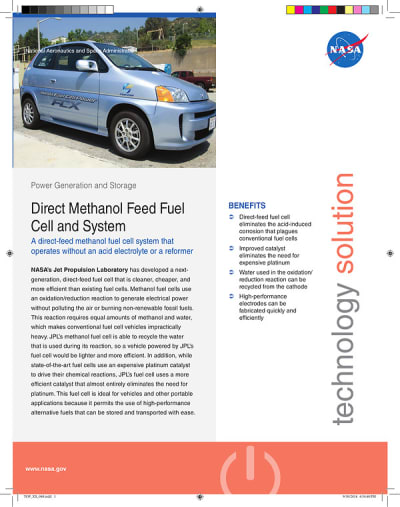
Direct Methanol Feed Fuel Cell and System
 This fuel cell is cleaner, cheaper, and more efficient than existing fuel cells. It is able to recycle the water used during its reaction, so a vehicle powered by the fuel cell would be lighter and more efficient. In addition, it uses a more efficient catalyst that almost entirely eliminates the need for platinum. This fuel cell permits use of high-performance alternative fuels that can be stored and transported with ease.
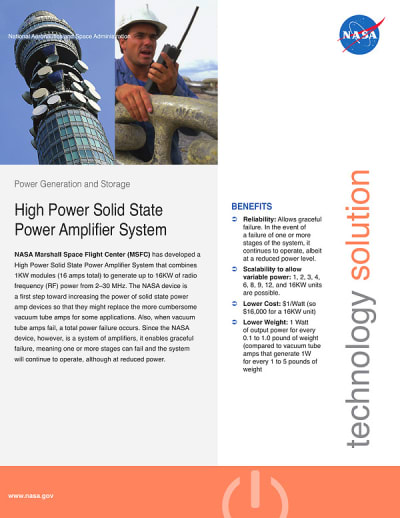
High-Power Solid-State Power Amplifier System
 This system combines 1KW modules to generate up to 16KW of radio frequency power from 2–30 MHz. The device is a first step toward increasing the power of solidstate power amp devices so that they might replace the more cumbersome vacuum tube amps for some applications. One or more stages can fail and the system will continue to operate, although at reduced power.
Overview
The document outlines NASA's Technology Transfer Program, which aims to maximize the application of NASA's technological innovations for the benefit of U.S. citizens. Through partnerships and licensing agreements with industry, the program seeks to ensure that NASA's investments in research lead to secondary uses that enhance the economy, create jobs, and improve quality of life.
A key focus of the document is the development of a High Power Solid State Power Amplifier System by NASA's Marshall Space Flight Center. This system represents a significant advancement in power amplification technology, offering a viable alternative to traditional vacuum tube amplifiers, which have dominated high-power applications. The existing solid-state power amplifiers typically operate at lower power levels (1-5KW), while vacuum tube amplifiers can reach power levels in the tens of megawatts. However, vacuum tube amplifiers are often large and heavy, posing challenges in various applications.
The NASA-developed solid-state amplifier system combines multiple 1KW modules to generate up to 16KW of radio frequency (RF) power across a frequency range of 2-30 MHz. This system is designed to provide several benefits, including:
-
Reliability: The system allows for graceful failure, meaning that if one or more amplifier stages fail, the system can continue to operate at a reduced power level, unlike vacuum tube amplifiers, which experience total power failure upon failure of any component.
-
Scalability: The system can be configured to provide variable power outputs, with options for 1, 2, 3, 4, 6, 8, 9, 12, and 16KW units.
-
Cost Efficiency: The cost of the system is approximately $1 per watt, making a 16KW unit around $16,000, which is economically advantageous compared to traditional solutions.
-
Weight Reduction: The solid-state system offers a significant weight advantage, producing 1 watt of output power for every 0.1 to 1.0 pound, compared to vacuum tube amplifiers that require 1 to 5 pounds for the same output.
The document also highlights potential applications for this technology, including RF induction heating for various industrial processes, high-power transmitters for broadcasting and communications, and plasma generation for cleaning ultrahigh vacuum parts. Overall, NASA's advancements in solid-state power amplification hold promise for diverse industries and applications, enhancing both technological capabilities and economic benefits.







