

An ultrafast camera can acquire two-dimensional images at 100 billion frames per second, a speed capable of revealing light pulses and other phenomena previously too fast to be observed. While other research groups have achieved higher frame rates (trillion f/s), this camera is the world’s fastest 2D camera that doesn’t require an external flash or multiple exposures.
This distinction makes the camera particularly suited for imaging ultrafast, non-repetitive phenomena such as a single laser pulse or the short-lived, intermediate states of a biochemical reaction. If coupled to a microscope, it could help researchers gain valuable insights into previously unobservable biological phenomena.
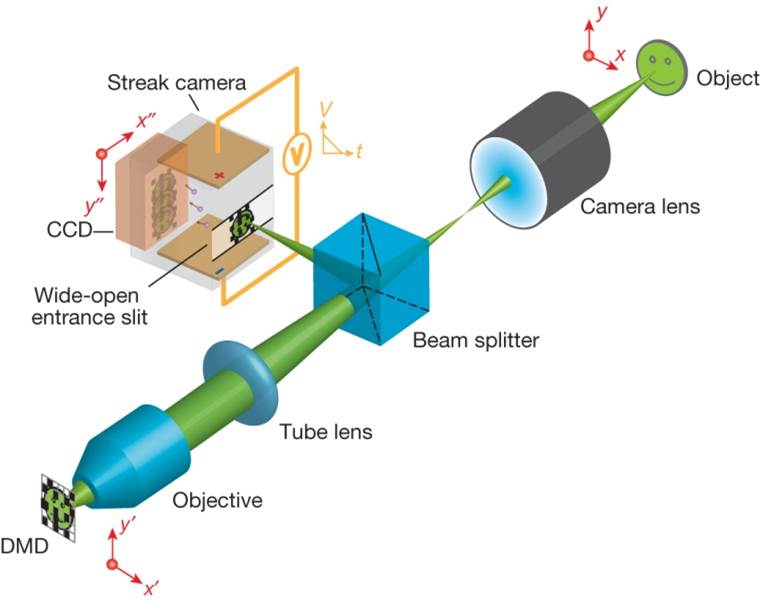
In order to capture a 2D event using a streak camera, the camera’s narrow slit needed to be widened. Yet doing so would be detrimental to the temporal resolution. To get around this, a technique called compressed ultrafast photography (CUP) was used.











