

Thermoelectric (TE) energy recovery is an important technology for recovering waste thermal energy in high-temperature industrial, transportation, and military energy systems. TE power systems in these applications require high-performance hot-side and cold-side heat transfer to provide the critical temperature differential and transfer the required thermal energy to create the power output. Hot- and cold-side heat transfer performance is typically characterized by hot-side and cold-side thermal resistances, Rh,th and Rc,th, respectively. This heat transfer performance determines the hot-side temperature, Th, and cold-side temperature, Tc, conditions when operating in energy recovery environments with available temperature differentials characterized by an external driving temperature, Text, and ambient temperature, Tamb.
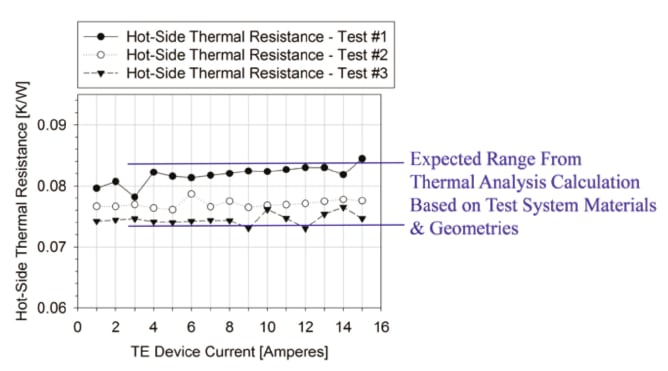 Hot-side thermal resistances (see figure) can be affected by many external factors, including hot exhaust gas contaminations, differential expansion forces, external vibration forces, or changes at key transfer interfaces caused by material diffusions or breakdowns. It is crucial to monitor and track the hot-side thermal performance at all times during TE energy recovery system operation, thereby allowing one to track the system “health,” predict future expected system performance, and anticipate/ prevent system failures.
A perturbation methodology and the direct coupling between TE current, voltage, and hot-side energy flow are used to extract a real-time, in-situ evaluation of hot-side thermal resistances. External measurable TE parameters, either system current or Text, can be perturbed during system operation, and the resulting TE system response can then be coupled mathematically to the hot-side thermal transfer performance (i.e., thermal resistance). This can then assist in developing faster, real-time techniques to alleviate any system performance degradation, or identify and prevent system damage from dramatic changes in hot-side thermal transfer conditions.
This approach provides an internally consistent methodology for identifying and mitigating system performance problems early in critical system testing and validation cycles, thereby providing a real-time methodology for modifying system performance expectations and predictions, as required, and early prevention of potential system-damaging conditions.
This technique can be applied to all spacecraft radioisotope thermoelectric generator (RTG) systems in providing another critical technique for monitoring system health, control system performance, and adjust performance expectations based on real-time, in-situ operational data analysis. It can be applied to any thermoelectric energy recovery system used in automotive and industrial process applications.
This work was done by Terry Hendricks of Caltech for NASA’s Jet Propulsion Laboratory.
In accordance with Public Law 96-517, the contractor has elected to retain title to this invention. Inquiries concerning rights for its commercial use should be addressed to:
Innovative Technology Assets Management
JPL
Mail Stop 321-123
4800 Oak Grove Drive
Pasadena, CA 91109-8099
E-mail: This email address is being protected from spambots. You need JavaScript enabled to view it.
Refer to NPO-49583.
This Brief includes a Technical Support Package (TSP).
Real-Time, In-Situ Determination and Monitoring of Hot- and Cold-Side Thermal Resistances in Thermoelectric Systems
(reference NPO49583) is currently available for download from the TSP library.
Don't have an account?
Overview
The document is a Technical Support Package from NASA's Jet Propulsion Laboratory (JPL) detailing advancements in the real-time, in-situ determination and monitoring of hot- and cold-side thermal resistances in thermoelectric systems. It emphasizes the critical importance of thermal resistances (R_h,th and R_c,th) in optimizing the performance and power output of thermoelectric devices.
Key highlights include:
-
Importance of Thermal Resistances: The document discusses a recent study presented at MRS 2013, which underscores the significance of the ratio of hot-side to cold-side thermal resistances (R_h,th / R_c,th) in achieving maximum power output. It notes that optimal conditions require this ratio to be between 10 to 30 to maximize power efficiency.
-
Testing and Evaluation Techniques: The document outlines the methodologies employed at JPL for testing thermoelectric devices, including the use of linear regression techniques to evaluate temperature variability and uncertainties during routine I-V curve and electrical resistance testing. It highlights the need for a dual-approach technique that allows for effective monitoring and evaluation of both R_h,th and R_c,th.
-
Real-Time Monitoring: A strong emphasis is placed on the development of real-time, in-situ techniques for evaluating thermal resistances. The dual-approach not only provides accurate monitoring but also incorporates cross-checking characteristics that enhance reliability in assessments.
-
Applications and Future Work: The document mentions ongoing work and enhancements expected in the field, including applications in full convective systems for waste heat recovery and radioisotope-driven systems. It indicates that the techniques developed could have broader implications beyond aerospace applications.
-
Acknowledgments and Funding: The work is acknowledged to have been carried out under a NASA Space Act Agreement, with funding from the U.S. Department of Energy, highlighting the collaborative nature of the research.
Overall, the document serves as a comprehensive overview of the advancements in thermoelectric systems at JPL, focusing on the methodologies for monitoring thermal resistances, the importance of these measurements for maximizing power output, and the future directions of this research. It aims to make the results of aerospace-related developments accessible for wider technological, scientific, and commercial applications.











