

Solar-array panels will experience very low temperatures of 50 K for the proposed Europa Clipper Mission (ECM). Solar-array panels will also undergo thermal cycling from 50 K to 133 K during the mission due to Jovian eclipsing. Unfortunately, there was no knowledge of the physical properties of the materials planned to be used down to ≈50 K, making it difficult to assess their reliability under such extreme cryogenic temperature conditions.
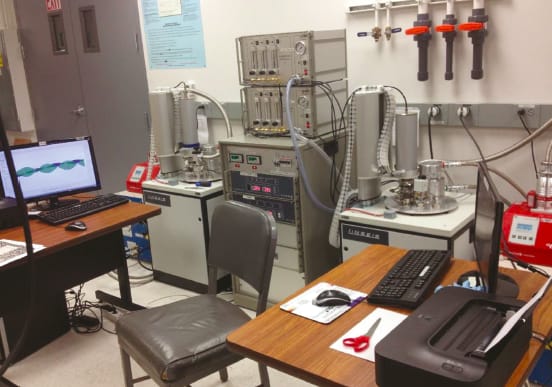
The TMA was used to measure the Young’s modulus of a given material. The deflection of the test sample under load in the TPBP was measured by means of a special sample holder set-up and a knife-edge piston. The effective sample load is the sum of the static sample load and momentary value of the dynamic sample load. The change in deflection is recorded as a function of time and temperature. One can evaluate using the data of Delta deflection, temperature, dimensions of the materials, etc., to determine Young’s modulus for a given material and temperature.
The dilatometer basic unit consists of a measuring head, furnace lift control, and the computer-controlled power supply for the furnace. Dilatometers measure either change in length, width, or thickness of a test coupon as a function of temperature. This change in length (DL) can be a reversible change, or a sum of reversible and irreversible changes in length in the cases where there are phase transformations. Principally, samples lying in a sample holder are linearly heated while the case may be cooled. The change in length is transmitted by means of a push rod from the furnace on a linear variable differential transducer (LVDT). The sample temperature is recorded by a diode temperature sensor. Measurements were carried out under a partial vacuum of helium. CTE and Young’s modulus were studied to less than 20 K for solar array materials. At the time of this reporting, no such data exists in the published literature for such extreme cryogenic temperature conditions. The existing methods are only capable of measuring CTE and Young’s modulus to 123 K.
This work was done by Rajeshuni Ramesham, Stephen F. Dawson, and Antonio Ulloa-Severino of Caltech for NASA’s Jet Propulsion Laboratory. NPO-49666
This Brief includes a Technical Support Package (TSP).
Physical Characterization of Radiated and Non-Radiated Materials to Temperatures Less Than 50 K
(reference NPO49666) is currently available for download from the TSP library.
Don't have an account?
Overview
The document discusses the physical characterization and qualification of materials intended for use in solar arrays (SAs) for NASA's Europa Clipper Mission (ECM). It highlights the challenges posed by the extreme cryogenic temperatures that these materials will encounter, specifically temperatures as low as approximately 50 K, and the thermal cycling between 50 K and 133 K due to Jovian eclipse conditions.
The research emphasizes the need for reliable data on the properties of materials at cryogenic temperatures, as existing knowledge is limited. To address this, two specialized instruments were developed: a Thermo-Mechanical Analyzer (TMA) with a Three Point Bend Probe (TPBP) module, and a Dilatometer. The TMA is designed to measure Young's modulus (e-modulus) at cryogenic temperatures, while the Dilatometer measures the Coefficient of Thermal Expansion (CTE). These measurements are crucial for assessing the reliability of materials and processes under the extreme conditions expected during the mission.
The document also describes a separate study focused on the thermal cycling qualification of solar array structures bonded with solar cells. Traditional methods for thermal cycling, such as using liquid helium, are noted to be expensive and inefficient. Instead, a more controllable vacuum setup was created, utilizing a cryostat in a closed-loop system, which successfully achieved temperatures down to approximately 35 K. This setup allowed for the qualification of solar array structures with solar cells down to 50 K, marking a significant achievement in the field.
The findings from this research are expected to enhance the understanding of material behavior in cryogenic environments, ultimately contributing to the reliability and performance of solar arrays for the ECM. The document serves as a technical support package under NASA's Commercial Technology Program, aiming to disseminate aerospace-related developments with broader technological, scientific, or commercial applications.
For further inquiries or detailed information, the document provides contact details for the Innovative Technology Assets Management at NASA's Jet Propulsion Laboratory. Overall, this research represents a critical step in ensuring the success of the ECM by addressing the material challenges posed by extreme temperatures in space.











