A lake and shore sampling and sample distribution system was developed for a Titan lake environment (93.7 K, in liquid hydrocarbons). The Titan Lake and Shore Sampler (TLASS) would enable the chemical analysis of hydrocarbon lake samples via a Dual Rectilinear Ion and Orbitrap Mass Spectrometer and Nuclear Magnetic Resonance (NMR) Spectrometry.
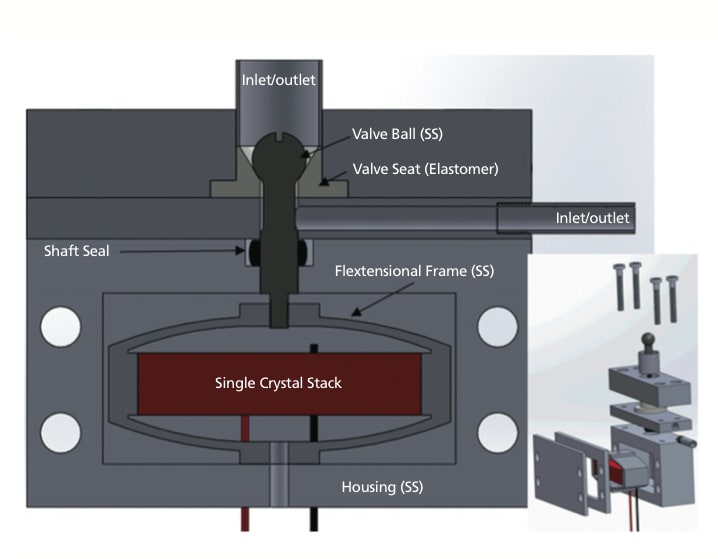
A system was built to demonstrate the required functionality of a potential Titan sampling system for sample distribution to three separate instruments. A vacuum manifold supplies the vacuum to the inlet ports of each instrument. A solid sampler that is to be developed utilizes a narrow pneumatic penetrator that samples the solid and returns the sample to the spacecraft where it is melted under controlled conditions. The sample outlet of the solid sampler is connected to the inlet of the liquid sampler allowing for a single solid sample to be delivered by melting to the liquid sampler and sample handling system design. A variety of thermal problems need to be addressed when sampling from a cryogenic lake. The first is the heat flow from the spacecraft to the local fluid.
The best candidate actuator material for this application, based on mass, power, and reliability, were the new single-crystal piezoelectric materials that have been developed for cryogenic applications. Since the origin of high electromechanical properties of relaxor-PT single crystals is due to the polarization rotation effect (i.e., intrinsic contributions), the property degradation at cryogenic temperatures is much lower than in PZT (lead zirconate titanate) ceramics, making them promising candidates for cryogenic actuators from the perspective of stroke and power loss in the actuator when activated.
The novelty is the use of cryogenic valving to implement a sampler system that can operate at cryogenic temperatures. The potential mission target of Titan has methane and ethane lakes that are in thermal equilibrium with the atmosphere and surface. The vapor pressures of methane and ethane are important for the effective design of an ambient phase sampler. The surface pressure and temperature of Titan is 1.47 atmospheres and 93.7 K. The boiling temperature (when the vapor pressure equals the ambient pressure) of the methane and ethane would occur at 110 K and 190 K, respectively. This means that thermal control of the sampling system is critical for the controlled sampling, and the heating of each of the liquids must be small, to be accounted for by the heat capacity of the methane and thermal conductivity away from the spacecraft. The cryogenic valves developed for this instrument will allow for the sampling and interrogation by critical instrumentation to determine the complex physical chemistry found on the surface of Titan or other cryogenic worlds.
This work was done by Stewart Sherrit, Eric A. Kulczycki, and Wayne F. Zimmerman of Caltech; Nobuyuki Takano of the California Polytechnic Institute; and Louisa Avellar of UC Berkeley for NASA’s Jet Propulsion Laboratory. NPO-49343
This Brief includes a Technical Support Package (TSP).
Titan Lake and Shore Sampler
(reference NPO49343) is currently available for download from the TSP library.
Don't have an account?
Overview
The document is a Technical Support Package for the Titan Lake and Shore Sampler (TLASS), developed under NASA's Commercial Technology Program. It outlines the advancements in sampling technology designed for in-situ analysis of Titan, Saturn's largest moon, particularly its unique methane and ethane lakes. The research was conducted at the Jet Propulsion Laboratory (JPL), California Institute of Technology, under NASA sponsorship.
The primary objective of the TLASS is to collect samples from Titan's cryogenic environment without altering their original conditions. This requires a sophisticated sampling system that maintains thermal control during sample ingestion and delivery. The document describes a bench-top sampling system that has been designed and tested to meet these requirements. This system is capable of distributing samples to multiple instruments, ensuring that the integrity of the samples is preserved for accurate analysis.
Key features of the sampling system include low power actuators that can function effectively at cryogenic temperatures, which is essential for operating in Titan's frigid environment. The system incorporates relaxor-PT single crystal materials within a flextensional frame, serving as valve actuators to facilitate the sampling process. The design also includes a vacuum manifold that supplies vacuum to the inlet ports of the instruments, further ensuring the preservation of sample integrity.
The document emphasizes the importance of delivering samples that have not been randomly differentiated from their in-situ conditions, which is crucial for accurate physical chemistry measurements. It highlights the challenges faced in developing such a system and the innovative solutions that have been implemented to overcome them.
In addition to the technical details, the document provides contact information for further inquiries regarding research and technology in this area, emphasizing NASA's commitment to technology transfer and collaboration. It also includes a disclaimer regarding the use of the information contained within the document, clarifying that the U.S. Government does not assume liability for its use.
Overall, the TLASS Technical Support Package showcases NASA's efforts to advance our understanding of extraterrestrial environments through innovative sampling technologies, paving the way for future exploration missions to Titan and beyond.