An improved miniature electrostatic sector has been designed for a miniature double-focusing mass spectrometer (see figure). Miniature mass spectrometers are essential components of high-performance, miniature, low-power instruments that are being developed for use in analyzing chemical compositions of small amounts of substances (e.g., toxic chemicals in the environment) in scientific laboratories, in industrial settings, and in the field.
Precision is critical in the design and fabrication of an electrostatic sector for a mass spectrometer. Especially notable is a very tight tolerance on the radii of the sector rails (the concentric cylindrical electrode surfaces); for this particular electrostatic sector, the nominal inner and outer radii are 29.21 and 30.48 mm, respectively, and the difference between these radii must not vary by more than 10 ?m over the entire arc. In an older design, the two rails were fabricated separately, making it necessary to resort to an elaborate and laborious procedure to align them with each other to satisfy the radius requirement as well as to obtain the required precise alignment between these rails and the other spectrometer components. The older two-piece design also made it difficult to maintain alignment during transport. These difficulties of establishing and maintaining alignment added significantly to the cost of fabrication and limited use to applications in which ruggedness was not needed.
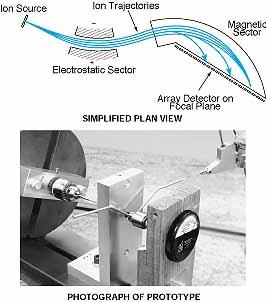
The improved electrostatic sector is inherently rugged and dimensionally stable because it is made from a single piece of a machinable ceramic. The electrodes are made by plating the machined concentric electrode surfaces with nickel to a thickness of 6 µm. Reference surfaces for alignment are machined onto the single piece of ceramic; these surfaces are designed to be positioned on alignment ridges on a mounting plate that is also a precise component of the mass spectrometer. Two screws hold the unitary electrostatic sector in place with the reference surfaces pressing against the alignment ridges. Thus, provided that the concentric electrode surfaces and the reference surfaces are machined within tolerances, alignment of the electrodes with the other components of the mass spectrometer is assured. As a result, the cost of fabrication is no more than about 1/40 of that of the older electrostatic-sector design.
A Mass Spectrometer of Mattauch-Herzog Geometry includes an electrostatic sector plus a magnetic sector that ends in an array detector on a focal plane. The electrostatic sector is made from a single piece of machinable ceramic and has a mass of only 30 g.
This work was done by Mahadeva P. Sinha of Caltech for NASA's Jet Propulsion Laboratory. For further information, access the Technical Support Package (TSP) free on-line at www.nasatech.com under the Physical Sciences category. In accordance with Public Law 96-517, the contractor has elected to retain title to this invention. Inquiries concerning rights for its commercial use should be addressed to
Technology Reporting Office
JPL
Mail Stop 122-116
4800 Oak Grove Drive
Pasadena, CA 91109
(818) 354-2240
Refer to NPO-20215, volume and number of this NASA Tech Briefs issue, and the page number.
This Brief includes a Technical Support Package (TSP).
Monolithic electrostatic sector for miniature mass spectrometers
(reference NPO-20215) is currently available for download from the TSP library.
Don't have an account?
Overview
The document presents a technical report on a novel design for a miniature electrostatic sector (ESA) intended for use in double-focusing mass spectrometers, developed by NASA's Jet Propulsion Laboratory. The new ESA is characterized by its compactness, lightweight design (approximately 30 grams), and ease of alignment with other mass spectrometer components, such as ion sources and magnetic sectors. This innovation aims to facilitate the development of high-performance, miniaturized mass spectrometers suitable for both terrestrial and planetary applications, particularly in analyzing small quantities of substances, including toxic chemicals in various environments.
Key features of the new ESA include its construction from a single block of machinable ceramic material, MACOR, which ensures high parallelism and alignment between the sector rails. This design overcomes challenges faced by previous models, where separate fabrication of the rails led to difficulties in maintaining precise alignment and tolerances during transportation and use in field conditions. The new design allows for a much tighter tolerance on the radii of the sector rails, with nominal inner and outer radii of 29.21 mm and 30.48 mm, respectively, and a maximum variation of 10 micrometers over the entire arc.
The document emphasizes the importance of precision in the design and fabrication of the electrostatic sector, as it directly impacts the performance of the mass spectrometer. The new ESA design not only simplifies the manufacturing process but also significantly reduces costs—by 40-50 times compared to previous designs—making it more accessible for various applications.
Additionally, the report highlights the potential applications of these miniature mass spectrometers in real-time monitoring of hazardous chemicals in field environments, as well as their integration with microbore/micromachined gas chromatographs for organic mixture analysis. The advancements in the ESA technology are expected to enhance the capabilities of mass spectrometers, making them more suitable for use outside laboratory settings, thus broadening their utility in environmental monitoring and other critical fields.
In summary, this document outlines a significant technological advancement in the design of electrostatic sectors for mass spectrometers, focusing on improved performance, reduced costs, and enhanced applicability in diverse environments.