An apparatus that includes an array of multiple electrodes has been invented as a means of simultaneously testing multiple materials for their utility as oxygen-reduction catalysts in fuel cells. The apparatus ensures comparability of test results by exposing all the catalyst-material specimens to the same electrolytic test solution at the same potential. Heretofore, it has been possible to test only one specimen at a time, using a precise rotating disk electrode that provides a controlled flux of solution to the surface of the specimen.
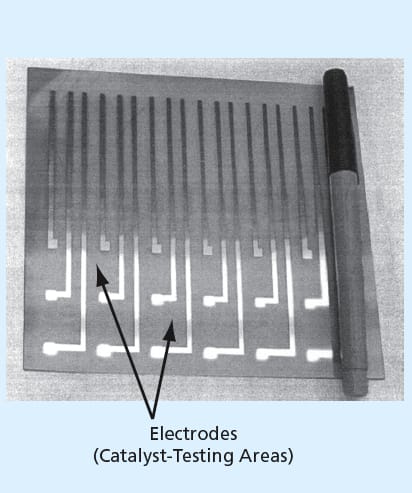
The resulting flexible electrode fixture is placed on the inside wall of a 20cm-diameter vertical cylindrical container with the electrodes facing inward. The current collectors are connected to the input terminals of a multichannel potentiostat. The container is filled with electrolyte solution. In operation, oxygen is bubbled through the solution and the solution is stirred rapidly (e.g., by use of a conventional propeller/impeller or a magnetic stirrer) to maintain a laminar flow of consistently oxygenated solution over the electrodes. During operation, the multichannel potentiostat simultaneously measures the currents generated at all the electrodes as functions of an applied bias voltage. Typically, the voltage is varied in a slow potentiodynamic scan.
This work was done by Jay Whitacre and Sekharipuram Narayanan of Caltech for NASA’s Jet Propulsion Laboratory.
In accordance with Public Law 96-517, the contractor has elected to retain title to this invention. Inquiries concerning rights for its commercial use should be addressed to:
Innovative Technology Assets Management
JPL
Mail Stop 202-233
4800 Oak Grove Drive
Pasadena, CA 91109-8099
(818) 354-2240
E-mail: This email address is being protected from spambots. You need JavaScript enabled to view it.
Refer to NPO-43220, volume and number of this NASA Tech Briefs issue, and the page number.
This Brief includes a Technical Support Package (TSP).
Apparatus for Screening Multiple Oxygen-Reduction Catalysts
(reference NPO-43220) is currently available for download from the TSP library.
Don't have an account?
Overview
The document outlines NASA's Technical Support Package NPO-43220, which details a novel multi-electrode test system designed for the rapid electrochemical screening of oxygen reduction catalysts. This technology addresses a significant limitation in current testing methods, where only single samples can be analyzed at a time. The primary goal of the invention is to enable the simultaneous quantitative study of the oxygen reduction reaction across multiple catalyst surfaces using a single test solution bath.
The solution involves the use of flexible, highly polished polyvinylidene fluoride (PVDF) substrates that are patterned with gold (Au) current-collector structures. These structures support small catalyst test areas measuring 5 mm by 5 mm. The flexible fixture is molded to fit the inner diameter of a 20 cm cylindrical solution bath. This design allows for effective stirring of the solution, creating a laminar flow condition over the catalyst array. As a result, each catalyst area receives a uniformly oxygenated solution, which is crucial for accurate testing.
A multi-channel potentiostat is employed to measure the current generated at each catalyst test area under varying bias conditions. This setup facilitates rapid parallel testing of oxygen reduction catalysts, which is particularly beneficial for applications in fuel cells. Traditional methods, such as using a rotating disk electrode, are limited to one sample at a time and require precise control of the solution flux. In contrast, this new apparatus allows for high-throughput testing, significantly speeding up the evaluation process.
The document also references a related study titled “A high-throughput study of PtNiZr catalysts for application in PEM fuel cells” by J.F. Whitacre et al., published in Electrochimica Acta. This study exemplifies the potential applications of the technology in advancing fuel cell research.
Overall, the Technical Support Package emphasizes the innovative aspects of the multi-electrode system, its design, and its implications for enhancing the efficiency of catalyst screening processes. It highlights NASA's commitment to developing technologies with broader scientific and commercial applications, particularly in the field of electrochemistry and energy conversion. For further inquiries, the document provides contact information for the Innovative Technology Assets Management at JPL.