Inside this issue
Supplements

Overview
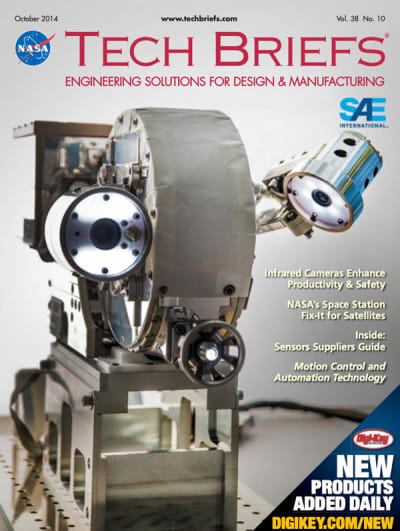
The October 2014 issue of NASA Tech Briefs and Motion Control and Automation Technology presents a wealth of information on the latest advancements in technology, engineering, and automation. This edition features a variety of articles that highlight innovative solutions and products designed to address contemporary challenges in various industries.
One of the key topics covered in this issue is harmonic mitigation techniques. Harmonics can cause significant issues in electrical systems, leading to inefficiencies and potential damage. The article discusses various methods to mitigate these effects, including the use of filters and advanced control strategies. By implementing these techniques, engineers can enhance the reliability and efficiency of electrical systems, which is crucial for both industrial applications and space missions.
Another significant focus of this issue is on reliable locking mechanisms in high-vibration environments. In industries such as aerospace and automotive, components are often subjected to extreme conditions, including vibrations that can lead to mechanical failures. The article explores innovative locking mechanisms that ensure the integrity of critical components, thereby improving safety and performance. These advancements are particularly relevant for applications in spacecraft, where reliability is paramount.
The issue also showcases a range of new products that are making waves in the market. From advanced sensors to cutting-edge automation solutions, these products are designed to improve efficiency and productivity across various sectors. The advertisers' index provides readers with easy access to product literature, allowing them to explore these innovations further.
In addition to technical articles, the magazine includes insights into industry trends and future directions. The editors emphasize the importance of staying informed about emerging technologies and market shifts, as these factors can significantly impact engineering practices and business strategies. The issue encourages readers to embrace innovation and adapt to the rapidly changing landscape of technology.
Furthermore, the magazine features case studies that illustrate the practical applications of the technologies discussed. These real-world examples provide valuable context and demonstrate how companies are successfully implementing new solutions to overcome challenges. By learning from these case studies, readers can gain insights into best practices and strategies for their own projects.
The layout of the magazine is designed for easy navigation, with clear sections and links to additional resources. Readers can quickly find the information they need, whether they are looking for specific articles, product information, or industry news. This user-friendly approach enhances the overall reading experience and encourages engagement with the content.
Overall, the October 2014 issue of NASA Tech Briefs and Motion Control and Automation Technology serves as a comprehensive resource for professionals in engineering, automation, and technology. It combines technical insights, product showcases, and industry trends to provide a well-rounded perspective on the current state of technology and its future directions. By staying informed and embracing innovation, readers can position themselves for success in an increasingly competitive landscape.
Features
-
Application Briefs
NASA Launch Pads Protected Against Lightning-Induced Power Surges
-
Who's Who
Dr. Ajay Koshti, Lead Nondestructive Evaluation Engineer, Johnson Space Center, Houston, TX
Tech Briefs
-
Physical Sciences
Nanosensor/Cellphone Hybrid for Detecting Chemicals and Concentrations
Coated or Doped Carbon Nanotube Network Sensors as Affected by Environmental Parameters
Regenerable Internal CO Scrubber for Hydrogen Sensors
Nanostructure Sensor Determines Presence and Concentration of a Target Molecule in Fluid
Floating Ultrasonic Transducer Inspection System for Nondestructive Evaluation
Multiplexer for Multiple Sensors in a Vacuum Chamber
Miniaturized Schottky Diode Sensors for Hydrogen and Hydrocarbon Detection at High Temperatures
Analog Ceramic Isolated Voltage Sensor
Flexible and Erectable Magnetic Field Response Sensors
Miniature Amperometric Solid Electrolyte Carbon Dioxide Sensor with Low Detection Limit
A High-Cross-Polarization-Isolation, Multi-Frequency Antenna for Cloud and Precipitation Research
External Magnetic Field Reduction Technique for Advanced Stirling Radioisotope Generator
Advanced P-Band Spaceborne Radar System
-
Manufacturing & Prototyping
Multi-Step DRIE Process to Fabricate Silicon-Based THz Components
Plasma Reduction of Lunar Regolith for In-Space Fabrication
Method for Determining Self-Reacting Friction Stir Weld Schedules
Bulk Separation and Manipulation of Carbon Nanotubes by Type
-
Materials
Layered Composite Thermal Insulation System for Non-Vacuum Applications
White, Electrically Dissipative Thermal Control Coating
Ultra-High-Temperature Ceramic Composites with SiC Reinforcements
Cathode Discharge Catalytic Systems for Hydrogen Recovery from Methane
Beneficiation of Planetary Regolith by Pneumatically Enhanced Tribocharging of Granular Material
-
Information Sciences
Interface Validation for Distributed Software Systems
Simple, Scalable, Script-Based Science Processing Archive
A Model-Driven Science Data Product Registration Service
Design of Rate-Compatible Protograph LDPC Codes
-
Mechanics & Machinery
Novel Catalytic Reactor System for CO₂ Reduction via Sabatier Process
Technology for a Comet Sample Return Mission Version 2
Nitrous Oxide Ethane-Ethylene Engine
Method for Improved Gun-Drilled Cold Plate Fabrication and Inspection
-
Electronics & Computers
Fourier Transform Spectrometer on Autonomous Self-Healing Hardware Platform
Low-Temperature-Compatible Electronics for a Miniature Nuclear Magnetic Resonance Spectrometer
Ionospheric Delay Compensation Using a Scale Factor Based on an Altitude of a Receiver
Microelectronic Repair Techniques for Wafer-Level Integration
Products
-
Applications