A conventional Sun sensor determines the orientation of the Sun in two axes. If mounted on Earth in a known coordinate system, it can determine the azimuth and elevation of the Sun. When mounted on a spacecraft, it can determine the pointing direction toward the Sun. Traditionally, Sun sensors have been based on optical/detector configurations that would change the magnitude of an electrical signal based on the angular incidence of the Sun (analog Sun sensor). Other types of Sun sensors have relied on optics and a geometric pattern placed over the detectors that generated an on/off (digital) signal depending on the solar angle (digital Sun sensor).
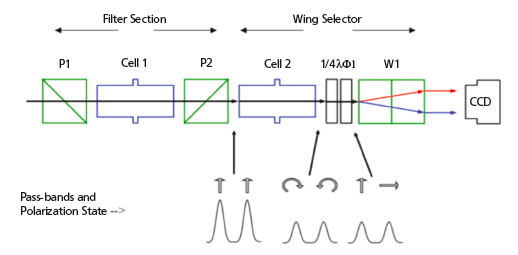
The proposed Sun sensor determines the orientation to the Sun similar to a conventional two-axis Sun sensor (imaging the Sun and calculating the centroid). However, it also measures the solar rotation axis, which provides the third axis of attitude information. Since the Sun is bright, the proposed Sun sensor has the ability to operate at large slew rates (short exposure times) compared to a conventional star scanner/tracker that images faint stars.
The Sun is rotating with a rotation period of approximately 25 days. This causes the solar photosphere close to the Sun’s equator to move at a speed of ≈2 km/second. At one limb it will move toward the observer, and at the other limb it will move away from the observer. This causes a Doppler shift of the solar spectrum and the absorption lines in the solar spectrum (of ≈5 pm at 770 nm). The proposed Sun sensor operates by imaging the Sun in a narrow band centered on a potassium absorption line at ≈770 nm (it is also possible to utilize other solar lines like the sodium absorption line at 589 nm). By utilizing the Zeeman effect, it is possible to measure very small shifts in the wavelength.

The magnetic field strength in the second cell is selected to produce Zeemansplit absorption lines that coincide with the transmission passbands from the filter section. Partial absorption via the inverse Zeeman effect causes the two transmission bands to become circularly polarized in opposing senses, as the longitudinal magnetic field orientation only allows circularly polarized light to be absorbed. The quarter wave plate switches the circularly polarized light back to linearly polarized light, with each passband now having orthogonal linear polarization. Finally, the Wollaston prism separates the two linearly polarized passbands into two separate beams, which are imaged on the CCD (charge coupled device).
This work was done by Carl Christian Liebe, Leonard Dorsky, and Neil Murphy of Caltech; and Nythi Udomkesmalee for NASA’s Jet Propulsion Laboratory. For more information, contact