

Inside this issue
Supplements
Overview
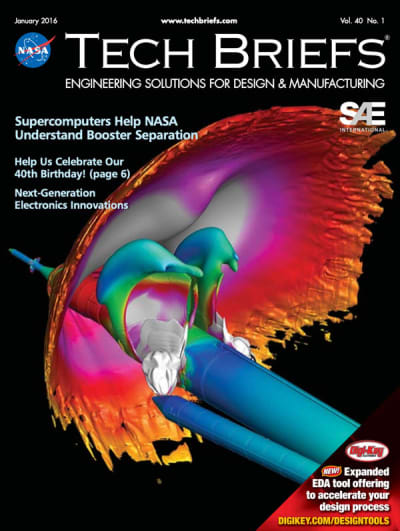
The January 2016 issue of NASA Tech Briefs marks a significant milestone, celebrating the magazine's 40th anniversary. This edition highlights the evolution of technology and innovation within NASA and the broader aerospace community over the past four decades.
The issue features a variety of articles that showcase cutting-edge advancements in aerospace technology, including the use of supercomputers to enhance understanding of complex phenomena such as booster separation during launches. This technology plays a crucial role in ensuring the safety and efficiency of space missions, allowing engineers to simulate and analyze various scenarios that occur during rocket launches.
In addition to the focus on supercomputing, the magazine includes insights into new materials and engineering techniques that are being developed to improve spacecraft design and performance. These innovations are essential for future missions, including those aimed at exploring Mars and beyond. The articles delve into the challenges faced by engineers and scientists in creating reliable and efficient systems that can withstand the harsh conditions of space.
The issue also emphasizes the importance of collaboration between NASA and private industry. As commercial spaceflight continues to grow, partnerships between government agencies and private companies are becoming increasingly vital. This collaboration not only accelerates technological advancements but also fosters a competitive environment that drives innovation.
Readers will find sections dedicated to various topics, including propulsion systems, robotics, and advanced manufacturing techniques. Each article is designed to provide a comprehensive overview of the current state of technology and its potential future applications. The magazine encourages readers to engage with the content through links to additional resources and information, making it a valuable tool for professionals and enthusiasts alike.
Moreover, the issue highlights the role of education and outreach in inspiring the next generation of engineers and scientists. NASA Tech Briefs aims to inform and engage a diverse audience, from students to seasoned professionals, about the exciting developments in aerospace technology.
Overall, the January 2016 issue of NASA Tech Briefs serves as a celebration of the past 40 years of innovation while looking forward to the future of space exploration and technology. It encapsulates the spirit of discovery and the relentless pursuit of knowledge that has defined NASA's mission and its impact on the world.
Features
-
Application Briefs
Robot Simulation Software Lets NASA Study Conditions on Planetary Surfaces
Radiation Detectors Help NASA Understand Planets from Orbiters and Landers
Tech Briefs
-
Machinery & Automation
Contact State Estimation for Multi-Finger Robot Hands Using Particle Filters
Tendon-Driven Finger, Wrist, and Thumb Actuation System
Visual-Aided Inertial Navigation for Computationally Constrained Aerial Vehicles
Robotic Surgical Devices, Systems, and Related Methods
Ship Classification Using Gnostic Fields
Tension-Stiffened and Tendon-Actuated Space Manipulators
NASA Tensegrity Robotics Toolkit (NTRT) v1
RoboSimian Software System from the DARPA Robotics Challenge Finals
-
Manufacturing & Prototyping
Thermal Spraying of Coatings Using Resonant Pulsed Combustion
Plasma Treatments to Assist Fluid Manipulation in Microgravity
-
Information Sciences
DRAT: A Distributed Release Audit Tool
Graphical Input-Output Visualization Tool for DAVE-ML Models
Synchronization and Visualization of Arbitrary Streams (SAVORS)
Using a Moderate Ionospheric Storm Detector to Improve WAAS Availability
Orbital Mechanics Simulation Program for Educational Outreach
-
Mechanics & Machinery
Miniature, Multi-Functional, Self-Braking Vehicle
Pulse-Echo Probe Mounting Fixture for Blind Alignment on Pipes
Zero-Gravity Mobile Robot Using ON/OFF Adhesive Pads and Inchworm Mechanism
Passive Mechanism for Maintaining Tension at a Spool to Within a Given Window
-
Electronics & Computers
Ultra-High-Power W-Band/F-Band Schottky Diode-Based Frequency Multipliers
FPGA Reconfiguration with Accelerated Bitstream Relocation
-
Sensors/Data Acquisition
Improved Ground Collision Avoidance System for General Aviation Aircraft and UAVs
Programmable Linear Position Sensors Leverage Inductive Technology
Three-Axis Sun Sensor for Attitude Determination
RFID Waveguide, Antenna, and Cavity Sensors
Sensor Planning Service for Submitting Requests to Task the EO-1
Transparent and Ubiquitous Sensing Technology
-
Aerospace
Station/Orbiter Multibody Berthing/Docking Analysis Tool (SOMBAT)
Flight Deck Predicted Weather Display and Decision Support Interface
Method of Performing Computational Aeroelastic Analyses
Products
-
Briefs
Thermal Cycle Qualification of Radiated Solar Arrays for 50 to 133 K Temperatures in Vacuum
Downhole Regolith Interrogation with Helium-Assisted Drill and Laser Induced Breakdown Spectroscopy
Large, High-Speed, Precision Optic Indexing Wheel
Web-Based Search Service to Support Imaging Spectrometer Instrument Operations
Design, Fabrication, and Test of WFIRST/AFTA GRISM Assembly
Spinal Ultrasound Just-in-Time Training Tool
Wide-Spectrum Organic Mass Spectrometer Using Far-Ultraviolet Ionization
-
Applications
-
Articles
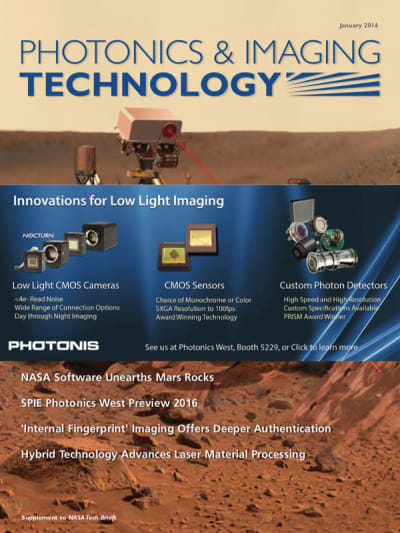
AEGIS Imaging Software Unearths Mars Rocks
-
Products
THz-TDS and THZ-FDS Imaging Systems
FPGA Support for GigE Vision IP Cores
Dual Wavelength Excitation Light Source











