

Inside this issue
Supplements
Overview
The May 2016 issue of NASA Tech Briefs presents a collection of innovative technologies and advancements across various fields, particularly focusing on photonics, imaging technology, and applications in space exploration and other industries. This edition highlights several key topics and breakthroughs that are shaping the future of technology.
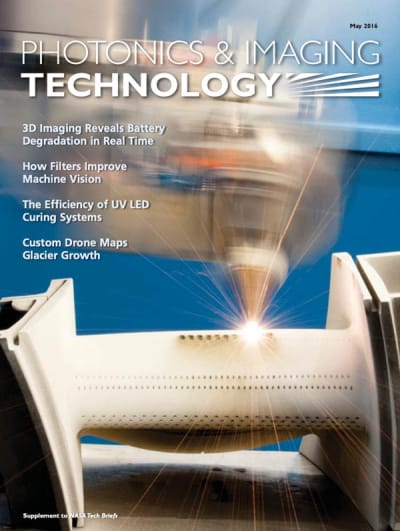
One of the standout features of this issue is the exploration of 3D imaging technologies that reveal battery degradation in real time. This advancement is crucial for industries relying on battery performance, such as electric vehicles and portable electronics. By utilizing sophisticated imaging techniques, engineers can monitor the health of batteries, allowing for timely maintenance and improved safety.
The magazine also delves into the efficiency of UV LED curing systems. These systems are becoming increasingly popular in manufacturing processes, particularly in the curing of inks, coatings, and adhesives. The issue discusses how UV LED technology offers advantages over traditional curing methods, including faster curing times, reduced energy consumption, and lower environmental impact.
Another significant topic covered is the use of custom drones for mapping glacier growth. This application of drone technology is vital for understanding climate change and its effects on polar regions. By providing detailed aerial imagery and data collection capabilities, these drones enable researchers to monitor glacier dynamics and contribute to more accurate climate models.
In addition to these technological advancements, the issue features insights into machine vision and how filters can enhance its efficiency. Machine vision systems are integral to automation and quality control in manufacturing, and the article discusses various filtering techniques that improve image processing and object recognition.
The magazine also includes a section on simulation applications that are transforming the transformer industry. These applications allow for better design and testing of electrical transformers, leading to improved performance and reliability in power distribution systems.
Throughout the issue, readers will find contributions from various experts in the field, including editorial insights and technical articles that provide a deeper understanding of the technologies discussed. The editorial team, led by Linda L. Bell, emphasizes the importance of innovation and collaboration in driving technological advancements.
The publication also features a comprehensive directory of contributors and editorial staff, showcasing the diverse expertise that supports the magazine's mission to disseminate cutting-edge research and developments in technology.
In summary, the May 2016 issue of NASA Tech Briefs serves as a valuable resource for professionals and enthusiasts interested in the latest technological innovations. From advancements in battery monitoring and UV LED curing systems to the application of drones in environmental research, this issue encapsulates the spirit of exploration and innovation that defines NASA's mission. Readers are encouraged to engage with the content and explore the potential applications of these technologies in their respective fields.
Features
-
Application Briefs
-
Who's Who
Mike Krainak, Laser and Electro-Optics Branch Head, Goddard Space Flight Center, Greenbelt, MD
-
Articles
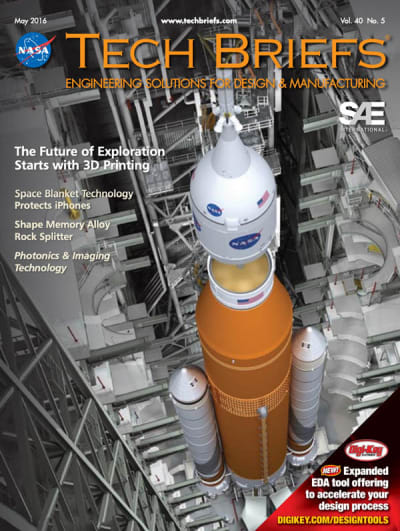
The Future of Exploration Starts With 3D Printing
Tech Briefs
-
Bio-Medical
Relativistic Ion Tracks (RITRACKS)
Medical Oxygen Concentrator for Microgravity Operation
Lateral Displacement Device for Blood Cell Separation
Using a Blood Clot in Microfluidic Valving Applications
Drug-Encapsulated Prosthetic Enhancement
Portable Resting State Detection System Using Functional Near-Infrared Spectroscopy
-
Information Sciences
BALFIT Version 3.1 Multivariate Regression Analysis and Regression Model Optimization Software
Mariana Text Classification System
Marshall MRMS Mosaic Python Toolkit (MMM-Py)
Framework Software Library Version 1.0
Crisis Mapping Toolkit (CMT) V1
Real-Bogus Machine Learning Systems at the Intermediate Palomar Transient Factory
Scalable Gaussian Process Regression
-
Mechanics & Machinery
Lightweight, Reusable Payload Launch and Transportation Latch
Structural Assembly Incorporating Integral Thermal Heat Spreader for Cold Plate Cooling
Advanced Magnetostrictive Regulator, Valve, and Force-to-Angle Sensor
Circular Cross-Section Blades for a Sampling Device
Shape Memory Alloy Rock Splitter
Passive, Low-Insertion-Force/High-Retention-Force Cam Plug Design for Sample Tube Sample Caging
Design Support and Analysis Tool for Pyrotechnically Actuated Valves
Deployable Extra-Vehicular Activity Platform (DEVAP) for Planetary Surfaces
-
Electronics & Computers
Ethernet-to-HRDL Conversion Design
Nanotube-Based Device Cooling System
Architecture for an Intermediate-Frequency Digital Downconversion and Data Distribution Network
-
Sensors/Data Acquisition
Pressure Sensor Using Piezoelectric Bending Resonators
Pressure-Optimized Optical Breath Gas Analyzer for Portable Life Support Systems
Lightweight Metal Rubber Textile Sensor for In-Situ Lunar Health Monitoring
-
Aerospace
Pair-wise Trajectory Management (PTM) Airborne Human Machine Interface (HMI) Display Design
Elastomeric Structural Attachment Concepts for Aircraft Flap Noise Reduction
Aircraft Engine Exhaust Nozzle System for Jet Noise Reduction
-
RF & Microwave Electronics
High-Data-Rate Platform to Capture and Analyze Raw Baseband Clock/Data
V-FASTR Radio Transient Classifier
RF Source Modifications to Improve Performance of an Electronegative Plasma Thruster
Simple Impedance Matched Planar Microwave Blocking Filter
Microwave Regenerative Sorbent-based Hydrogen Purifier (MRSHP)
Low-Power Wireless Body Area Network (WBAN) Communication System
RF System MATLAB Model Simulation Using a Variety of Data Sources
-
Briefs
One-Micron (1064-nm) Planar External Cavity Laser (PLANEX)
Micro Cylindrical Ion Trap Micro Mass Spectrometer Instrument System
Spatially Aberrated Spectral Filtering for High-Performance Spectral Imaging











