Researchers from the University of Antwerp and KU Leuven have built a proof-of-concept device that performs two noble functions simultaneously: purifying polluted air and generating power. Read the Tech Briefs Q&A with Professor Sammy Verbruggen.
Requiring only light exposure to function, the two-part system, separated by a membrane, filters the air on one side and produces hydrogen gas on the other. The hydrogen gas can be stored and used later as fuel.
Tech Briefs: What does the device look like?
Professor Sammy Verbruggen: The device, in essence, is a photoelectrochemical cell , which is a very large name for a device that generates electricity by using light. These types of devices have been used in the past to generate hydrogen gas out of liquid water.
The devices send liquid water through one side of the device where a photocatalyst is applied. The material, activated by light energy, splits water into hydrogen and oxygen. These hydrogen atoms are protons; they fuse through a membrane to the other side of the device. A platinum catalyst reduces these protons to hydrogen gas. That way you actually generate hydrogen gas, as an energy carrier, out of liquid water.
What we do now in this research is use polluted air, not clean water. We switch from a liquid environment to a gas environment. You purify the gases to some extent, but you also recover some of the energy that was stored in these organic pollutants at the same time.
Tech Briefs: How large is the device currently?
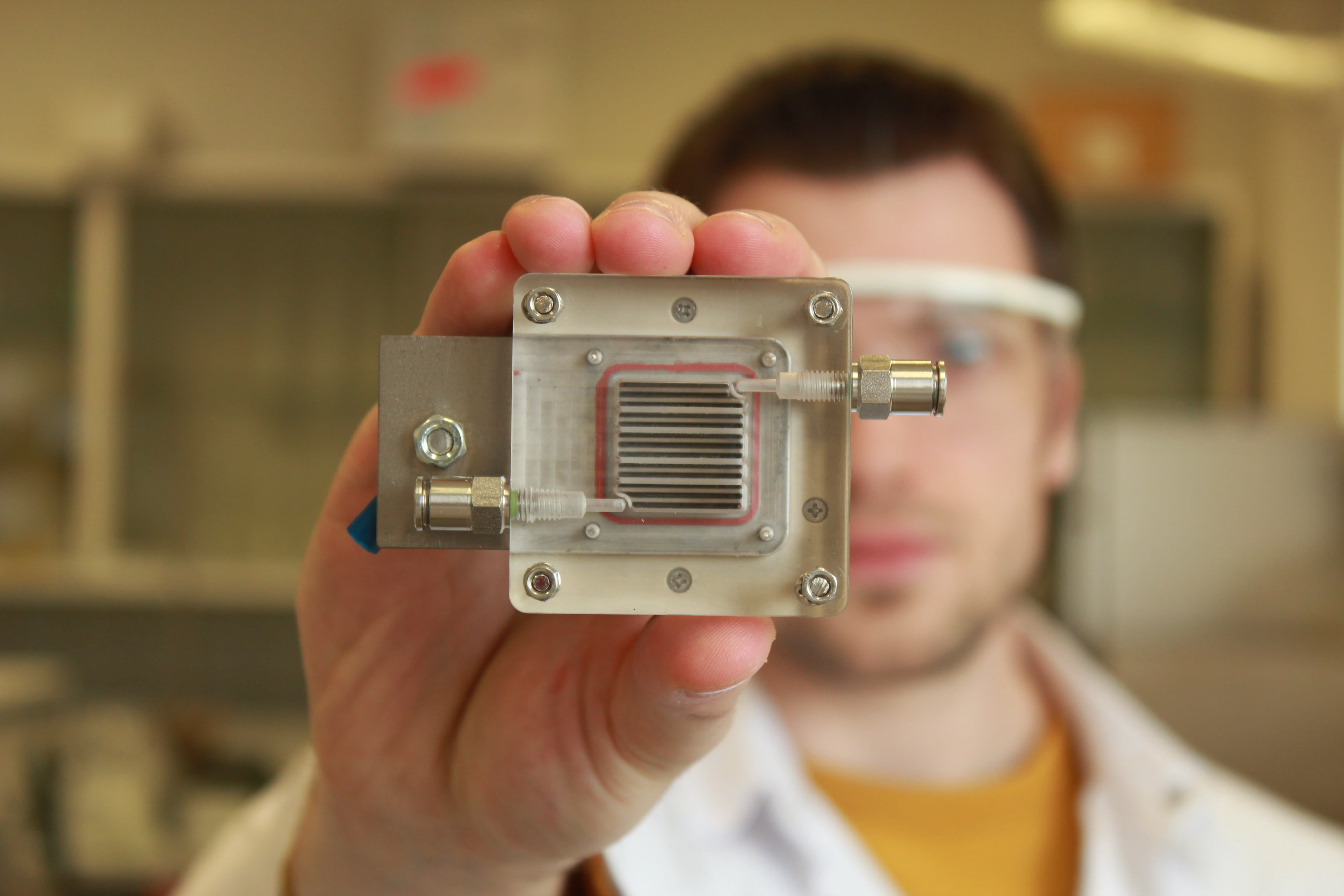
Verbruggen: The device that we are working with is only lab-scale. The active area is about one square centimeter, which is obviously not a lot compared to other devices that generate power out of light, like the solar panels that you could put on domestic houses, which have square meters of active area. We have to look for a technology solution to scale these up.
Tech Briefs: What is needed, from a technology perspective, to scale this to larger, industrial-scale applications?
Verbruggen: First, there is the challenge of light efficiency. That’s something that we’re already working on quite heavily right now: the photocatalyst that is applied at the anode part of the device, where you do the purification reactions of polluted gases. This catalyst is mainly activated by UV light, which counts for only 4 or 5 percent of the entire solar spectrum. What we’re trying to do right now is to modify these materials so that the entire UV-visible light range can be analyzed, which would mean that we could use up to 45-50 percent of the solar spectrum.
Tech Briefs: What’s most exciting to you about your research?
Verbruggen: We’ve now been able to combine two purposes in one device — to do two noble things simultaneously. On the one hand, you can purify gas and make a better living environment. On the other hand, you also have an alternative way to produce an energy carrier. We don’t apply any additional electricity. There’s no heat and no electrical power that you need to apply. In our device, we only use polluted air and light; that’s all.
Tech Briefs: If you can scale this, what kinds of exciting examples do you envision?
Verbruggen: It’s very difficult to answer, because it’s really in the very first phase of research now. I can imagine it mainly in chemical industries, for paints or textiles. I can assume that those industries have a lot of gas streams that are seriously loaded with organic contaminants, volatile compounds that can be quite hazardous.
Imagine if you could apply this technology to those heavily polluted waste streams so you could purify these streams to meet environmental regulations. At the same time, you could also recover part of the energy that was stored in the molecules just by irradiating the entire device with sunlight. That would be an additional extreme bonus. You could generate an energy carrier that could be used for local energy demands.
RELATED CONTENT:
- NASA’s High-Performance Photocatalytic Oxidation Reactor System supports future Mars missions.
- Read about Ames Research Center’s Solar-Powered Carbon Dioxide Conversions with Thin-Film Devices.
- Visit KU Leuven to learn more about the Power-Generating Air Purifier.
- Watch more videos on Tech Briefs TV.
Transcript
00:00:04 in The Joint Center for artificial photosynthesis at Caltech we investigate millions of materials for converting sunlight into fuel this solar fuels prototype is splitting water to generate hydrogen fuel and jcap is building Technologies to create a broad range of renewable fuels for powering our society our Theory colleagues at the Lawrence
00:00:27 Berkeley lab can predict new materials faster than ever before and we test those predictions with high throughput material synthesis in this combinatorial sputter deposition system we combine multiple elements from the periodic table using a technique that's like Atomic spray painting this creates new materials in a thin film format that can be further optimized using thermal
00:00:50 processing which produces these colorful Library plates where each material looks different because it interacts with sunlight in a unique way to fully characterize the solar absorption properties we perform High throughput Optical spectroscopy which in addition to identifying promising light absorber materials provides critical data for combining with Theory to understand
00:01:12 these materials and design new ones after determining which materials can efficiently absorb sunlight we investigate their ability to convert that solar energy into chemical reactions that generate fuel this is photo electrochemistry and we invented an instrument that performs these experiments 100 to a thousand times faster than traditional methods the
00:01:36 photoelectrochemical reaction being measured here is water oxidation where the hydrogen atoms are extracted from water a crucial part of fuel generation the combination of our high thrit experiments and state-of-the-art computational methods is producing a vast materials database that enables us to generate scientific knowledge for a sustainable
00:01:59 future