

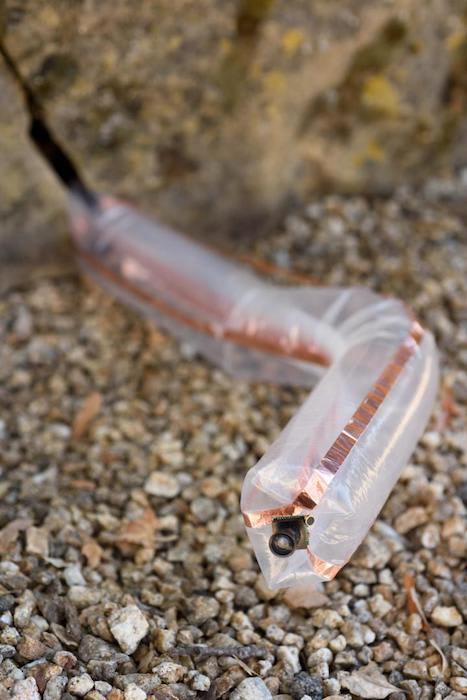
Inspired by natural organisms like vines that cover distance by growing, researchers at Stanford University have created a soft, tubular robot that lengthens to explore hard-to-reach areas. The vine-like robot can grow across long distances without moving its whole body, which could prove useful in search-and-rescue operations and medical applications.
For example, the small air-tight cylinder can be placed at the entrance of disaster site debris, and with the flip of a switch a tendril extends from one end of the cylinder into the mass of stones and dirt like a fast-climbing vine. A camera at the tip of the tendril gives rescuers a view of the otherwise unreachable places beneath the rubble. The Stanford researchers have made a proof of concept of their soft, growing robot and have run it through some challenging tests.
“Essentially, we’re trying to understand the fundamentals of this new approach to getting mobility or movement out of a mechanism,” explained researcher Allison Okamura, a Stanford professor of mechanical engineering. “It’s very, very different from the way that animals or people get around the world.”
To investigate what their robot can do, the group created prototypes that move through various obstacles, travel toward a designated goal, and grow into a free-standing structure. This robot could serve a wide range of purposes, particularly in the realms of search-and-rescue and medical devices, the researchers said.
The basic idea behind this robot is straightforward: it’s a tube of soft material folded inside itself, like an inside-out sock, that grows in one direction when the material at the front of the tube everts and the tube becomes right-side-out. In the prototypes, the material was a thin, cheap plastic and the robot body everted when the scientists pumped pressurized air into the stationary end. In other versions, fluid could replace the pressurized air.
What makes this robot design useful is that the design results in movement of the tip without movement of the body. “The body lengthens as the material extends from the end, but the rest of the body doesn’t move,” explained researcher Elliot Hawkes who is a visiting assistant professor from the University of California, Santa Barbara. “The body can be stuck to the environment or jammed between rocks, but that doesn’t stop the robot because the tip can continue to progress as new material is added to the end.”
The group tested the benefits of this method for getting the robot from one place to another in several ways. It grew through an obstacle course, where it traveled over flypaper, sticky glue, and nails and up an ice wall to deliver a sensor, which could potentially sense carbon dioxide produced by trapped survivors. It successfully completed this course even though it was punctured by the nails because the area that was punctured didn’t continue to move and, as a result, self-sealed by staying on top of the nail.
In other demonstrations, the robot lifted a 100-kilogram crate, grew under a door gap that was 10 percent of its diameter, and spiraled on itself to form a free-standing structure that then sent out a radio signal. The robot also maneuvered through the space above a dropped ceiling, which showed how it was able to navigate unknown obstacles as a robot like this might have to do in walls, under roads, or inside pipes. Further, it pulled a cable through its body while growing above the dropped ceiling, offering a new method for routing wires in tight spaces.
Some iterations of these robots included a control system that differentially inflated the body, which made the robot turn right or left. The researchers developed a software system that based direction decisions on images coming in from a camera at the tip of the robot.
The prototype was built by hand and it is powered through pneumatic air pressure. In the future, the researchers would like to create a version that would be manufactured automatically. Future versions may also grow using liquid, which could help deliver water to people trapped in tight spaces or to put out fires in closed rooms. They are also exploring new, tougher materials, like rip-stop nylon and Kevlar.
The researchers also hope to scale the robot much larger and much smaller to see how it performs. They’ve already created a 1.8-mm version and believe small growing robots could advance medical procedures. In place of a tube that is pushed through the body, this type of soft robot would grow without dragging along delicate structures.
Transcript
00:00:01 [MUSIC PLAYING] Stanford University. We were trying to come up with a new way for robots to explore their environment, moving away from robots that walk or locomote to robots that can grow like plants or cells. The basic mechanism of the device is called eversion. So it basically turns inside out as the material emits from the tip. By doing so, we allow more material to be
00:00:34 fed through the center. And that allows us to grow to very long lengths and can follow very convoluted paths through very difficult-to-reach places. We implement it here with pneumatic pressure-- so just air pressure to make it extend. And you could also do it with hydraulics, so using a pressurized fluid. It can have a power supply that doesn't need to move. It can just stay stationary, unlike a locomoting robot.
00:01:00 That gives us a lot more flexibility in terms of weight as we move through our environments. This version of the robot had a turning mechanism that worked by [? maintaining ?] a particular side. We have a camera that's kept up the tip, and it's used to sense the environment just like the human eye does. And based on that, a goal destination can be designated by a user to grow the robot to. The body can be stuck to the environment
00:01:26 or jammed between rocks, and then the new material just comes out the end. One instance, we made a little obstacle course. We also had a demonstration of lifting a large crate. We could grow under it and use the air pressure to lift the crate off the ground. As you're growing the device, you can pull cables along. So this is an application for wiring ceilings or the walls or floors of a house. You can think about scaling it up for, say,
00:01:49 search and rescue applications. We can make it take the shape of an antenna so you can enable communications. We can make it sneak through very small crevices in order to get access to places where people can't go. And also, we can deliver material through the center of it-- whether it be a sensor or water, for example-- to reach a disaster victim. Our device is currently made out of cheap plastic.
00:02:14 It was available and easy to prototype with. We're looking now at making it out of more robust, airtight waterproof fabrics. The main point of this first paper on the idea is just showing proof of concept. It's a whole new form of mobility. I think the biggest challenge is so much the scope of what it can be. For more, please visit us at stanford.edu.











