Biomimetic/optical sensors have been proposed as means of real-time detection of bacteria in liquid samples through real-time detection of compounds secreted by the bacteria. Bacterial species of interest would be identified through detection of signaling compounds unique to those species. The best-characterized examples of quorum- signaling compounds are acylhomoserine lactones and peptides. Each compound, secreted by each bacterium of an affected species, serves as a signal to other bacteria of the same species to engage in a collective behavior when the population density of that species reaches a threshold level analogous to a quorum.
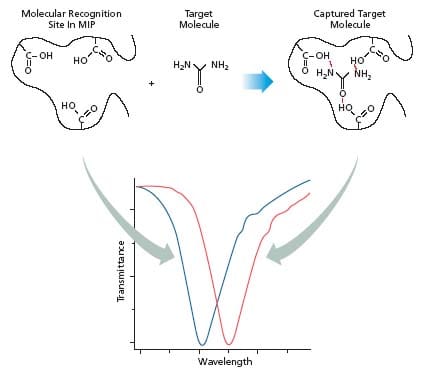
A sensor according to the proposal would include a specially formulated biomimetic film, made of a molecularly imprinted polymer (MIP), that would respond optically to the signaling compound of interest. The MIP film would be integrated directly onto an optical-waveguide-based ring resonator for optical readout. Optically, the sensor would resemble the one described in “Chemical Sensors Based on Optical Ring Resonators” (NPO-40601), NASA Tech Briefs, Vol. 29, No. 10 (October 2005), page 32.
MIPs have been used before as molecular-recognition compounds, though not in the manner of the present proposal. Molecular imprinting is an approach to making molecularly selective cavities in a polymer matrix. These cavities function much as enzyme receptor sites: the chemical functionality and shape of a cavity in the polymer matrix cause the cavity to bind to specific molecules. An MIP matrix is made by polymerizing monomers in the presence of the compound of interest (template molecule). The polymer forms around the template. After the polymer solidifies, the template molecules are removed from the polymer matrix by decomplexing them from their binding sites and then dissolving them, leaving cavities that are matched to the template molecules in size, shape, and chemical functionality. The cavities thus become molecular- recognition sites that bind only to molecules matched to the sites; other molecules are excluded.
In a sensor according to the proposal, the MIP would feature molecular recognition sites that would bind the specific signaling molecules selectively according to their size, shape, and chemical functionality (see figure). As the film took up the signaling molecules in the molecular recognition sites, the index of refraction and thickness of the film would change, causing a wavelength shift of the peak of the resonance spectrum. It has been estimated that by measuring this wavelength shift, it should be possible to detect as little as 10 picomoles of a peptide signaling compound.
This work was done by Margie Homer, Alexander Ksendzov, Shiao-Pin Yen, and Margaret Ryan of Caltech and Beth Lazazzera of the University of California, Los Angeles, for NASA’s Jet Propulsion Laboratory. For further information, access the Technical Support Package (TSP) free on-line at www.techbriefs.com/tsp under the Bio-Medical category.
In accordance with Public Law 96-517, the contractor has elected to retain title to this invention. Inquiries concerning rights for its commercial use should be addressed to:
Innovative Technology Assets Management
JPL
Mail Stop 202-233
4800 Oak Grove Drive
Pasadena, CA 91109-8099
(818) 354-2240
E-mail: This email address is being protected from spambots. You need JavaScript enabled to view it.
Refer to NPO-40950, volume and number of this NASA Tech Briefs issue, and the page number.
This Brief includes a Technical Support Package (TSP).
Biomimetic/Optical Sensors for Detecting Bacterial Species
(reference NPO-40950) is currently available for download from the TSP library.
Don't have an account?
Overview
The document outlines a proposal for developing biomimetic and optical sensors aimed at the real-time detection of extracellular signaling molecules produced by bacteria. This initiative is part of NASA's efforts to leverage aerospace-related developments for broader technological and scientific applications.
The core of the research focuses on molecular imprinting, a technique that creates highly selective sensors by forming polymer cavities that match the size and shape of specific target molecules. An example provided in the document illustrates the process of molecular imprinting using theophyllin as a template. In this method, a copolymer containing acrylic acid is cross-linked in the presence of theophyllin, allowing the polymer to solidify around the template molecule. Once the template is removed, a cavity specific to theophyllin remains, enabling the sensor to selectively bind to this molecule while excluding similar compounds, such as caffeine.
The document references various studies and technical papers that support the feasibility and effectiveness of molecularly imprinted polymers in sensor technology. These references highlight the potential for these sensors to detect specific compounds in complex mixtures, which is crucial for applications in environmental monitoring, medical diagnostics, and food safety.
Additionally, the document emphasizes the importance of real-time detection capabilities, which can significantly enhance the understanding of bacterial behavior and communication through signaling molecules. This could lead to advancements in microbiology and biotechnology, providing insights into bacterial interactions and their implications for health and disease.
The proposal is positioned within the broader context of NASA's Commercial Technology Program, which aims to disseminate aerospace innovations for wider use. The document also includes contact information for the NASA Scientific and Technical Information Program Office, indicating a commitment to sharing knowledge and facilitating further research in this area.
In summary, the document presents a comprehensive overview of a research initiative focused on developing advanced sensors through molecular imprinting, with the potential to revolutionize the detection of bacterial signaling molecules and contribute to various scientific and commercial fields.