The James Webb Space Telescope will be the most powerful space telescope ever built. With a 21-foot diameter, the telescope’s primary mirror is six times larger than the one used by the Hubble Space Telescope. In order for such a large mirror to travel into space, it has to be broken up into multiple segments; in this case, 18 of them. But for the 18 to act as one primary mirror, they have to be adjusted while in orbit.
Part of the Webb telescope’s ongoing cryogenic testing at NASA’s Johnson Space Center in Houston includes aligning, or “phasing,” the telescope’s 18 hexagonally shaped primary mirror segments so they function as a single 6.5-meter mirror. All of these segments must have the correct position and correct curvature; otherwise, the telescope will not be able to accurately focus on its celestial targets.
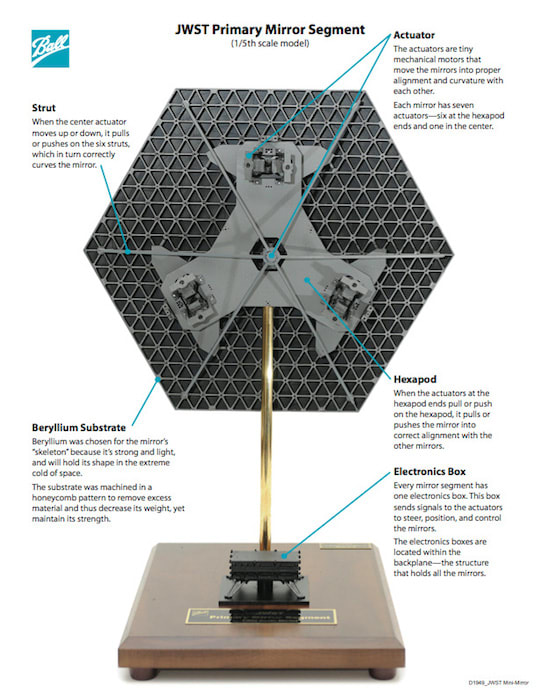
NASA engineers used light waves to align the mirror segments to each other. Seven actuators (tiny mechanical motors) attached to the back of each one of the mirror segments are used to adjust the positions and shapes of the mirror segments to achieve precise alignment. For each segment, six of these actuators are placed into groups of two, at three equally spaced points along the outside of the mirror (to adjust the segment’s position), and one is attached to six struts that are connected to each of the hexagonal mirror segment’s corners (to adjust the segment’s shape).
The actuators on each mirror segment are capable of extremely minute movements, which allow engineers to align the entire primary mirror by finely adjusting each mirror segment. “They can move in steps that are a fraction of a wavelength of light, or about 1/10,000th the diameter of a human hair,” explained Lee Feinberg, optical telescope element manager for the Webb telescope at NASA’s Goddard Space Flight Center in Greenbelt, Maryland.
These actuators can also be used to precisely reshape each mirror segment to ensure they all match up once aligned. The ability to change the mirror alignment and shape is critical because the mirror must be unfolded from its unaligned stowed position when the telescope deploys. This test verifies the actuators have enough range of movement once they are in space, at their operational temperature of about 40 K (or about -388 °F/-233 °C), to put the telescope’s primary mirror into its correct shape so it can accurately survey the universe.
Transcript
00:00:00 The James Webb Space Telescope is moved inside this massive cryogenic vacuum chamber at NASA’s Johnson Space Center called Chamber A. This chamber simulates the vacuum and super cold environment of space in which Webb will operate about 40 K or about minus 388 degrees Fahrenheit or minus 233 degrees Celsius The Webb telescope mission team uses Chamber A to further verify the entire telescope, including its optics and instruments, will work correctly in space. Part of this test includes aligning Webb’s 18 mirror segments into a perfect, monolithic mirror. The process is similar to the way the mirrors will be aligned in space. Actuators behind each mirror enable the aligning, or “phasing,” of the telescope’s 18 hexagonally shaped primary mirror segments to function as a single 6.5-meter mirror.
00:01:09 The mirror’s actuators can move in steps that are a fraction of a wavelength of light, or about 1/10,000th the diameter of a human hair. In space, a star will be used to as the light source to align the mirrors. Engineers will move each mirror and determine which image is coming from which mirror. Then, through a process called Wave Front Sensing and Control, the mirrors will be aligned and very finely focused. For this test, the Webb team uses a special laser to act as the ‘star’ and a test device called a multi-wavelength interferometer. By analyzing the interference signal between these two light beams, engineers determine the mirror shape and the alignment of the mirrors to within one wavelength of light.
00:01:58 The James Webb Space Telescope is the scientific complement to NASA's Hubble Space Telescope. It will be the most powerful space telescope ever built. Webb is an international project led by NASA with its partners, ESA (European Space Agency) and the Canadian Space Agency. music. beep. beep.