During a routine spacewalk, astronauts can easily lose their sense of orientation and direction. Creators of a new kind of spacesuit aim to address the challenge — with the push of a button.
In collaboration with NASA, researchers from the Cambridge, MA-based nonprofit Draper are developing a backup capability — a “Return to Home” activator — that secures an automatic, efficient, and safe trip back to the space station.
A Spacewalk Gone Wrong
Zero-gravity conditions present disorienting, sometimes dangerous, challenges for astronauts conducting the “extravehicular activity” known as a spacewalk.
In 2013, a European Space Agency astronaut’s suit and helmet began to fill with water, requiring crewmates’ assistance to bring him back to the airlock.
Draper’s proposed technology supports a safe homecoming for space-station astronauts in the event of an emergency. The “extravehicular activity self-return” combines a sensor, navigation module, guidance algorithms, and controls.
Kevin Duda, a space systems principal engineer at Draper, recently filed the patent for the self-return system. The lead inventor heads the Human Systems Integration Group, a team responsible for architecting technologies where the human — a soldier, a pilot, an astronaut — is the central element of a complex technology.
“The ‘Take Me Home’ system computes a trajectory that will automatically fly you safely and efficiently back to the airlock so that your crewmembers can assist you,” Duda told Tech Briefs.
The Need for a New Suit
In addition to today’s spacesuit, also known as the Extravehicular Mobility Unit (EMU), a spacewalking astronaut currently wears the SAFER (Simplified Aid for EVA Rescue) system.
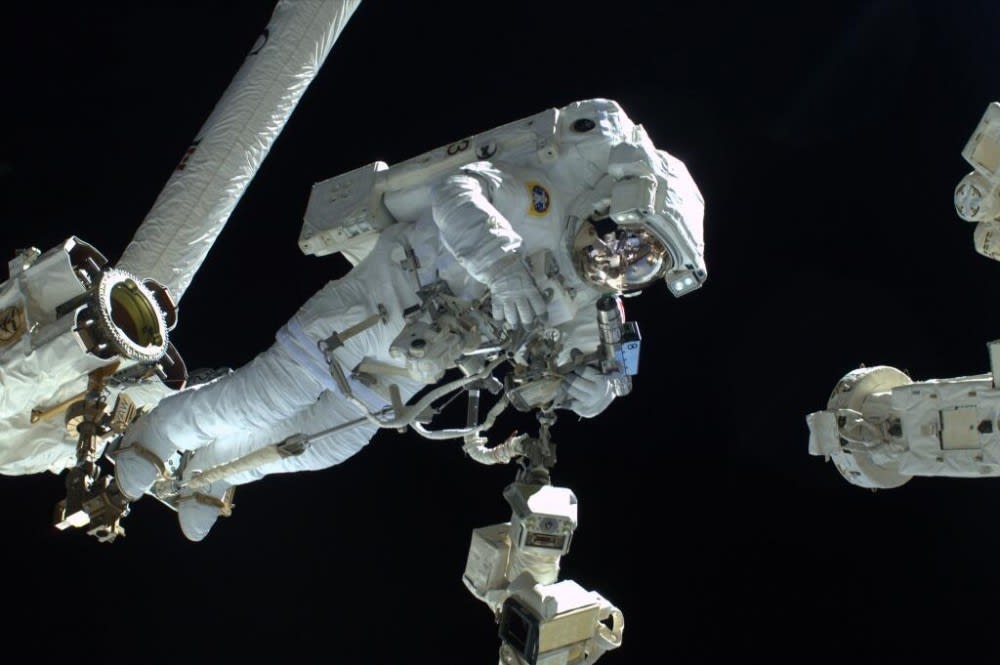
Strapped on like a backpack, the self-contained SAFER unit’s nitrogen jet thrusters allow astronauts to maneuver in space. Through hand controllers, an astronaut controls orientation and translation around the International Space Station (ISS).
In terms of its jet pack operation, however, Draper’s team lead considers the current spacesuit to be somewhat manual.
“There’s no navigation system on the spacesuit, so it doesn’t know where it is in relation to any of its surroundings,” said Duda.
The lone sensor on the EMU and jet pack: a rate gyroscope, which detects direction to prevent an astronaut from tumbling.
Draper’s self-return system design keeps the thrusters but adds a navigation capability — one that uses GPS, vision-aided navigation, or a star-tracker system to determine a precise location in space.
Seeking Guidance
Knowing where you are is only part of the answer, of course. You also need to know where you’re going.
Draper’s guidance algorithms compute several optimal trajectories, much like a GPS system, to find the most efficient route, accounting for parameters like orbital mechanics, safety requirements, oxygen consumption, and proximity to sensitive space-station structures such as solar arrays.
In addition to the guidance software that provides a path for the wayward astronaut, other algorithms determine how to fire the thrusters in order to stay on the particular route.
Control Moment Gyroscopes (CMGs) offer attitude or orientation control, and thrusters provide translation or linear movements.
The system’s sensors and helmet visor display also send the astronaut directions through a combination of visual, auditory and sensory cues.
The “Take Me Home” button could be physically located on suit itself, said Duda, or could be actuated by someone remotely inside the space station or on the ground. Biosensors in the suit could theoretically determine when an astronaut is unresponsive and activate a return automatically.
From Space to Earth
Knowing where you are and where you need to go is not fundamentally just a space challenge.
Duda says the technology could be also used on Earth: to guide scuba divers through dark environments or send firefighters through burning buildings, for example.
“The most exciting thing is the ability to integrate all of these complicated systems into one working device that has a broad applicability to both astronauts and those on Earth,” said Duda.
Although no timeline exists currently for adoption of the new spacesuit idea, Draper has done some early prototyping with NASA to refine the design and test the automatic return capabilities.
What do you think? Share your comments below.
Related Content:
- NASA is evaluating pressurizable spacesuits for missions to a variety of exploration destinations.
- 3D imaging reveals real-time battery degradation in spacesuit batteries.
Transcript
00:00:01 [Applause] [Applause] it's hard to tell but it feels like a lot of water I feel a lot of water on the back of my head but I don't think it SED from my back are you sweating are you working
00:00:28 hard um I am sweating but feels like a lot of water I see it now weing all right Chris and Luca just for you guys u based on what we heard with Lucas saying that uh water is in his eyes now and it seems to be increasing uh we think we're going to terminate Eva case for ev2 so Luca we'll have you head back to the airlock Chris we'll get a
00:00:52 plan for you to uh clean things up here and then join him here in a minute hatch is open Shane for I think that for a couple of minutes there maybe more than a couple of minutes I experienced what it's like to be a goldfish in the Fishbowl from the point of view of the of the Goldfish uh
00:01:18 so about half an hour into the Eva 45 minutes maybe uh Chris and I were were ahead on our task so uh we were starting our our third task and I felt some water on the back of my head and I realized that it was cold water it it it it was a it was not a normal feeling so I I I told ground Chris came came by to to give to give it a look he couldn't see anything he took some pictures of it but
00:01:43 it wasn't until a couple of minutes later that we actually saw the water trickling in the front of the helmet and then I felt it covering my ears and uh at that point we called the terminate for the Eva I started going back to the airlock and uh um the water kept trickling until it completely covered my eyes and my nose um it was really hard to see I I couldn't hear anything it was
00:02:07 really hard to communicate uh I just I went back using just uh um just memory basically going back to the airlock until until I found it and then went inside and uh Chris was there in in in Split seconds to come inside close the close the airlock and repressurize Karen was already there ready to repressurize our Russian colleagues uh were all there to help and they as soon as the as the
00:02:33 two compartments were equalized uh they duffed uh meaning they took off my helmet wiped my face from all the water about uh three p three lounds of water I would say and uh and that was the end of it this is Lucas helmet and the uh the ventilation air comes into the helmet through this port right here and then goes behind the uh crew member's head
00:03:01 and then blows the air across the front of your face well with water a mixture of water and air getting into this vent Port the water bubble started to build up behind his behind this white plastic um piece once the water got big enough that it went all the way around and started coming outside the edge of the white plastic then it it saturated his communication cap and
00:03:30 sort of capillary flow just brought the water all to the all around his head and he had uh water on his and filled up in his ear cups and it started to creep into his eyes and covered covered his nose scary situation um the ground teams worked really well to give us some direction and as a team we got everybody back and everything was fine um for me the worst part uh as as um Chris
00:03:59 mentioned I was I was was miserable but okay uh it's just imagine walking around with your eyes closed in a fishball really that that that what was going on at the at the p and the M moment it's just a very uncomfortable feeling to to be with your with your face underwater for all for all that time uh but the reaction of the crew was outstanding I think the crew on the ground and the
00:04:20 crew on board uh Chris really supported me and I was just uh lucky to uh to be back inside in no time work is complete and we'll continue on with the rest