Inside this issue
Supplements
Overview
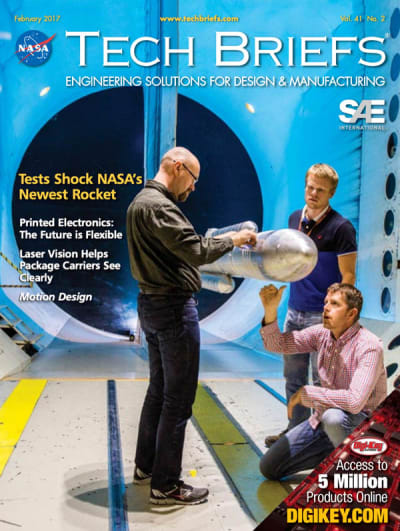
The February 2017 edition of NASA Tech Briefs and Motion Design presents a comprehensive overview of innovative technologies and advancements in various fields, particularly focusing on aerospace and engineering applications. This issue highlights several key topics, showcasing the intersection of technology and design, and how they contribute to modern engineering solutions.
Key Features and Innovations
-
Printed Electronics: The Future is Flexible This article discusses the emerging field of printed electronics, which allows for the creation of flexible, lightweight electronic devices. The technology utilizes printing techniques to produce electronic circuits on various substrates, enabling the development of innovative products such as flexible displays, sensors, and wearable technology. The potential applications in aerospace, automotive, and consumer electronics are vast, promising to revolutionize how devices are designed and manufactured.
-
Laser Vision Helps Package Carriers See Clearly The issue also explores advancements in laser vision technology, which enhances the capabilities of package carriers. This technology improves the accuracy and efficiency of package handling and sorting processes. By utilizing laser-based systems, companies can achieve better visibility and tracking of packages, reducing errors and improving overall logistics operations. The integration of such technologies is crucial for meeting the demands of fast-paced delivery services.
-
Motion Design: Tests Shock NASA’s Newest Rocket Another highlight of this edition is the focus on motion design and its application in testing NASA's latest rocket systems. The article details how motion design principles are applied to simulate and analyze the performance of rockets under various conditions. This testing is essential for ensuring the safety and reliability of space missions, as it allows engineers to predict how rockets will behave during launch and flight.
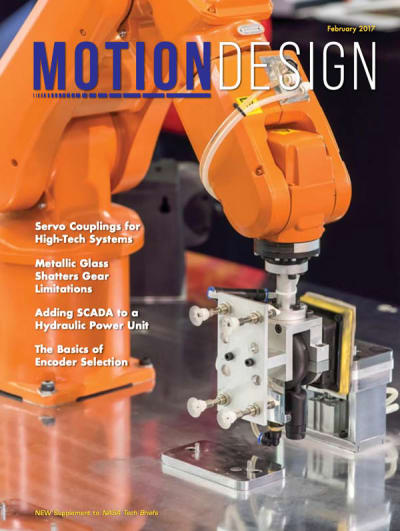
Servo Couplings for High-Tech Systems The magazine introduces a new supplement discussing servo couplings, which are critical components in high-tech systems. These couplings are designed to connect two shafts while allowing for misalignment and absorbing shock loads. The article emphasizes the importance of selecting the right servo coupling for specific applications, as it can significantly impact the performance and longevity of machinery in various industries, including aerospace and robotics.
-
Metallic Glass Shatters Gear Limitations The issue also features an article on metallic glass, a material that offers unique properties such as high strength and resistance to wear. This material is being explored as a solution to overcome limitations in traditional gear designs. By utilizing metallic glass, engineers can create gears that are lighter, stronger, and more durable, which is particularly beneficial in high-performance applications like aerospace and automotive engineering.
-
Adding SCADA to a Hydraulic Power Unit The integration of Supervisory Control and Data Acquisition (SCADA) systems into hydraulic power units is another significant topic covered in this edition. SCADA systems enhance the monitoring and control of hydraulic systems, providing real-time data and analytics. This integration allows for improved efficiency, reliability, and safety in operations, making it a valuable advancement for industries that rely on hydraulic power.
Editorial Insights
The editorial team, led by Joseph T. Pramberger and Linda L. Bell, emphasizes the importance of innovation in engineering and technology. The articles in this issue reflect a commitment to exploring new ideas and solutions that can drive progress in various fields. The contributions from experts in photonics, imaging technology, and motion design further enrich the content, providing readers with a well-rounded perspective on current trends and future directions.
Conclusion
The February 2017 edition of NASA Tech Briefs and Motion Design serves as a valuable resource for engineers, designers, and technology enthusiasts. It highlights the latest advancements in printed electronics, laser vision systems, motion design, and materials science, showcasing how these innovations are shaping the future of engineering. With a focus on practical applications and real-world solutions, this issue inspires readers to explore new possibilities and embrace the technological advancements that are transforming industries.
Overall, this edition not only informs but also encourages collaboration and innovation among professionals in the field, paving the way for future breakthroughs in technology and design.
Features
-
Who's Who
Branimir Blagojevic, Technologist, Goddard Space Flight Center, Greenbelt, MD
Farzin Amzajerdian, Principal Investigator, Langley Research Center, Hampton, VA
-
NASA Spinoff
Tech Briefs
-
Test & Measurement
Reliability Testing of High-Power Devices
Electronic Device Monitors the Heart and Recognizes Speech
Split Laser System for Environmental Monitoring
Measuring Tiny Forces with Light
Laser Scanning Technique for Testing Fire-Damaged Concrete
3D Measurement and Visualization of Displacement and Strain Fields
-
Bio-Medical
High-Quality Tissue Formation Method
Filtering Molecules with Nanotube Technology
Automated Behavior and Cohesion Assessment Tools (ABCAT)
Algorithm Measures Range of Motion and Applies Eccentric and Concentric Loads DuringExercise
-
Manufacturing & Prototyping
Use of Beam Deflection to Control an Electron Beam Wire Deposition Process
Systems, Apparatuses, and Methods for Using Durable Adhesively Bonded Joints forSandwich Structures
Preliminary Design of a Cryogenic Hydrogen Radiation Shield for Human Spaceflight
Methods of Making and Using Tubular Solid Oxide Fuel Cells (SOFCs)
-
Materials
Methods for Intercalating and Exfoliating Hexagonal Boron Nitride
Enhanced Composite Damping Through Engineered Interfaces
Mechanoresponsive Healing Polymers
Methodology for the Effective Stabilization of Tin-Oxide-Based Oxidation/ReductionCatalysts
Polymer-Reinforced, Non-Brittle, Lightweight Cryogenic Insulation for Reduced Lifecycle Costs
-
Information Sciences
Generalized Query Tool for Accessing the Database of the Mars Relay OperationsService (MaROS)
High-Performance Fault-Tolerant xEmbedded Computing (HPFEC) Benchmark Suite
JPF-NAS Extension of Java Pathfinder
Institutional Budgeting Tool (IBT)
Tubes Standards-Compliant C Header Library
Techniques for Conducting Effective Concept Design and Design-to-Cost Trade Studies
HyDE Model-Based Diagnosis Engine for Stochastic Hybrid Systems
-
Sensors/Data Acquisition
Eddy Current System and Method for Crack Detection
Eddy Current Probe for Surface and Sub-Surface Inspection
Damage Detection System for Flat Surfaces
Wireless Sensing System Using Open-Circuit, Electrically Conductive Spiral-TraceSensor
Variable Permeability Magnetometer Systems and Methods for Aerospace Applications
-
Photonics/Optics
Photonic Choke-Joints for Dual-Polarization Waveguides
Smart Optical Material Characterization System and Method
Compact Planar Microwave Blocking Filters
System and Method for Generating a Frequency-Modulated Linear Laser Waveform
Systems and Methods for Mirror Mounting with Minimized Distortion
Improved Approach to Exoplanet Coronagraphy
Apparatus and Method for a Light Direction Sensor
Apparatus and Method for Creating a Photonic Densely Accumulated Ray-Point
-
Briefs
Rescue Robot Has Remote Control Function
Small Robot Has Outstanding Vertical Agility
Interactive Robot Control System and Method of Use
-
Articles
The Basics of Encoder Selection
Servo Couplings for High-Tech Systems
-
Applications