

The SEASCRAPE computer program estimates the composition, temperature, and pressure of the atmosphere as a function of position by fitting remote-sounding spectroscopic data to a mathematical model of the transfer of radiation through the atmosphere. SEASCRAPE consists of two integrated parts: (1) A forward mathematical model that is used to generate synthetic spectra and (2) an inversion algorithm that is used to estimate parameters. The forward model evaluates the emission and absorption of radiation on a line-by-line basis; in itscurrent form, it includes a one-dimensional (spherically symmetrical) atmospheric submodel with homogeneous layers of arbitrary thickness. A future version of the code will include a multidimensional submodel with inhomogeneous cells. The inversion algorithm uses a sequential parameter-estimation method known as the square-root information filter. The program incorporates some flexibility for handling large sets of data; the user can control the level of accuracy in the model equations for spectral lines to trade accuracy against speed. The program can run on a single processor but is written for a parallel-processing environment; if a parallel processor is available, it can simultaneously retrieve multiple distributions and/or estimate a single set of parameters from multiple spectra.
This program was written by Lawrence Sparks, James McComb, and John L. Fanselow of Caltech for NASA's Jet Propulsion Laboratory.
This software is available for commercial licensing. Please contact Don Hart of the California Institute of Technology at (818) 393-3425. Refer to NPO-19694.
This Brief includes a Technical Support Package (TSP).
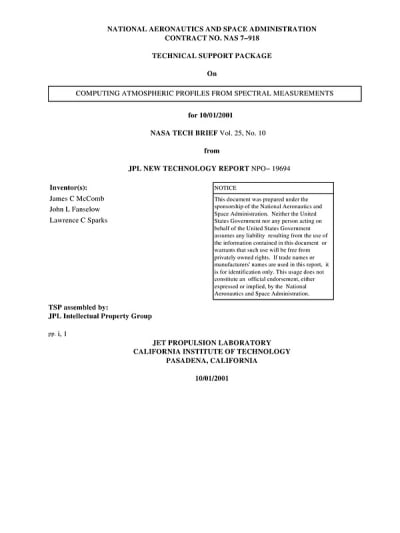
Computing Atmospheric Profiles From Spectral Measurements
(reference NPO19694) is currently available for download from the TSP library.
Don't have an account?
Overview
The document presents a technical support package from NASA detailing the SEASCRAPE computer program, developed by Lawrence Sparks, James McComb, and John L. Fanselow at the Jet Propulsion Laboratory (JPL) for NASA. SEASCRAPE is designed to estimate atmospheric profiles, including composition, temperature, and pressure, by fitting remote-sensing spectroscopic data to a mathematical model that simulates the transfer of radiation through the atmosphere.
The program consists of two main components: a forward mathematical model and an inversion algorithm. The forward model generates synthetic spectra by evaluating the emission and absorption of radiation on a line-by-line basis. Currently, it employs a one-dimensional atmospheric submodel with homogeneous layers of arbitrary thickness. Future versions of SEASCRAPE are expected to incorporate a multidimensional submodel with inhomogeneous cells, enhancing its capability to analyze more complex atmospheric conditions.
The inversion algorithm utilizes a sequential parameter-estimation method known as the square-root information filter, which allows for efficient estimation of atmospheric parameters from the spectral data. SEASCRAPE is designed with flexibility in mind, enabling users to manage large datasets and control the accuracy of model equations for spectral lines, allowing a trade-off between accuracy and computational speed.
The program can operate on a single processor but is optimized for parallel processing environments. This capability allows it to simultaneously retrieve multiple distributions or estimate a single set of parameters from various spectra, significantly improving processing efficiency.
The document also includes a notice regarding the liability and endorsement of the information contained within, emphasizing that the U.S. Government does not assume liability for its use. It is noted that the work was conducted under contract with NASA, and the software is available for commercial licensing through the California Institute of Technology.
Overall, the SEASCRAPE program represents a significant advancement in atmospheric profiling technology, providing researchers with a powerful tool for analyzing atmospheric conditions through sophisticated spectral measurements. The document serves as a technical overview of the program's capabilities, development, and potential applications in atmospheric science.









