

A concept for obtaining high energy-conversion efficiency in a solar photovoltaic system involves (1) concentration and spectral dispersion of sunlight and (2) use of several types of solar photovoltaic cells, each placed at its optimum location in the spectrum. The spectral dispersion and concentration of sunlight can be effected by use of mirrors or lenses combined with prisms. The photovoltaic cells can be of the conventional single-junction type, which cost less than do the more advanced multijunction cells.
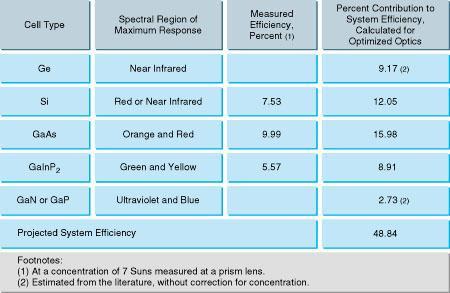
Preliminary experiments to demonstrate the feasibility of this concept were performed on several types of cells, using artificial sunlight and prisms that had not been optimized. On the basis of these experiments plus references to the literature, it has been estimated that an optimized system of this type could perform with an energy-conversion efficiency approaching 50 percent (see table). In contrast, the more-expensive multijunction solar cells yield efficiencies between 20 and 30 percent, while the efficiencies of conventional solar cells range from 11 to 19 percent in white light.
This work was done by Wayne Phillips of Caltech for NASA's Jet Propulsion Laboratory. For further information, access the Technical Support Package (TSP) free on-line at www.techbriefs.com under the category, or circle no. 20 on the TSP Order Card in this issue to receive a copy by mail ($5 charge).
Refer to NPO-20354
This Brief includes a Technical Support Package (TSP).
Solar-Cell System With High Conversion Efficiency
(reference NPO20354) is currently available for download from the TSP library.
Don't have an account?
Overview
The document presents a novel solar-cell system developed by NASA's Jet Propulsion Laboratory (JPL) aimed at achieving high conversion efficiency through a method known as spectrum splitting. This innovative approach involves dispersing sunlight into its spectral components and directing these components to different types of solar cells, each optimized for specific wavelengths of light. The goal is to enhance the overall energy conversion efficiency, potentially reaching up to 50%, which is approximately double that of current solar technologies.
Key features of the system include the use of prisms to create a high-intensity rainbow effect, allowing for the strategic placement of various solar cells at optimal locations within the spectrum. This design not only improves efficiency but also aims to reduce the overall cost and weight of solar power systems, making them more suitable for space applications.
The document outlines several qualitative test results, indicating that the LAPSS (Lightweight Advanced Photovoltaic Solar Simulator) solar simulator system is not optimal for testing concentrator/spectrum systems at higher solar concentrations. It suggests that accurate testing requires a sun source equipped with a parabolic light bucket and columnator mirror. Additionally, it notes that mechanical stacking of solar cells may not be necessary, and a small number of compact prisms could significantly reduce the mass and cost of the prism lens components.
The report also discusses potential system improvements, such as replacing low-cost prisms with high-quality optical glass, reducing prism sizes, eliminating surface contamination, and applying anti-reflective coatings. These enhancements are expected to yield performance improvements in the several percent range, with cost estimates for these upgrades being relatively low.
Furthermore, the document highlights the forgiving nature of the system in terms of spacing and alignment, which simplifies deployment in space environments. It emphasizes the importance of identifying candidate suppliers for prototype components, with initial cost estimates for the prototype being in the $100,000 range.
Overall, this document outlines a promising advancement in solar technology that could lead to more efficient and cost-effective solar power solutions, particularly for space applications, while also addressing challenges related to material costs and system design.











