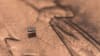

A computer program processes images acquired at different times by instrumentation aboard a spacecraft to detect small satellites of asteroids and other planetary bodies. The program coregisters the images, removes instrument artifacts and images of background stars, and performs a thresholding operation to suppress noise and generate binary versions of the images. The program then searches the binary images for persistent objects, which when found, are put on a list of candidate satellites. The entire process takes place automatically, without human intervention. The data on the candidate satellites can be sent to an autonomous spacecraft executive program for targeting of the spacecraft and/or its instrumentation. The program may also be adaptable to terrestrial use in automated detection of objects and avoidance of hazards. At present, the program runs under Matlab on Sun workstations running Solaris.
This program was written by Paul Stolorz, Victoria Gor, and Richard Doyle of Caltech and Clark Chapman, Randy Gladstone, William Merline, and Alan Stern of the Southwest Research Institute for NASA's Jet Propulsion Laboratory. NPO-20201
This Brief includes a Technical Support Package (TSP).
Software detects small satellites in spacecraft imagery
(reference NPO20201) is currently available for download from the TSP library.
Don't have an account?
Overview
The document discusses advancements in autonomous systems for space exploration, particularly focusing on the detection of small satellites and the analysis of ultraviolet (UV) spectra. It highlights the development of a prototype ground-based system capable of identifying the moon Dactyl orbiting asteroid Ida from images taken by the Galileo spacecraft in 1993. This system successfully distinguished Dactyl from background noise in a blind test, demonstrating the potential for automated satellite detection in space missions.
The document emphasizes the significance of autonomous systems in enhancing scientific discovery during space missions. It describes a second system, the UV Spectral-Analyzer, designed to support autonomous UV spectrometer experiments onboard spacecraft. This system utilizes automatic iterative identification of spectral lines, allowing for rapid analysis of low-resolution spectra. Such capabilities enable spacecraft to autonomously target regions of interest for high-resolution imaging, thereby improving scientific returns.
The paper also outlines the importance of automated analysis and decision-making in interpreting UV spectra, which is crucial for understanding planetary and cometary atmospheres. UV spectroscopy has been a key technique in exploring these environments, providing insights into their compositions and physical properties. The document notes that UV spectrographs have been integral to missions involving various celestial bodies, including the Cassini orbiter and the Rosetta orbiter.
Furthermore, the document describes the automated interpretation of UV spectra as a means to enhance mission execution. This capability allows spacecraft to autonomously assess the quality and content of spectral data, enabling intelligent prioritization of datasets for transmission to Earth. The approach aims to facilitate real-time decision-making regarding which scientific targets to pursue based on the detected spectral features.
Overall, the document presents a comprehensive overview of the integration of autonomy in space missions, showcasing how automated systems can significantly improve the efficiency and effectiveness of scientific exploration. By enabling spacecraft to make informed decisions based on onboard data analysis, these technologies open new avenues for inquisitive scientific experiments and enhance the potential for serendipitous discoveries in the cosmos.