

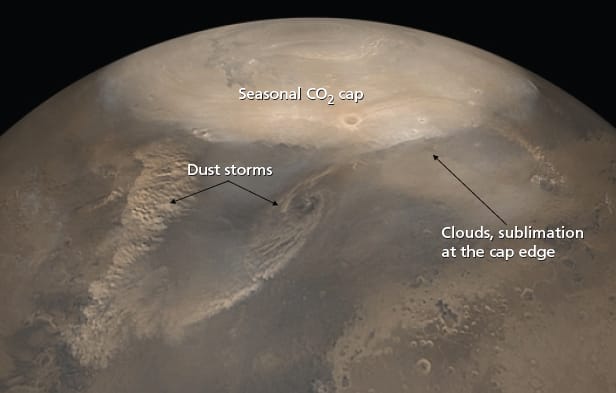
Researchers at NASA’s Jet Propulsion Laboratory have developed a method for automatically tracking the polar caps on Mars as they advance and recede each year (see figure). The seasonal Mars polar caps are composed mainly of CO2 ice and are therefore cold enough to stand out clearly in infrared data collected by the Thermal Emission Imaging System (THEMIS) onboard the Mars Odyssey spacecraft. The Bimodal Image Temperature (BIT) histogram analysis algorithm analyzes raw, uncalibrated data to identify images that contain both “cold” (“polar cap”) and “warm” (“not polar cap”) pixels. The algorithm dynamically identifies the temperature that separates these two regions. This flexibility is critical, because in the absence of any calibration, the threshold temperature can vary significantly from image to image. Using the identified threshold, the algorithm classifies each pixel in the image as “polar cap” or “not polar cap,” then identifies the image row that contains the spatial transition from “polar cap” to “not polar cap.” While this method is useful for analyzing data that has already been returned by THEMIS, it has even more significance with respect to data that has not yet been collected. Instead of seeking the polar cap only in specific, targeted images, the simplicity and efficiency of this method makes it feasible for direct, onboard use. That is, THEMIS could continuously monitor its observations for any detections of the polar-cap edge, producing detections over a wide range of spatial and temporal conditions. This effort can greatly contribute to our understanding of long-term climatic change on Mars.
This work was done by Kiri L. Wagstaff, Rebecca Castano, and Steve Chien of Caltech for NASA’s Jet Propulsion Laboratory. For further information, access the Technical Support Package (TSP) free on-line at www.techbriefs.com/tsp under the Software category.
This software is available for commercial licensing. Please contact Karina Edmonds of the California Institute of Technology at (626) 395-2322. Refer to NPO-41732.
This Brief includes a Technical Support Package (TSP).
Tracking the Martian CO2 Polar Ice Caps in Infrared Images
(reference NPO-41732) is currently available for download from the TSP library.
Don't have an account?
Overview
The document titled "Technical Support Package for Tracking the Martian CO₂ Polar Ice Caps in Infrared Images" presents a method developed by a team from the Jet Propulsion Laboratory (JPL) and the United States Geological Survey (USGS) for monitoring the seasonal changes of the polar ice caps on Mars. The research focuses on enhancing the efficiency of data collection and analysis during Mars missions, particularly using the Thermal Emission Imaging System (THEMIS).
The primary goal of the method is to increase the spatial and temporal coverage of the polar caps while adhering to bandwidth constraints inherent in space missions. The THEMIS orbits Mars 12 times per sol (Martian day), but only targets the polar caps a fraction of the time, consuming significant bandwidth for each targeted image. To address this, the proposed onboard data analysis method prioritizes the transmission of data based on the presence of features of interest, such as the edge of the CO₂ cap, without requiring changes to the existing bandwidth.
The document outlines the effectiveness of the onboard analysis method, known as BIT (Boundary Identification Tool), which was evaluated using 435 THEMIS images. The results showed good agreement with manual annotations, with a margin of error of only 28.2 km. This method is designed for eventual onboard use, meaning it can operate without the need for extensive data calibration, although it does require additional computational resources.
Key benefits of this approach include significantly increased coverage of cap recession, which is crucial for understanding Martian climate dynamics, and improved data prioritization for downlink, allowing for more efficient use of available bandwidth. The method's adaptability in window size also allows it to be tailored to the spacecraft's memory and processing speed capabilities.
In conclusion, the document emphasizes the importance of innovative data analysis techniques in enhancing the scientific return from Mars missions. By effectively tracking the seasonal changes of the Martian polar caps, this research contributes to our understanding of Mars' climate and geological history, paving the way for future explorations and studies of the planet.










