

Studies of physical and chemical effects in the hydride-forming electrodes of rechargeable nickel/metal hydride electrochemical cells have yielded results that now guide efforts to formulate improved electrode alloys to extend the cycle lives of the cells. These efforts involve finding appropriate ternary solutes and amounts of those solutes to alloy with the original hydride-forming binary alloy LaNi5 to form alloys of general composition LaNi5–xMx. Here, M denotes any suitable element or alloy that forms a strong bond with lanthanum, as explained below.

Findings consistent with this approach were reported in two previous articles in NASA Tech Briefs: "LaNi5–xSnx Electrodes for Ni/MH Electrochemical Cells" (NPO-19805), Vol. 22, No. 8 (August 1998), page 60 and "LaNi5–xGex Electrodes for Ni/MH Electrochemical Cells" (NPO-19962), Vol. 22, No. 8 (August 1990), page 61. At the time of reporting the information for those articles, there was no explanation of the basic physical and chemical mechanisms for the degradation of cycle lives of LiNi5 electrodes and for the improvements afforded by partial substitution of Sn or Ge for Ni. The basic mechanisms are still not well understood, but the following understanding has emerged from the research performed thus far:
Hydrides of LaNi5 are thermodynamically unstable against disproportionation reactions in which they decompose into Ni plus LaH2 or La(OH)3. In addition, upon absorption of hydrogen, LaNi5 can expand by as much as 24 volume percent; the combination of large expansion during absorption and the corresponding large contraction during subsequent desorption of hydrogen induces structural defects and reductions in particle sizes, with a consequent increase in the diffusion of metal atoms in the LaNi5 crystalline lattice. This increase in diffusion increases the La content at the surface, where the La is readily oxidized to form a thick hydroxide layer in one of the disproportionation reactions. The present approach involving formulation of LaNi5–xMx is based on suppressing diffusion of La and thereby preventing disproportionation of LaNi5.
More specifically, the approach is to seek compositions and crystalline structures to immobilize lanthanum atoms in the Haucke-phase metal hydrides. The most promising ternary solutes for this purpose should be elements that form the strongest chemical bonds with lanthanum — stronger than the bonds between nickel and lanthanum. The solute atoms would be positioned on the nickel planes of the Haucke phase, so that they would be close to lanthanum neighbors. Strong bonds to neighboring atoms would suppress the formation of crystalline-lattice defects as well as movements of lanthanum atoms.
Preliminary support for this approach has been found through an analysis of cyclic lifetimes for various solutes as reported in the literature; the analysis reveals a close relationship between cyclic lifetime and the heat of formation of the solute with lanthanum (see figure). The finding of this relationship motivated the hypothesis that the rates disproportionation and/or degradation could be reduced by adding solutes that bond strongly with lanthanum. Among the solutes that exhibit high heats of formation with lanthanum are germanium and tin (mentioned in the cited prior articles), plus indium.
This work was done by Ratnakumar Bugga, Robert Bowman, Adrian Hightower, Charles Witham, and Brent Fultz of Caltech for NASA's Jet Propulsion Laboratory. For further information, access the Technical Support Package (TSP) free on-line at www.techbriefs.com under the Electronic Components and Systems category. In accordance with Public Law 96-517, the contractor has elected to retain title to this invention. Inquiries concerning rights for its commercial use should be addressed to
Technology Reporting Office JPL Mail Stop 122-116 4800 Oak Grove Drive Pasadena, CA 91109 (818) 354-2240
Refer to NPO-20107, volume and number of this NASA Tech Briefs issue, and the page number.
This Brief includes a Technical Support Package (TSP).
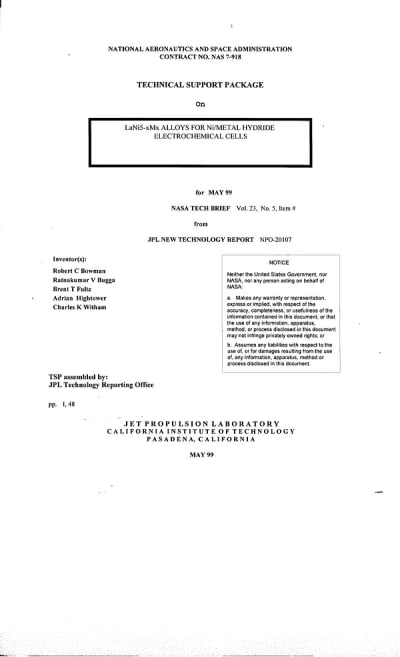
LaNi5-xMx alloys for Ni/metal hydride electrochemical cells
(reference NPO20107) is currently available for download from the TSP library.
Don't have an account?
Overview
The document is a NASA Tech Brief detailing research on LaNi5-xMx alloys for nickel/metal hydride (Ni/MH) electrochemical cells, focusing on the development of new metal hydride materials for enhanced performance in electrochemical applications. The work is conducted by a team at the Jet Propulsion Laboratory (JPL) under a NASA contract, emphasizing the importance of these materials in energy storage technologies.
The introduction highlights the growing interest in metal hydride materials due to their potential in electrochemical devices, particularly in improving the efficiency and longevity of rechargeable batteries. The document outlines a systematic approach to extending the cycle lives of Ni/MH cells, which is crucial for applications in various fields, including aerospace and consumer electronics.
Key findings include the exploration of different alloy compositions, specifically the substitution of nickel with other metals such as aluminum (Al), tin (Sn), germanium (Ge), and gallium (Ga). These substitutions aim to optimize the electrochemical properties of the alloys, enhancing their performance in terms of capacity, stability, and cycle life. The document presents data and figures illustrating the relationships between the alloy compositions and their electrochemical characteristics, such as strain parameters and enthalpy changes.
The research indicates that specific alloying elements can significantly influence the hydrogen absorption and desorption properties of the materials, which are critical for the efficiency of the electrochemical cells. The document also discusses the implications of these findings for the design of next-generation energy storage systems, highlighting the potential for improved performance in real-world applications.
Additionally, the document includes a disclaimer regarding the endorsement of specific commercial products or processes, clarifying that the information presented does not imply any warranty or representation by the U.S. Government or NASA.
In summary, this NASA Tech Brief presents significant advancements in the development of LaNi5-xMx alloys for Ni/MH electrochemical cells, showcasing the potential for enhanced energy storage solutions through innovative material science. The research contributes to the ongoing efforts to improve the efficiency and longevity of rechargeable batteries, which are essential for a wide range of technological applications.










