

Vehicle Electrification - June 2018
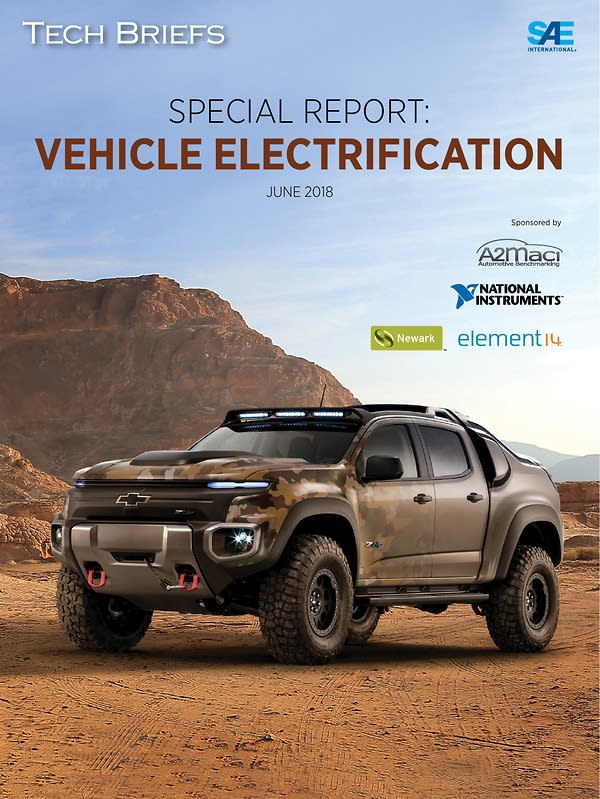
Demand for electric vehicles is accelerating, with several major automakers announcing that their entire lineups will either be hybrid or all-electric by the 2020's. To help you keep pace with the rapid changes in vehicle electrification technology, we present this compendium of recent articles from the editors of Automotive Engineering, Truck & Off-Highway Engineering, and Tech Briefs magazines.
What's inside:
- Feature stories on new initiatives by major OEMs and suppliers including GM, Nissan, Hyundai, and BorgWarner
- Articles exploring the hurdles to electrification in the commercial vehicle and off-highway markets
- Tech briefs spotlighting technology breakthroughs from top R&D labs including NASA, the Department of Energy, Stanford U., and more.
- Resource Report -- a selection of publications, white papers, courses, and conferences to advance your knowledge and education
Don't have an account?
Overview
The "Vehicle Electrification Special Report" from June 2018 provides a comprehensive overview of the advancements, challenges, and future directions in the electrified vehicle sector. It highlights the growing importance of hybrid and electric vehicles (EVs) in the automotive market, driven by consumer demand for sustainable transportation solutions.
One of the key challenges identified in the report is the operating distance range per charge, which remains a significant barrier to the widespread adoption of hybrid and electric vehicles. To address this concern, the report emphasizes the need for rapid battery charging systems and improvements in onboard charging technologies. The integration of power electronic converters is also discussed, as reducing losses in these systems can lead to lighter, more cost-effective vehicles with enhanced range capabilities.
The report contrasts the limitations of traditional silicon (Si) semiconductors with the advantages of silicon carbide (SiC) MOSFETs. While Si semiconductors struggle with high switching frequencies and thermal loads, SiC MOSFETs can operate efficiently at much higher temperatures and switching speeds, significantly improving the performance of electric vehicle systems.
In addition to technical advancements, the report touches on the importance of standardization in the electrified transportation sector. It references a bibliographical review of electrified vehicle standards issued by major standardization organizations, underscoring the need for a cohesive framework to guide the development and implementation of new technologies.
The report also explores the evolving landscape of connected and electrified vehicles, highlighting the necessity for automakers and suppliers to adapt to new data-driven manufacturing processes. This shift is crucial for the production of the next generation of vehicles that are not only electrified but also integrated with advanced connectivity features.
Furthermore, the report discusses the potential of hydrogen fuel cell technology, exemplified by the SURUS vehicle, which boasts a hydrogen storage system capable of providing a driving range of over 400 miles. This innovation represents a promising avenue for extending the range of zero-emission vehicles and could play a significant role in future transportation solutions.
Overall, the "Vehicle Electrification Special Report" serves as a valuable resource for industry stakeholders, providing insights into the current state of electrified vehicles, the challenges that lie ahead, and the technological innovations that are shaping the future of the automotive industry. It emphasizes the importance of collaboration among manufacturers, researchers, and standardization bodies to drive the transition towards a more sustainable and electrified transportation ecosystem.







