

ADAS/Connected Car - December 2018
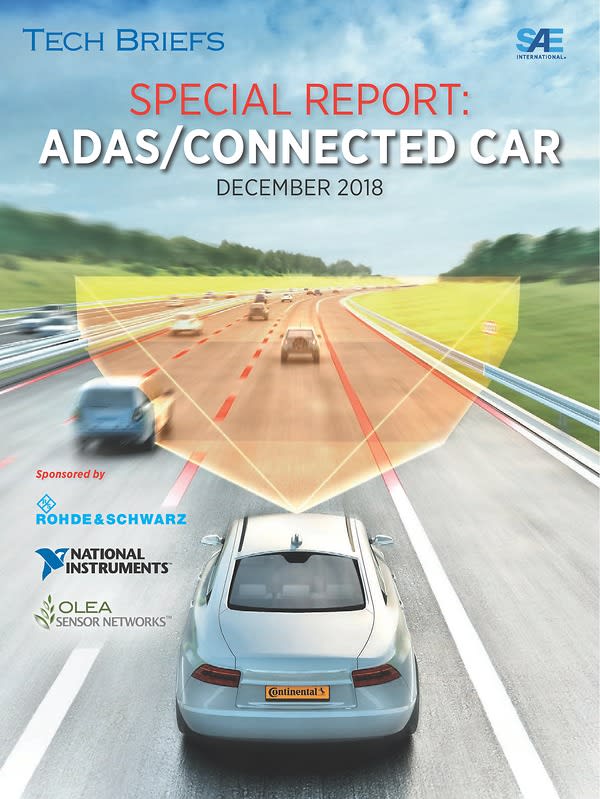
Today's Advanced Driver Assistance Systems (ADAS) and connected cars are paving the way for tomorrow's automated vehicles. To help you keep pace with the latest technology developments, we present this compendium of recent articles from the editors of Automotive Engineering, Autonomous Vehicle Engineering, and Truck & Off-Highway Engineering.
Don't have an account?
Overview
The ADAS (Advanced Driver Assistance Systems) and Connected Car Special Report from December 2018 provides a comprehensive overview of the advancements and challenges in the automotive industry, particularly focusing on autonomous driving technologies and the integration of smart systems in vehicles.
The report emphasizes the critical role of various sensors, processors, and communication technologies in developing autonomous vehicles. It highlights the necessity of fusing data from multiple sensors to create an accurate representation of the vehicle's surroundings, which is essential for safe navigation. This process requires sophisticated architectures and significant computing power to ensure real-time responsiveness and reliability.
One of the key themes of the report is the importance of public trust in data handling and privacy. As vehicles become more connected and data-driven, consumers are increasingly concerned about how their data is collected, used, and shared. Industry leaders, such as Chris Moyer from DXC and Steve Crumb from GENIVI Alliance, stress the need for the automotive industry to establish standards to avoid potential legislation from uninformed regulators. Building trust with consumers is crucial for the success of data-driven initiatives, especially as automakers engage in smart city programs that require extensive data sharing.
The report also discusses the growing challenges associated with implementing autonomous driving systems, particularly in urban environments. As cities evolve into smart cities, the integration of transportation options and real-time data sharing becomes essential. Executives like Stefan Hartung from Bosch argue that cities must adopt intelligent technologies to remain viable, as failure to do so could lead to congestion and inefficiency.
Safety remains a paramount concern in the development of ADAS and autonomous vehicles. The report outlines the need for redundant systems to address safety challenges, particularly in applications such as nighttime warning systems and pedestrian detection. The National Highway Traffic Safety Administration (NHTSA) and automakers have been collaborating on dedicated short-range communication (DSRC) technologies to enhance vehicle-to-vehicle and vehicle-to-infrastructure communication, although a formal implementation mandate has yet to be established.
Overall, the report underscores the transformative potential of ADAS and connected car technologies in reshaping mobility. It highlights the importance of collaboration among automakers, technology providers, and regulatory bodies to create a safe and efficient transportation ecosystem. As the industry continues to innovate, addressing public concerns about data privacy and safety will be critical to gaining consumer acceptance and ensuring the successful deployment of autonomous vehicles.
In summary, the ADAS and Connected Car Special Report provides valuable insights into the current state of the automotive industry, the technological advancements driving autonomous vehicles, and the challenges that must be overcome to realize a future of safe, connected, and intelligent transportation.







