Automotive Manufacturing - April 2019
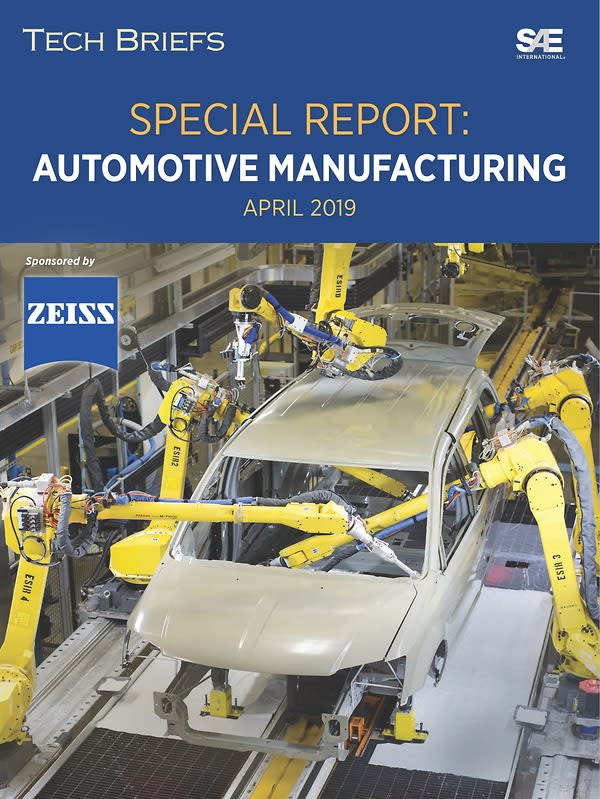
Factories are getting smarter thanks to advances in robotics, analytics, simulation, metrology and more. To help you keep pace with the latest developments, we present this compendium of recent articles from the editors of Automotive Engineering and Automotive Manufacturing & Machining.
Don't have an account?
Overview
The Automotive Manufacturing Special Report from April 2019 provides a comprehensive overview of the latest trends and innovations in the automotive industry, particularly focusing on manufacturing technologies and processes. The report highlights several key areas of development that are shaping the future of automotive manufacturing.
One of the central themes is the increasing investment in advanced manufacturing centers, such as Ford's initiative aimed at speeding up production innovations. This investment reflects a broader trend where manufacturers are adopting smart technologies to enhance efficiency and productivity. The report discusses how manufacturing systems are becoming smarter and more self-healing, leveraging digital data to optimize operations.
Digitization is another critical focus, with the report emphasizing the extension of simulation technologies into factories. This integration allows for better planning and execution of manufacturing processes, ultimately leading to improved product quality and reduced time-to-market. The role of digital data is expanding rapidly, influencing everything from component design to the final assembly of vehicles.
The report also addresses the growing importance of materials in automotive manufacturing, particularly the use of adhesives and lightweight materials like aluminum. Honda's increasing reliance on adhesives for manufacturing processes is highlighted, showcasing how these materials contribute to vehicle performance and efficiency. Additionally, Constellium's emergence as a leader in electric vehicle (EV) structures and lightweighting technology is noted, emphasizing the industry's shift towards more sustainable practices.
The concept of smart factories is explored in depth, with a focus on the need for flexibility, connectivity, and security. Collaborative robots (cobots), augmented reality, and big data analytics are identified as key enablers of the factory of the future. These technologies not only enhance operational efficiency but also improve worker safety and ergonomics, as seen in General Motors' use of robo-gloves and 3D-printed tools to assist assembly line workers.
Additive manufacturing, or 3D printing, is also making significant inroads in the automotive sector. The report discusses how this technology is transforming operations by enabling the production of manufacturing tools and aids on-site, thus reducing costs and lead times. The ability to create components on demand is particularly beneficial for fulfilling requests for obsolete parts, streamlining the supply chain.
Furthermore, the report touches on the importance of automated data translation in manufacturing processes, as demonstrated by seating giant Adient's modular approach to validating modeling data across its global enterprise. This integration of data ensures that design, testing, production, and review processes are aligned, ultimately leading to better product outcomes.
In conclusion, the Automotive Manufacturing Special Report underscores the transformative impact of automation, connectivity, and advanced materials on the automotive industry. As manufacturers prepare for disruption, the report emphasizes that a combination of innovative technologies and traditional practices will be essential for navigating the challenges and opportunities ahead. The future of automotive manufacturing is poised for significant change, driven by a commitment to efficiency, sustainability, and quality.