

Unmanned Systems - March 2019
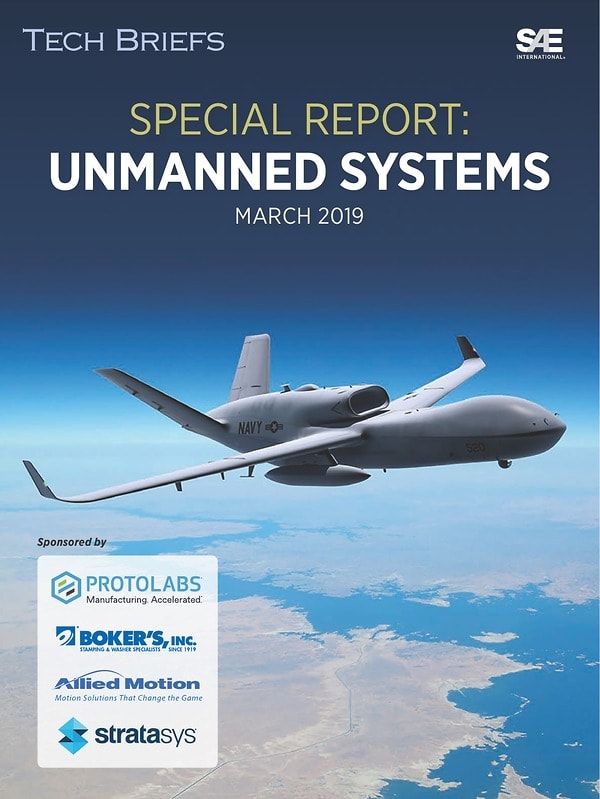
The latest advances in aerial, ground, and underwater unmanned systems are covered in this special report, a compendium of recent articles from the editors of Tech Briefs and Aerospace & Defense Technology.
Don't have an account?
Overview
The March 2019 Special Report on Unmanned Systems provides a comprehensive overview of the latest advancements and challenges in unmanned vehicle technology, particularly focusing on military applications. The report emphasizes the importance of open standards in the design and operation of unmanned systems, which can simplify thermal design and enhance life cycle support. This is particularly crucial for military programs that require long-term operational capabilities and maintenance, as it allows for easier upgrades and replacements of critical components like processors and memory.
One of the key highlights of the report is the application of advanced composite materials in the development of unmanned aerial vehicles (UAVs). General Atomics Aeronautical Systems, Inc. (GA-ASI) is noted for its innovative approach in creating integrated fuel tank structures for the MQ-25 unmanned aerial refueling aircraft for the U.S. Navy. This design maximizes fuel offload and demonstrates the potential of composite structures in enhancing UAV performance.
The report also discusses the evolution of communication technologies for unmanned systems, particularly in the context of hybrid warfare. It notes that while satellites have historically enabled global communications, the effectiveness of unmanned aircraft systems (UAS) relies heavily on robust command and control links. The challenges of limited infrastructure in theater environments necessitate reliable communication methods, with traditional radio waves being a common solution for maintaining line-of-sight operations.
In addition to UAVs, the report touches on the emerging requirements for Unmanned Underwater Vehicles (UUVs) driven by global defense forces. These platforms are increasingly being developed to meet new mission demands, showcasing the versatility and adaptability of unmanned systems across different domains.
The report also features various application briefs, including advancements in maritime unmanned aircraft systems, nano-unmanned aerial vehicles, and autonomous helicopters. These briefs highlight the ongoing innovation in the field, with a focus on multi-purpose designs and flexible propulsion systems that enhance operational capabilities.
Furthermore, the report addresses the critical need for protecting data on unmanned underwater platforms, emphasizing the importance of cybersecurity in the operation of unmanned systems. As these technologies become more integrated into military operations, safeguarding sensitive information is paramount.
Overall, the Special Report on Unmanned Systems serves as a valuable resource for understanding the current landscape of unmanned vehicle technology, the challenges faced by military applications, and the innovative solutions being developed to address these challenges. It underscores the significance of collaboration, technological advancement, and adherence to open standards in ensuring the success and longevity of unmanned systems in various operational environments.











