Microscopes are essential for precise 2D and 3D visualization and measurement in quality control, failure analysis, and R&D. Choosing the right setup requires...
See the future of aerospace and defense manufacturing in this compendium of articles from the editors of Tech Briefs and Aerospace & Defense Technology magazines.
The Create the Future Design Contest recognizes and rewards engineering innovations that promise a better tomorrow. In this special report, learn about the amazing winners chosen in 2025 from hundreds...
Researchers at CITENI and CITIC developed a novel method to evaluate adhesive aging on naval steel substrates under maritime conditions. Using Master Bond EP40, a high performance...
On the heels of taking first place in the Aerospace & Defense category at the 2023 Create the Future Contest, Zulu Pods has grown in nearly every way imaginable and shows no signs of slowing down (nor a desire to!) at any point soon.
As drones and UAVs become increasingly central to commercial, industrial, and defense operations, the electromagnetic environment in which they operate grows more complex....
Selecting the right adhesive product for extreme temperature applications may seem as straightforward as reading temperature resistance values on data sheets. Some engineers will sometimes...
On this episode of the Aerospace & Defense Technology podcast, Corsha CEO Anusha Iyer explains how machine identity, continuous authentication, and secure connectivity are accelerating digital transformation for the U.S. Air Force Sustainment Center. Listen now!
Aerospace and defense programs face increasing challenges in predicting and mitigating vibration, acoustic, and shock impacts on vehicle performance and reliability. This...
Modern aerial technologies are reshaping the future of warfare. Countering these threats requires adaptable, multi-layered systems that integrate detection, electronic warfare,...
This compendium of articles from the editors of Tech Briefs and Aerospace & Defense Technology magazines looks at the latest advances in power electronics and energy storage for applications ranging from...
On this episode of the Aerospace & Defense Technology podcast we examine the technical and strategic foundations behind Guam’s new advanced manufacturing hub. Neal Orringer of ASTRO America and Alex Benham of GAMMA are the guests to discuss the facility’s additive manufacturing capabilities, supply-chain objectives, and workforce development plans. Listen now!
On this episode of the Aerospace & Defense Technology podcast, Patrick Acox, Forterra Vice President of Defense Growth, is the guest to explain how the company provides autonomy-enabling modules for a wide variety of military applications.
The battlefield is changing and so is mission computing. In this interview, Mercury System’s Brad Bruce explains how open architectures like SOSA and MOSA are driving...
Rob Creighton, Windlift Founder & CEO, is the guest on this episode of the Aerospace & Defense Technology podcast to explain how Windlift's autonomous tethered drone system leverages wind to power a wide variety of defense applications.
In industries where heat, pressure, and chemistry converge, surface integrity is everything. APV Maskant materials provide targeted protection for industrial applications during high-temperature diffusion coating and chemical...
The electrification of military systems is a positive step that will deliver enormous technical, operational, and sustainability advantages across defense equipment lifecycles. But it requires deep system-level technical expertise to ensure systems work seamlessly together across power conversion, distribution, and conditioning. Read on to learn more.
US Army tests innovative autonomous tactical vehicle...AI boosts super‐resolution microscopy…novel sensor enables ultra‐high temperature measurement. Read about these and other advances in this...
In this article, you’ll learn about the Create the Future Design Contest finalists in all seven categories chosen from over 600 new product ideas submitted from 67 countries.
Silent Sentry is a software system that transforms existing passive microwave sensors into advanced threat detectors. The system is based on Passive Microwave Radiometry (PMR), which “listens” for the faint, naturally emitted thermal radiation from all objects. Read on to learn more about Silent Sentry, which was the Aerospace & Defense finalist at the 2025 Create the Future Design contest.
Lasers vs. drones: military demonstrates new tech…high-‐flying uncrewed solar aircraft aces key test…the next frontier for autonomous UAVs. Read about these and other developments in this...
Modern defense UAVs must deliver endurance, autonomy, and secure communications in contested environments. The Drone Systems Engineering Playbook provides practical guidance on subsystem...
Critical advantages and challenges of using laser communications in space…the future of EMI protection for military aircraft…new "micro comb" chips promise to improve GPS accuracy. Read about these...
Bryan Bockmon, CEO of AimLock, is the guest on this episode of the Aerospace & Defense Technology podcast to discuss their new partnership with Overland AI and the future of autonomous targeting systems in modern warfare.
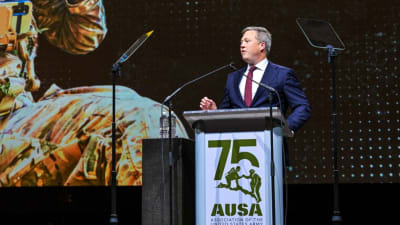
Listen to this episode of the Aerospace & Defense Technology podcast to hear selected portions from Secretary of the Army Dan Driscoll’s AUSA 2025 opening keynote. In it, he discusses the Army’s transition to a drone-centric future and an acquisition paradigm reshaped by Silicon Valley principles. Listen now!
Pickering's white paper explores the use of Hardware-in-the-Loop (HIL) simulation to accelerate and de-risk the development of Next-Generation Aircraft (NGA) systems. It highlights key...
MGI Engineering recently unveiled their new long-range autonomous precision strike drone, TigerShark, at the 2025 DSEI event in London. MGI is a U.K.-based engineering consultancy founded by former F1 Chief Designer Mike Gascoyne. Gascoyne is the guest on this episode of the Aerospace & Defense Technology podcast to explain how MGI is leveraging their history of collaborating with F1 racing teams to design low cost precision strike drones that can be manufactured at scale.