Although life has not been found on Mars just yet, an astrophysicist thinks there could be life...under it.
Dimitra Atri, research scientist at the Center for Space Science at NYU Abu Dhabi, believes that the sub-surface conditions of Mars could be home to organic molecules.
Atri hopes that upcoming explorations of the planet, like the Mars 2020 mission and the European Space Agency's ExoMars mission in 2022 , will confirm his hypothesis.
Above the surface, Mars is not very hospitable. Aside from small amounts of water in brines, polar caps, and hydrated minerals, the Red Planet lacks the necessary resources to support life. Oxyidants and chemical compounds known as perchlorates, when activated by heat, destroy potential biomolecules and chemical biosignatures.
Below the surface of Mars, however, may be where to look for life.
One reason to dig deep on the planet: There's more water down there.
Although the Martian sub-surface environment has not yet been directly probed, satellite observations and rover measurements have shown large deposits of water ice. The ice deposits occur as shallow as 1 meter below the surface, extending down to several kilometers in depth.
Another reason to explore the sub-surface: There's radiation.
The Martian surface is bombarded by Galactic Cosmic Rays (GCRs), energetic charged particles that penetrate a few meters below the surface.
According to Atri, the steady bombardment of penetrating Galactic Cosmic Rays (GCRs) provides the energy needed to catalyze organic activity there.
One of the most important requirements for life to exist is chemical disequilibrium, says Atri, and the radiation from GCRs offers that kind of disruption, initiating a chemical process known as radiolysis.
"A system is in equilibrium when a substance A converts to substance B, at the same rate as substance B converts back to substance A — overall nothing new is being produced in the system." Atri told Tech Briefs. "The system is in disequilibrium when this equilibrium gets disrupted."
And below the surface of Mars, the radiation from Galactic Cosmic Rays continuously creates a "GCR-induced radiolytic zone" below the surface of Mars — an area of disequilibrium that is potentially supportive of life.
Atri proposes that galactic cosmic radiation, which can penetrate several meters below the surface, will induce chemical reactions that can be used for metabolic energy by extant life, and host organisms using mechanisms seen in similar chemical and radiation environments on Earth.
Atri’s findings are reported in the study Investigating the biological potential of galactic cosmic ray-induced radiation-driven chemical disequilibrium in the Martian subsurface environment in the journal Scientific Reports, Springer Nature.
“Based on the results of radiation chemistry experiments, and observations of interstellar ices and comets, it is highly likely that prebiotic molecules are present below the surface,” Atri says in the introduction of his report.
Using a combination of numerical models, space mission data, and studies of deep-cave ecosystems on Earth for his research, Atri proposes mechanisms through which life, if it ever existed on Mars, could survive and be detected with the upcoming ExoMars mission (2022) by the European Space Agency and Roscosmos Space Corporation.
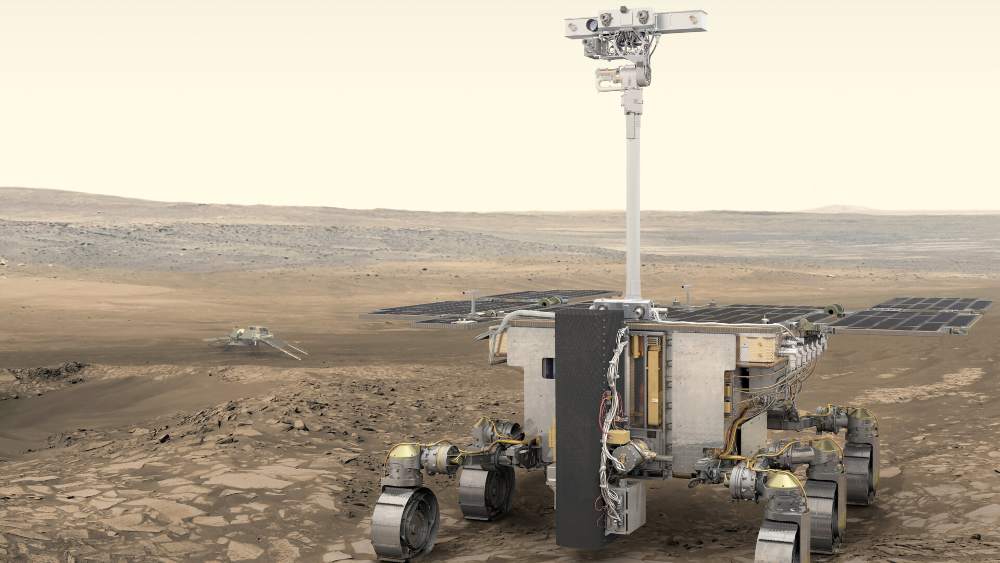
The ExoMars will send the Rosalind Franklin rover to dig two-meters deep into the Martian surface and pull samples for study.
{youtube} https://www.youtube.com/watch?v=BNItE7zjhq8 {/youtube}
In a short Q&A with Tech Briefs below, Atri explains why answering the question of life on Mars is such an important one to answer.
Tech Briefs: The Perseverance rover launched this month, where it will eventually take surface samples and hopefully return them to Earth. What parts of the Mars 2020 mission are you especially excited about and paying attention to, and that can help to support your study's hypotheses? Will Perseverance be reaching the subsurface levels that your study focuses on?

Dimitra Atri: The sample return aspect is certainly very exciting, but those samples will be available to study on Earth several years from now. At present, the most interesting instrument on board the rover for me is SHERLOC (Scanning Habitable Environments with Raman & Luminescence for Organics & Chemicals) which is going to analyze the surface and shallow subsurface of Mars.
Although it does not go deep enough in the Martian subsurface, I am hoping that it will provide us with new and useful information about the chemical environment there. It will certainly help with validating the chemistry part of my research and hopefully signs of present or past life on the planet.
Tech Briefs: How can the upcoming ExoMars mission (2022) by the European Space Agency and Roscosmos potentially detect the life that you're talking about?
Dimitra Atri: The ExoMars mission's Rosalind Franklin rover has a drill capable of retrieving samples from up to 2 meters below the Martian surface and studying them with sophisticated instruments such as:
- The Mars Organic Molecule Analyzer (MOMA) for the study of organic molecules and biosignatures.
- The close-up imager (CLUPI) for high-resolution color images.
- The MicroOmega instrument for imaging crushed sample material.
- The ADRON neutron and gamma ray detector to measure the subsurface hydrogen content.
- The Raman Laser Spectrometer (RLS) for the detection of organic functional groups.
These instruments would assist in detecting signs of possible microbial life and/or chemical biosignatures.
Tech Briefs: Why is answering this question about the proof of life below the surface of Mars such an important one to answer?
Dimitra Atri: All of us have wondered whether life exists beyond earth. It is also one of the biggest questions in modern science. If we detect life on Mars, it will help us understand how life fits in a broader astrophysical context and hopefully help us understand the physical underpinning of life!
What do you think? Share your questions and comments below.
Transcript
00:00:00 this is a dedicated facility where simulates all what we expect to see and we want to test in terms of performances on Mars the arrangement you see here is a setup we have to perform egress tests actually what we're testing in this period is different configurations of slope and orientations of the lander and the rover in reality what will happen is
00:00:32 that the robber will land encapsulated in the platform then we will unfold the wheels and the ramps will be deployed this is a very delicate and potentially dangerous operation we want to account for any adverse situation for example landing on the foot of a small hill which have a lander tilted or landing when our ramps open we have an obstacle on one of them
00:00:55 or one of the neither ramp lands on an obstacle so you have to address in a tilted configuration now the test platform is tilted 5 degrees we are simulating what the rover my encounter when it lands on Mars [Music] we are just checking if they can push
00:01:39 the test to the limits yes no I mean can we go we never did it but we are increasing the level of difficulty of this test before we went for five degrees now we are moving up to 15 degrees if before I was nervous now it's even worse disgusting [Applause] the rover has to overcome actually
00:02:41 obstacles which are half a height of at least 250 millimeters and there are Parramatta khals round or square ones and we will test it to overcome one or several in different inclinations [Music] without diplomatic traitors being strong enough we can implement an addition and
00:03:25 locomotion mode which we call wheel walking which articulates a motion around this axis and this motion gives very good traction capability in very soft soils and in very high slopes the eventually we will be able to go to places to find interesting elements on the surface of Mars and basically achieving the intended operations and their return in terms of science we are
00:03:50 on track for Mars we plan to complete this test basically as planned with some minor glitches here and there then continue with a further more elaborated test many of the tests are taking place across Europe to get the rubber ready for Mars when the flight model takes shape science instruments are carefully installed and the software runs all possible scenarios to guarantee a good
00:04:14 performance on the Red Planet stay tuned for the next episode you you