

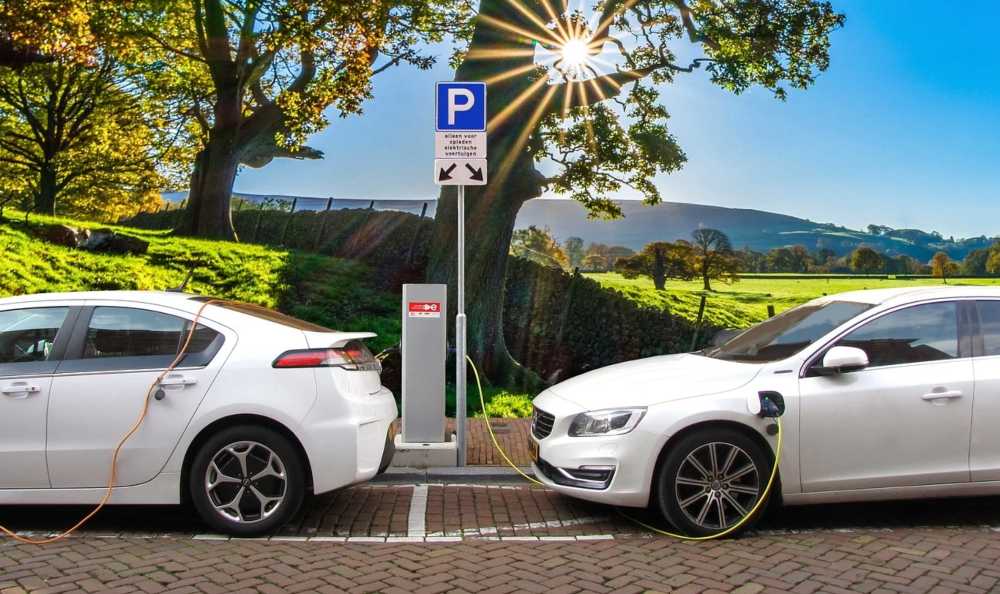
If you're concerned that electric vehicles don't have the reliability to get you where you need to go, Penn State engineers are working on a battery for you.
The researchers' lithium iron phosphate batteries have a range of 250 miles, with the ability to charge in 10 minutes.
According to the report in Nature Energy , the battery's long life and rapid recharging are due to its ability to thermally modulate. The battery quickly heats up to 140 degrees Fahrenheit, for charge and discharge, and then cool downs when the battery is not working.
"The very fast charge allows us to downsize the battery without incurring range anxiety," said Chao-Yang Wang , William E. Diefenderfer Chair of mechanical engineering, professor of chemical engineering and professor of materials science and engineering, and director of the Electrochemical Engine Center at Penn State.
Range anxiety, or the fear that a vehicle will lack the charge required to reach a destination, could be eased with a battery that self-heats.
The results of the thermally modulated, or "TM" technology, were reported in a January 2021 journal of Nature Energy .
The self-heating battery, developed in Wang's center, uses a thin nickel foil with one end attached to the negative terminal and the other extending outside the cell to create a third terminal.
As electrons flow, the battery rapidly heats up the nickel foil through resistance heating and the internal warmth of the battery. Once the battery's internal temperature is 140°F, the switch opens and the battery is ready.
With a self-heating method, low-cost materials can be used for the battery's cathode and anode, says Wang.
The cathode is a thermally stable, lithium iron phosphate, which does not contain any of the expensive and critical materials like cobalt. The anode is made of very-large-particle graphite — a safe, light and inexpensive material.
The self-heating approach also reduces uneven deposition of lithium on the anode, which can cause lithium spikes that are dangerous.
According to Wang, the smaller batteries produce a large amount of power upon heating — 40 kilowatt hours and 300 kilowatts of power. An electric vehicle with this battery could go from zero to 60 miles per hour in 3 seconds and would drive like a Porsche, the professor.
"This is how we are going to change the environment and not contribute to just the luxury cars," said Wang. "Let everyone afford electric vehicles."
In an interview with Tech Briefs below, Dr. Wang explains how he'll work with battery manufacturers and automakers to put more electric vehicles on the road.
Tech Briefs: What has prevented lithium iron phosphate batteries from being used in a mainstream way?
Dr. Chao-Yang Wang: Lithium iron phosphate (LFP) batteries have slightly lower energy density than nickel-cobalt-manganese (NCM) or nickel-cobalt-aluminum (NCA) batteries; as such, LFP batteries have not been widely used in electric cars that have been designed to carry big batteries in order to overcome consumer’s range anxiety. LFP batteries were too heavy if vehicle batteries are big.
Tech Briefs: In a news release from Penn State , you said you developed a “clever” battery. What makes the design clever, and how is it a different design from conventional battery designs?
Dr. Chao-Yang Wang: We took an opposite approach to invent 10-minute fast, convenient recharge. In turn we can use a small vehicle battery, such as a 40 kWh one, without worrying about range anxiety. The smaller the battery, the lower cost.
On top of that, because of a small battery on board, one can now use a lithium-iron phosphate material that is further cheaper than NMC or NCA. So we achieved double-saving in cost, a smaller battery for lower cost overall and a cheaper LFP material for lower unit cost.
The 10-min, fast-recharge LFP battery is enabled by a thermal modulation strategy. We always pre-heat the TM battery to ~60 deg C before driving or charging and do so rapidly (in 30-60 seconds). The TM battery will naturally cool down when it is not in use or the vehicle is shut down.
The elevated temperature operation significantly improves efficiency and permits 10-min fast [recharge], which would be otherwise not possible at room temperature. Simultaneously the elevated temperature operation offers huge discharge power, i.e. 300 kW for a 40kWh pack, which is enough to accelerate a car from 0-60 miles per hour in 3 seconds.
You can see that rapid heating — raising battery temperature by 100 °C per minute — is the key; otherwise it is impractical.
Tech Briefs: What needs to happen next for this kind of battery to be used throughout the electric vehicle market?
Dr. Chao-Yang Wang: We would encourage giga-factory battery manufacturers and automakers to partner with us to implement and demonstrate this TM battery technology in cars and then enter the marketplace.
Tech Briefs: What is it about the design that enables such a long lifetime?
Dr. Chao-Yang Wang: Our TM battery design uses thermally extremely stable LFP cathode and big-particle graphite anode, the latter of which is also more stable and less degrading than conventional graphite used in regular lithium-ion batteries.
Tech Briefs: How does the design address range anxiety? Can’t the battery still run out of power?
Dr. Chao-Yang Wang: The 40kWh TM battery will have a 200-mile range, but it can be readily extended by a 10-minute convenient recharge. (A 10-minute stop would offer opportunities for a restroom visit or coffee break).
So there should be no range anxiety. It is like driving a gasoline car; even when there is only 20 miles left, we don’t feel nervous as long as there is ubiquitous, fast refill available. In that case, we rarely need a 50-gallon gas tank. So the same thing will happen to electric cars.
By the way, our 40kWh TM battery needs only 240 kW charging power for a 10-min energy refill. So, all existing Tesla superchargers, V3 rated at 250 kW, would do the job. In fact, we could increase revenue for Tesla superchargers, because they currently can only do 1 Tesla car per hour. [If you have] 6 TM Battery cars per hour, [you can] increase the revenue of each charger by 6x without incurring additional installation or capital cost.
Other Penn State researchers working on this project were Xiao-Guang Yang, assistant research professor of mechanical engineering, and Teng Liu, doctoral student in mechanical engineering.
The U.S. Department of Energy's Office of Energy Efficiency and Renewable Energy and the William E Diefenderfer Endowment supported this research.
What do you think? Can this battery eliminate "range anxiety?" Share your questions and comments below.
Transcript
00:00:00 support for digging deeper comes from the Penn State Alumni Association connecting alumni to the University and to each other the Alumni Association is powered by pride learn more at alumni.psu.edu and from viewers like you thank you 95% of Americans use a cell phone that means 95% of Americans rely on
00:00:37 lithium-ion batteries the technology isn't new commercial production of lithium ion batteries began in the early 1990s today you can find them in everything from toys to toothbrushes but their power to change the way we travel is generating the most buzz in this edition of digging deeper Penn State President Eric Barron will explore breakthroughs in battery technology and
00:00:59 the effort to make electric vehicles mainstream here to discuss the topic is professor Chao yang Wang he is the co-director of the best Center at Penn State and Ryan longchamps a graduate student studying mechanical engineering I'll be back later in the show with a one-on-one conversation with dr. Baron so I want to thank you both for joining me on the show we have a fascinating
00:01:22 that topic I think so what is exactly does best stand for and what does best do so best stand for battery and energy storage technology Center so basically it's a collaborative Center where a group of faculty and students get together and foster collaboration and provide a focal point for research and education at Penn State more than one college it's within the department
00:01:52 across the campus or off the campus yes many many colleges and many departments are involved whatever skill set you need in order to improve that technology exact and that you focus on he's acting and activities we do range from materials all the way to system so we have faculty who are specializing discovering new material synthesizing advanced materials and then we have a
00:02:21 group of faculty who are using the good material to build cells and devices and then you know another group of Valley that is putting those cells in system putting control systems so you can integrate in vehicles or application so it's really broad very broad so in addition pretty so many things that this has an impact on but you know one of the things that
00:02:48 is seems to be taking off and everybody's paying attention to is is that the technology and battery storage for for electric cars and so if you just began thinking about this where where are the limitations what what is what is slowing I would say the pace for us to be dominated by electric cars I think at this point today we are probably on the verge of breaking out in terms of
00:03:21 electric cars and today I think the electric car probably take about three to five percent of the market and so we are a very critical point to improve robustness and performance our electric car batteries you know to take the mainstream now for electric car to take the mainstream the battery have to do different things so far people treat the electric cars as sort of you know toy
00:03:55 hobby but if cars become you know a mainstream you have to rely on people have to depend on that so yeah that the batteries have battery traction batteries have to become very reliable and very robust and almost you have people expect performance anywhere and anytime so that's the area that I think the battery technology still have some work to do mhm so if I'm sitting there
00:04:22 looking at this initially it might be you know I could be the first on my block to have an electric car but then you come down to the practicality you said reliability and so but I can imagine that if I was traveling a lot and mentally like going to a gas station I would be saying how long can i drive on this on this can I get the performance I want or even if I go to
00:04:47 work and I have a low low battery can i plug in somewhere so are these things really what's driving the research to create a better battery is to make sure that you would distance and fast charging and we need a lot of charging stations or it's not going to work right and I was going to say that that's part of that user experience that people you know things people are worried about
00:05:14 and one thing they mentioned is range anxiety yeah the issue of how far can I go before I need to charge again and is the infrastructure there so that's one thing that we work to do is increase that energy density which allows you to essentially to to drive for a further distance before needing that next charge so you say energy density and most people they would wonder what what is
00:05:34 that but you're really saying I got to pack a lot of energy in a small space right otherwise I need a really big vehicle to carry a lot of batteries right exactly it's weird this is all about size and and yeah yeah and what about the performance side of it I have to confess the individual who named the college of communications Don Belisario he has an electric car it also self
00:05:58 drove down the mountains in Santa Barbara but he said I'll show you what I've got as long as you lean back it was an incredible power search did that completely zap the battery in terms of how far he can get yeah I mean electric car tends to have great acceleration performance I think you know some of that you have touch up on some of the issues that we try to address you know
00:06:25 to make electric cars mainstream so range is one but I think again we are we have several commercial cars that are reaching the critical point to meet the range requirement for customers for instance you know GM has Chevy bolt with our travels about 20 40 miles per charge and so once you're charged you can get 20 40 miles they're just too bad so this is close to what you might have in a
00:06:54 gasoline and a small thing yeah exactly so and Tesla is a model 3 and all those are you know medium range cars they are not super expensive anymore so I think yeah so Ryan your grad student correct and I don't what your undergraduate degree was but how did you get attracted to this as a field so and the best so I did my undergraduate degree in mechanical
00:07:17 engineering which is what I'm pursuing my PhD in it oh okay and I started out thinking I wanted to go into a completely different field and I did some work in my masters at degree at my previous University that was related to energy storage technology and I saw a part of the future you know in research leading towards or staying with lithium-ion battery development and you
00:07:40 know in this application it's definitely going to be have that have a strong future so that's one thing that attracted me to it now specifically the best Center at Penn State it's just a great facility that's integrating all as he's mentioned all these research groups that have expertise in different areas that are integral to creating you know a successful and effective system in the
00:08:00 end so that's what attracted me to it so now lithium-ion you are focusing on but there are lots of different kind of batteries what are the advantages of a lithium-ion battery I think number one is it's relatively mature because as we used for two decades in consumer electronics and also the production scale is already there mm-hmm so you know once you try to implement
00:08:31 batteries in electric cars you need a huge scale examples are you know gigafactory for example by Tesla and the world probably need about 20 or 30 gigafactory you want to satisfy all the needs for electric car so the scale is very important there are some you know new technology coming up but a where takes some time to scale and that is so far that probably the biggest advantage
00:08:57 or EMI and with a scare the cars coming down and in the last five six years cost have been dropped by you know maybe three times that's very significant so so the maturity the cost literally the capability to produce millions are their weaknesses yeah you you you know although we can get range you know 240 miles per charge right now but we're
00:09:31 still you want to maybe double the energy density for instance and that give you into 400 miles range per charge and that would be great for transportation application and also you know there's safety issues associate with the lithium iron and pure engineers and scientists are working on those so there's definitely there's a lot more to to improve and there's even within the
00:09:58 lithium ion technology there's a new chemistry and new materials emerging that will allow you to double the energy density and improve the safety so there is a phone maker that had a considerable problem with with their batteries and you wouldn't let them on airplanes and is that what you mean by the safety issues yeah exactly it took it can be there can be a
00:10:22 catastrophic failure yes and so this is a a constant struggle on one hand for performance you want to have high energy dance right which means you know over small volume or weight you have a la carry a lot of energy where that is self intrinsic rates dangerous yeah and then on the other hand you want to have very high safety because those batteries are carried by by people yeah I mean and
00:10:51 they are close to your chest and and things like that yeah yeah airplane so this is a this is a a great research problem for scientists and engineers other things like you know here comes winter and and and I've heard that there's differences in performance is is this true is that significant yeah that's that's a very significant and probably all of us know that batteries
00:11:18 are notoriously afraid of the cold in the winter if you put out your iPhone you know outdoor after five minutes of power myself basically lose a power it's not so much losing energy Energy's there there but you cannot extract the energy anymore either because it's cold because of its code so in other words the battery will essentially become a
00:11:44 nonreactive state huh so that's an addition yeah it's a hibernating kind of thing and now if the energy is there if I warm up my phone do I get it back oh absolutely you do is you warm up and then fungi come back turn back right away energy is still there so the key really I mean this is not so much a problem for cell phones or other gadget but it's a tremendous challenge for
00:12:10 electric vehicles because the car is sitting outside exactly now everyone has heated garage right I mean we have a lot of people eating like from metropolitan cities like New York and London and Beijing they have a great need for electric car they all park out though overnight in the winter and customers expect to be able to drive away that car in the next money yeah so Ryan you were
00:12:36 smiling at that is your research focused on some of these drawbacks well I'm smiling consider in somewhat of a degree or two somewhat of a degree but one of the biggest developments recently coming out of our research group actually it's funny because the professor or now a professor that just left that you see EC would have worked on and he pushed switched universities
00:12:58 with me but that is the self-feeding lithium-ion battery and that actually draws current some of that energy out of the battery the battery is we're using some of the energy and the battery to keep the battery warm right or to warm it up or to warm it up if you need to right and this this engineering design leads to a much higher heating rate and allows you to use that energy much much
00:13:20 faster than current methods so in the old days I'm warming up my engine before I go off for performance I come into my cold car and I give it some time for the battery to warm up the battery right and it was yeah it was a very surprising discovery we actually published this piece of work last year in nature as consider as a breakthrough and and what we found is at the very low
00:13:46 temperature when the battery is in a nonreactive stable it still has a little bit of power you can draw but if you use that little power to heat up the batter itself it doesn't take much heat every little and warm up and you get there was a warm-up you get more power and then more power is more heat so it's kind of you know thermal runaway process occurring at a very low temperature so
00:14:10 to speak and they take a few seconds to warm up from minus thirty degree C to zero mm-hmm and they consume only one to two percent of the energy the battery energy very amazing huh that is that is amazing so so Ryan I this sounds like a lot of fun to be sitting there working on and sometimes I have the notion that if you're a more senior faculty member and you're working on problems you find
00:14:39 your way to cross disciplines in order to solve a problem but here you are you I think I've got this right you said you were a mechanical engineer right but you've got to be working with material scientists and electrical engineers and chemical engineers and I'm not too sure who all else is this easy as a PhD student is that kind of a really different world and then any sort of
00:15:06 previous degree and experience I would say definitely yeah that's largely what attracts me to it though is that it becomes a challenge and you know through this experience I'm going to gain so much knowledge through this collaborative environment from those people that are experts coming you know coming from a strong background in all of those fields and you know at a
00:15:26 similar rate we become somewhat at least knowledgeable within those other fields that we're branching off into there's something appealing about the notion that you're there to solve a problem not to live within your discipline right and see what's next but to solve a problem I mean I think that that that really is wonderful so if we're solving these problems and I went out into the
00:15:49 automotive industry and I said tell me about best what is best doing to really change the automotive industry would they answer how would they answer yeah we do how you hope they would answer right yeah yeah well I think you know if you get into an EDD created details we have a lot of new technologies and new discovery that we make and we have a number of projects
00:16:14 that do but as it on the top level I think just you know the size our our center and the number of student we produce every year and and and those are sent to you know out of industry that's that itself is a huge contribution to this emerging you know unified auto industry so those people and what about everything else from cell phones to hearing aid batteries to all these
00:16:40 things that are part of our everyday life same kind of impact same kind of we're probably less visible because you know cell phones in terms of the total number of batteries so in terms of the capacity is still very small as compared to cars right right since for instance I give you an example a Tesla car probably needs seven thousand houses you know cylindrical cell they use 10 to used in
00:17:12 laptops so you know so it's the the critical mass really is in auto and also this is a very important industry to motivate our student telling the students and researchers so are there things that we were not quite imagining so we've gone through a couple of major hurricanes would we imagine that people would have a weather forecast that was coming and I'd power up my storage
00:17:49 device that was in my home and then for the essentials I would have time because I'd keep my food safe or keep my pump operating or you kind of imagine that there'll be a safety factor in here some day that everybody will have their batteries so that they can yeah that's that's a very interesting question you know typically during emergencies and batteries are part of the first
00:18:18 responders you run to the store and buy batteries right yeah exactly I gotta have my flashlight I gotta have money and even for your cell phone so you can call your relative and say hey I'm safe and I'm still here and that kind of thing yeah so I think it battery become essential part of our life nowadays they basically Electrify everything in our life but if I can go 240 miles maybe my
00:18:39 nursing home is going to have a stack of backup batteries I don't know yeah that's that's see we have to continue to work on it and that's why we also have to make sure that the electric cars are very robust very convenient now rely on he the garage on rely on let's say eight or ten hours home charging right now this is home charging is most efficient but in the case of emergency you want to
00:19:06 have fast charging fast and safe charge on the road like just you know in the last yeah Harry can see that it's people have to evacuate from Florida and they may try you know 400 miles and you're there and they're in lines for gasoline and getting nowhere and if you know their charging station 240 but if it's a tight tight if your bumper them up or traffic you may need a little bit more
00:19:29 than your 240 miles yeah so a couple of other things environmental consequences yeah that's that's a very good question I mean obviously electric car is going to cut cut down the carbon emissions good it's a good thing yeah and people worry about you know maybe the battery material then yeah exactly and actually I think Ryan can talk a little bit more about that what we try
00:19:56 to do as a scientist we really want to make batteries the long lasting and extremely long life and we have seen some evidence that shows the battery can actually say my brother can survive 100 years 1 million miles in that case we save on Natural Resources we really don't talk about too much about memento damage so this is his PhD seizes topic you new yep student and I give him
00:20:25 a very ambitious sounds fantastic sounds right dad I have one last question and that is let's just sort of and and you both might have a quick answer here let's just imagine we're twenty years out what does the world look like in terms of of batteries how different will it be oh I think it's gonna be beautiful future because you know it's gonna be autonomous electric
00:20:51 car so you don't have to worry about charging time because a car will basically say hey you know I drop doctor bed and I drop you off at the office I need to go get charged for fifteen minutes and come back and so it really doesn't matter how long it's good and Ryan your view yeah I think you'll start to see changes in the infrastructure and things that start to support a larger
00:21:11 penetration into the you know transit transportation market and you know you'll see a different landscape and to some degree at least fantastic thank you both so much for for being on bigger digging deeper I appreciate it a lot fascinating topic I can just tell it's gonna it really is taking off isn't it so thank you thank you so much up next on digging deeper I'll talk with dr.
00:21:38 Barron about Penn State tuition and the renovation of a major campus landmark president Barron thank you so much for joining me today my pleasure all right so recently you sat down and spoke with the Board of Directors and you were talking about how to avoid a tuition hike and for students in state when you factor in room and board the cost is about thirty thousand
00:21:59 dollars a lot all right it it definitely is are you concerned that tuition rates will negatively impact Penn State and are there ways to assure that a Penn State Education remains affordable both to current and also future students yeah so it's a very complicated subject in a lot of ways first of all we have a whole set of costs that are growing from pensions to health care to having to pay
00:22:28 people a decent wage and if you add those all up the expenses in the university grow by 70 to 80 million dollars a year without us doing anything so a 1 percent tuition increased Nets about 12 million dollars so if nobody else is adding new revenue if we're not increasing the size of the student body or the state's not providing extra funds we either have to
00:23:01 cut programs or raise tuition so it's kind of a battle and the third part of the battle is we don't want to give up quality they're gonna pay for a degree you want to walk out there and know that you have a great degree and you're gonna get a great job that's what students are paying for so really it's like a double triple tightrope and we don't want to raise
00:23:22 tuition but we have these costs that that are growing and we have to protect quality so what I was doing with the with the board is to go through what those costs were and the different ways that we're strategically trying to cut the budget without harming quality in order to have as lower tuition increase as possible now if the state helps us we can really control tuition but basically
00:23:50 that's the idea it's a big challenge and Penn State of course does provide a lot of perks for its students as of September 18th students now have access to the Adobe Creative Cloud and why do you think it's so important for students to have access to this type of creative software so first of all we we have the power of our size to get good deals and then to be able to pass on that buying
00:24:17 power so to speak to enable students to do all sorts of things without it being an added cost to them because we made it free then that's another part of the educational component where we can do something more and by our ability to argue because of our size we can do something that helps students be very creative and do more without them paying more so we saved
00:24:43 hundreds of dollars for a new student that would have wanted that package good to know and even more is changing on campus the Board of Trustees recently approved an architect for the Willard building renovation and that should be done sometime in 2020 the year 2020 and of course that building is just a landmark on campus what type of impact will have renovation like that have on
00:25:05 Penn State so first of all the impact begins with the fact that Donald P Belisario provided 30 million dollars to the College of communications to transform the college in terms of scholarships in terms of the best media related equipment in terms of hiring faculty so this is transformative for the college and to be transformative of the college we needed another building
00:25:31 next to the Carnegie building Willard was there Willard needed to be renovated so we've added money to what mr. Bao Belisario has done and we're gonna transform the inside of that building the outside should look close to the same the inside will be state-of-the-art some big changes coming on the way a lot of fun things thank you so much for
00:25:53 joining me I appreciate it my pleasure on behalf of Penn State President Eric Barron we'd like to thank our guest professor chow yang Wang and graduate student Ryan longchamps for digging deeper I'm Robert Johnson thanks for joining us support for digging deeper comes from the Penn State Alumni Association connecting alumni to the University and
00:26:14 to each other the Alumni Association is powered by pride learn more at alumni.psu.edu and from viewers like you thank you you you











