

Aerospace & Defense Sensing - April 2021
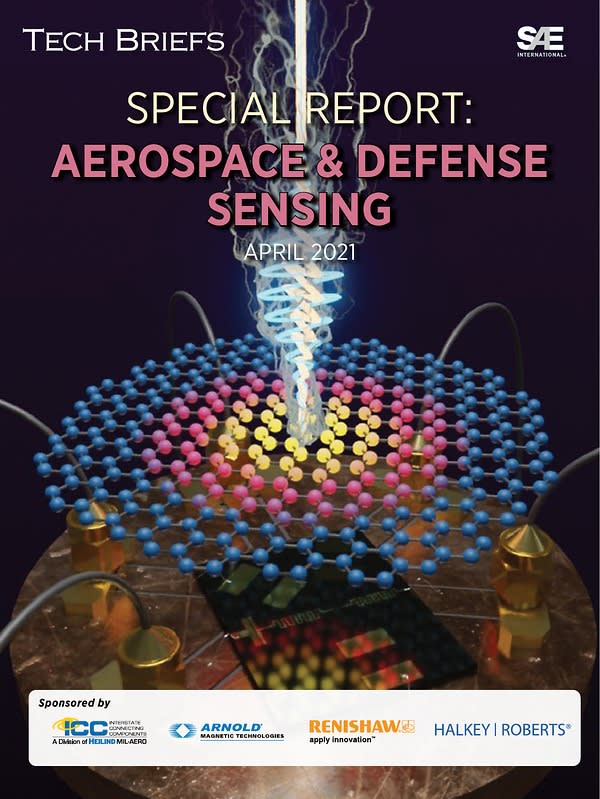
A microwave radiation sensor offers 100,000 times greater sensitivity...Nature-inspired sensors help autonomous machines to see better...New accelerometers aid the development of Electric Vertical Takeoff and Landing (eVTOL) aircraft. These are just a few of the innovations you'll read about in this special report from the editors of Aerospace & Defense Technology and Tech Briefs magazines.
Don't have an account?
Overview
The Aerospace & Defense Sensing Special Report from April 2021 presents a comprehensive overview of advancements in sensing technologies that are crucial for the aerospace and defense sectors. The report highlights various innovations and research efforts aimed at improving sensor capabilities, enhancing safety, and optimizing performance in complex environments.
One of the key technologies discussed is Armstrong's fiber optic sensing technologies (FOSS), which include a patented FBG interrogation system. This system allows for multiple engineering measurements—such as magnetic field, structural shape, buckling modes, external loads, and cryogenic liquid levels—within a compact framework. NASA is actively seeking licensees to commercialize this technology, indicating its potential for widespread application.
The report also explores nature-inspired sensors developed by researchers at Purdue University. These sensors mimic the sensory mechanisms of animals like spiders, bats, and birds, which have evolved to process essential environmental information efficiently. By leveraging biological mechanosensors, these innovations aim to enhance the navigation capabilities of drones in hazardous environments and improve safety features in vehicles, thereby reducing accidents caused by human error.
Another significant advancement is a new mathematical framework designed to assist engineers in selecting the most appropriate sensors for specific applications. This tool is particularly relevant in light of past incidents, such as the Boeing 737 Max crash, where sensor failures contributed to catastrophic outcomes. The framework emphasizes the importance of sensor selection, placement, and redundancy to enhance safety and reliability in aerospace systems.
The report also discusses high-sensitivity microwave radiation sensors, which promise better detection capabilities for applications in thermal imaging, electronic warfare, radio communications, and radar systems. These sensors are expected to play a vital role in enhancing situational awareness and operational effectiveness in defense scenarios.
Additionally, the report addresses the challenges associated with current sensor technologies, particularly their data processing speeds. It highlights the need for advancements that can keep pace with the demands of modern aerospace applications, where rapid decision-making is critical.
Overall, the Aerospace & Defense Sensing Special Report underscores the importance of innovative sensing technologies in enhancing the safety, efficiency, and effectiveness of aerospace and defense operations. By integrating advanced sensors and leveraging insights from nature, the industry can develop more robust systems capable of operating in increasingly complex and dynamic environments. The report serves as a valuable resource for professionals in the field, providing insights into the latest trends and technologies that are shaping the future of aerospace and defense sensing.










