

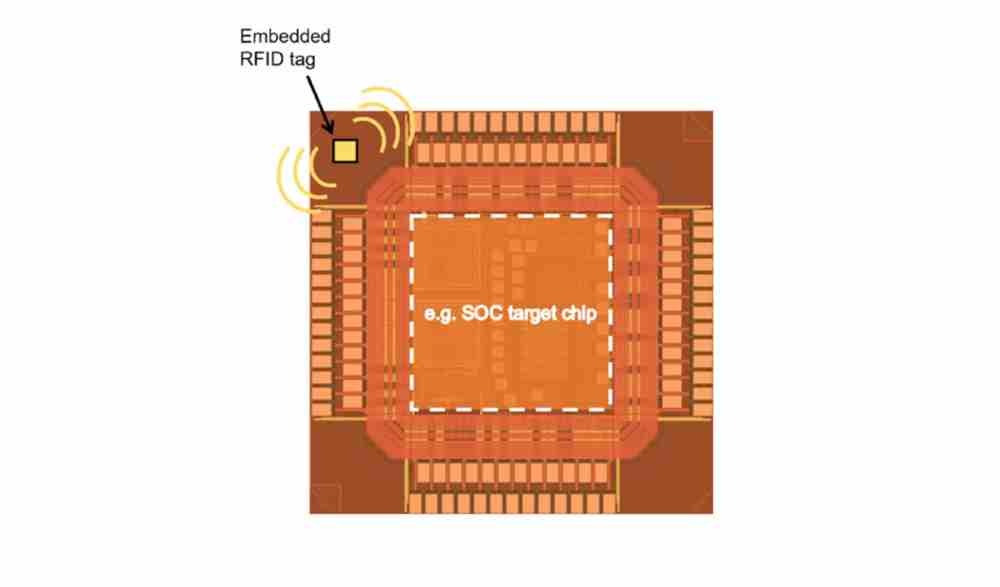
Researchers at North Carolina State University have made what is believed to be the smallest state-of-the-art RFID chip: a device measuring 125 micrometers (μm) by 245 μm. The tiny chip potentially reduces the cost of RFID tags and enables their use in supply-chain security for high-end technologies.
To manage supply chains, manufacturers have frequently considered attaching an RFID chip to microprocessors or systems on chips (SoCs). The RFID chip, however, has always had its own separate analog component, with charge pumps and capacitors.
Traditional RFID chips on the market today contain both analog and digital components. The analog front end, however, is not digital in nature, which adds cost and takes up a lot of space on the chip.
The design method from the team at NC State eliminates the majority of the analog setup, by enabling the digital piece to operate on the directly received RF signal.
The new chip from NC State uses standard building blocks of traditional digital architecture — foundry-provided standard cells — and enables them to operate directly on the RF signal. The digital structure readily ports RFID capability into a targeted component, like an integrated circuit in a supply chain.
This RFID capability is deployed in the targeted components using modular digital logic units called IP blocks.
The IP blocks are "mainly digital" in nature, and do not call for highly tuned analog layouts. The digital design is compatible with a wide range of semiconductor technologies, like those used in conventional computer chips.
"This makes it possible to incorporate RFID tags into computer chips, allowing users to track individual chips throughout their life cycle. This could help to reduce counterfeiting, and allow you to verify that a component is what it says it is," said Kirti Bhanushali , who worked on the project as a Ph.D. student at NC State and is first author of the paper.
The size of an RFID tag is largely determined by the size of its antenna, but the chip is the expensive part, says Paul Franzon, corresponding author of a paper on the work and Cirrus Logic Distinguished Professor of Electrical and Computer Engineering at NC State.
The smaller the chip, the more chips you can get from a single silicon wafer.
With cheaper RFID tags, manufacturers, distributors, or retailers can potentially use RFID tags to track lower-cost items, like the products in a grocery store, for example.
The team is now interested in working with industry partners to explore commercializing the chip in two ways, says Franzon: creating low-cost RFID at scale for use in sectors such as supermarkets; and embedding RFID tags into computer chips in order to secure high-value supply chains.
"The resulting tag can be under 1 cent in volume," Prof. Franzon told Tech Briefs via email. "That opens many applications including replacing UPC codes for groceries."
While exploring partnership opportunities with other companies, W. Shepherd Pitts, who worked on the project while a research assistant professor at NC State, emphasizes the "plug-and-play" aspect of the RFID tag. The idea is that a processor manufacturer could directly take the technology and simply add their digital peripheral to expand a chip's functionality.
"If they already have that functionality validated in their hardware description language (verilog, VHDL, etc), then it can be realized using our method using standard place and route tools," Pitts wrote via email. "The analog design component is very light and quick to deploy in new nodes as circuits like charge pumps are avoided, hence it is a 'Mostly Digital' approach utilizing vendor provided standard cells and thus scales to the most aggressive manufacturing nodes."
The paper, “A 125μm×245μm Mainly Digital UHF EPC Gen2 Compatible RFID tag in 55nm CMOS process,” was presented April 29 at the IEEE International Conference on RFID . The paper was co-authored by Wenxu Zhao, who worked on the project as a Ph.D. student at NC State; and Dr. Pitts.
What do you think? Share your questions and comments below.
Transcript
00:00:01 [ Music ]
>> [Background Music] For
more than 50 years scientists and engineers at NASA's Johnson
Space Center have pioneered breakthroughs in medicine,
computing, thermal materials and systems engineering. NASA technologies are
innovative solutions that have complex patterns. These patented for
technologies are available through a licensing agreement
that can enable entrepreneurs to create new products and
new market opportunities
00:00:28 for business. [ Music ]
>> [Background Music] So the
technology right now that seems to most enable our concept of autonomous logistics
management is radio frequency identification technology
or RFID. A lot of the inventory
that we want to try is designed behind
[inaudible] enclosure. So it might be drawers
such as this and in these drawers we
typically have fairly high
00:00:53 density of tank items and so the challenge is getting fields into all of those items to where they can rectify the energy and respond back. So we think a better approach is to increase the size of the tag antenna. That allows the [inaudible] to receive more energy to [inaudible] circuit and then respond back. So with the technology that we developed and as the tag is rotated the beam automatically steers back towards the interrogator and maintains longer range.
00:01:20 So this is what we call
our RFID dispenser. It allows us to track
inventory of fairly small items without having to put
a tag o each item. So this technology that we have
in the dispenser keeping track of the inventory can
be scaled to any level. We can track all types
of objects without having to have RFID tags on each item.
>> Extended range RFID
sensor tags are a suit of patented Johnson Space Center
technologies available for use through a license
agreement through NASA.
00:01:48 Extended range RFID benefit a wide range of inventory management applications and can be sold to a wide range of markets. To find out more about NASA developed RFID technology and other technology license opportunities visit technology.jsc.nasa.gov. [ Music ] ------------------------------b388f9d00bfa--







