The Intelligent Structural Monitoring and Response Testing (iSMaRT) Lab at the University of Pittsburgh Swanson School of Engineering has designed a new class of self-aware materials.
The self-powering metamaterial system is, in effect, its own sensor, recording and relaying important information about the pressure and stresses on its structure. The capability supports a wide array of sensing and monitoring applications, according to Amir Alavi, assistant professor of civil and environmental engineering and bioengineering, who leads the iSMaRT Lab.
The team's research was recently published in Nano Energy .
"The self-aware metamaterial systems that we’ve invented can offer these characteristics by fusing advanced metamaterial and energy harvesting technologies at multiscale, whether it’s a medical stent, shock absorber, or an airplane wing,” said Prof. Alavi .
Existing self-sensing materials are composites that rely on different forms of carbon fibers as sensing modules. The iSMaRT approach, by contrast, requires pressure.
With pressure, contact-electrification occurs between the material's conductive and dielectric layers, creating an electric charge that relays information about the material's condition. The power generated by the technology's built-in triboelectric nanogenerator mechanism eliminates the need for a separate power source — a breakthrough according to the inventors.
“We believe this invention is a game changer in metamaterial science where multifunctionality is now gaining a lot of traction,” said Kaveh Barri, lead author and doctoral student in Alavi’s lab . “While a substantial portion of the current efforts in this area has been merely going into exploring new mechanical properties, we are going a step further by introducing revolutionary self-charging and self-sensing mechanisms into the fabric of material systems.”
The researchers have created multiple prototype designs for a variety of civil, aerospace and biomedical engineering applications, from heart stents, to bridges, to even space.
"Imagine how we can even adapt this concept to build structurally-sound self-powering space habitats using only indigenous materials on Mars and beyond," said Alavi.
In a Q&A with Tech Briefs below, Prof. Alavi explains more about possible applications for the material — and just how close we are to self-aware space structures.
Tech Briefs: Which applications could be benefitted the most by a material’s “self-awareness?”
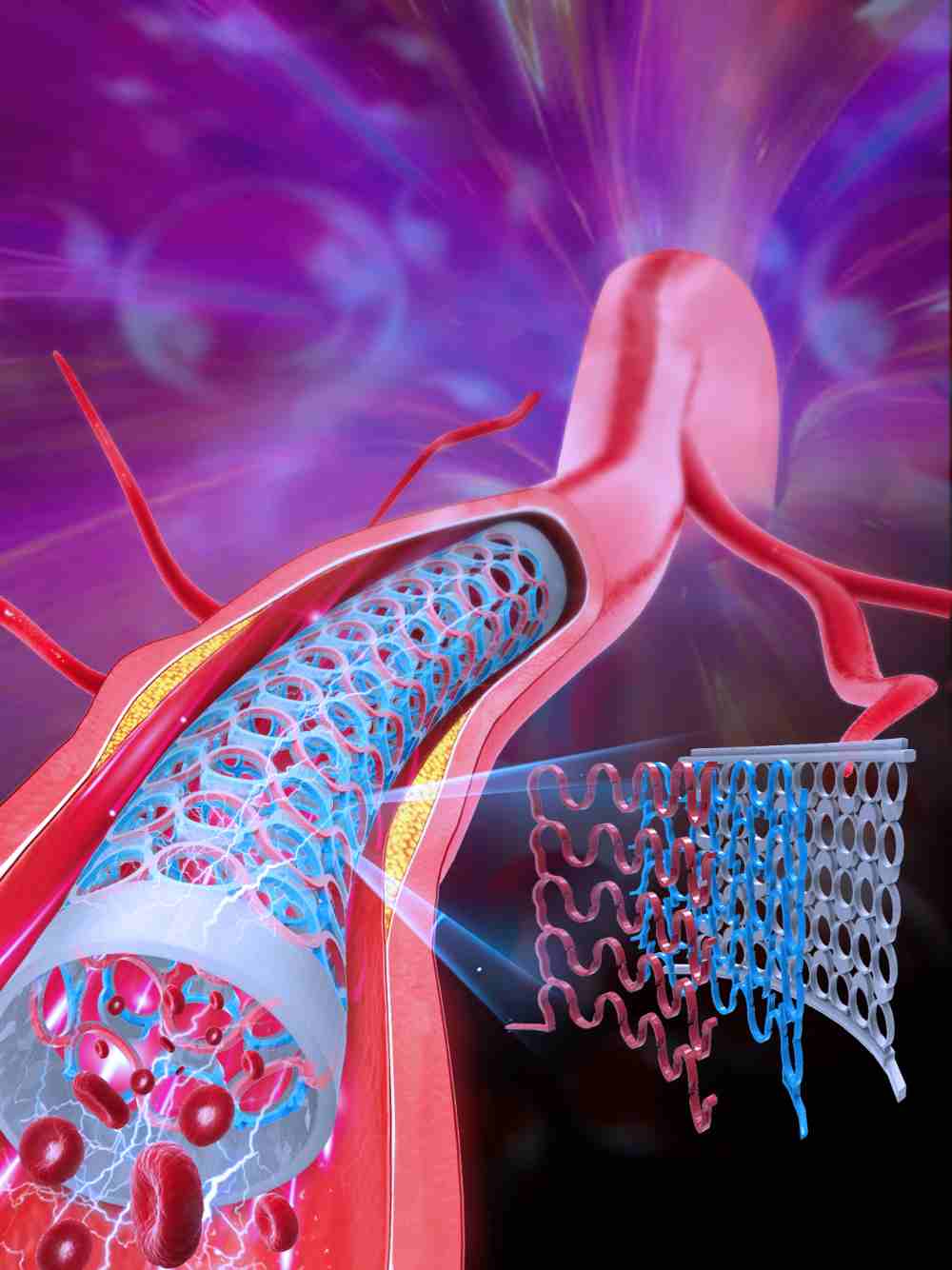
Prof. Amir Alavi: I am confident that the self-aware material technology will have a broad range of applications in the fields of aerospace, biomedical devices, civil infrastructure, and construction. We have already explored their capabilities in the aerospace and biomedical arena via prototyping self-powering and self-sensing blood vessel stents and shock absorbers.
The most immediate and beneficial application of this technology is for designing a new generation of biomedical devices. Under this concept, you can transform the medical implants into sensors and nanogenerators without having to incorporate any electronics. The beauty of the concept is that it gives people plenty of biocompatible and even bioresorbable material options to fabricate their implantable systems and simply tune the mechanical properties of the implants for a desired performance.
Tech Briefs: Do you see any other fields where this "self-aware" technology will be useful?
Prof. Amir Alavi: Obviously, the technology will have massive applications in civil infrastructure and construction because you can use it to design smart structures that are light in mass, low in cost, highly scalable, and mechanically tunable. In civil engineering, we are usually dealing with mega structures where you need tons of sensors to monitor their condition and health. These dense sensor networks are difficult to install and maintain in large-scale structures. Now assume a self-aware mega structure (like a bridge) where the structure is a sensing medium itself through a rational architectural design and choice of constituent materials. You can simply attach wires to any point on the structure to collect information about its structural condition. This would be a paradigm shift in distributed sensing technology, which is particularly important for continuous monitoring of our aging infrastructure!
Tech Briefs: Which application excites you the most?
Prof. Amir Alavi: The most exciting application of the technology is space explorations, where we must rely on indigenous materials to build space habitats! You can adapt this technology to create a first-of-its-kind, self-sustained habitat on Mars and beyond. I envision this as a scalable metamaterial structure that is strong enough to withstand a harsh environment and it is built merely using materials in Martian soil, which are plentiful based on the measurements taken by our space probes! The self-aware space habitat would be capable of harvesting the required energy using any source of vibration there — say, wind. At the same time, these structures will collect information about the operating environment and self-monitor their condition. This unique self-sensing and self-monitoring capability is why we strongly believe that the self-aware materials will build the foundation for future living structures. We have already started working on various aspects of our technology for space exploration applications!
Tech Briefs: How much power is generated, and how is that power generated? (Is it enough power to support applications?)
Prof. Amir Alavi: Our self-aware material systems naturally inherit the outstanding features of the triboelectric nanogenerators. Triboelectric nanogenerators have shown a significantly high power density (>300 W/m2). The same would be true for self-aware materials. For now, we are focused on low-power energy harvesting for embeddable systems, but such material systems can harness hundreds of watts of power at large scales.
Tech Briefs: What does the metamaterial look like? Can you help us visualize it, and its components? Is it strong? How does it feel?
Prof. Amir Alavi: A self-aware metamaterial is an artificial composite material composed of different layers of conductive and dielectric layers that are organized in a periodic manner. The material is designed such that, under pressure, contact-electrification occurs between its conductive and dielectric layers, creating an electric charge that relays information about the condition of the material.
The conductive and dielectric layers in this composite system can be chosen from a wide range of the organic and inorganic materials from the triboelectric series.
The material design involves snapping segments that offer a self-recovering behavior under loading. This self-recovering mechanism helps to create contact-separation cycles and, accordingly, contact-electrification. This will form a static electric field and a potential difference between the conductive layers. The electrical output signals generated due to contact-electrification can be used for active sensing of the external mechanical excitation applied to the structure. On the other hand, the generated electrical energy can be harvested and stored to empower sensors and electronics.
Tech Briefs: Do the characteristics of the material limit the possible applications?
Prof. Amir Alavi: There is a wide range of materials that can be used for fabricating the composite layers. This concept is the fusion of metamaterial and energy harvesting concepts. The beauty of metamaterials is that they are artificial structures based on rational geometric design and not the material chemical composition. So you can tune the design to achieve almost any desired mechanical performance. The only challenge for us is that we have to optimize various design and material-related parameters in a composite self-aware material matrix. We plan to take care of this using advanced computational models.
Tech Briefs: Can you bring me into an application? How would, say, a "self-aware" stent work?
Prof. Amir Alavi: Millions of cardiovascular stents are implanted every year. The presence of a stent within an artery can lead to excess growth of arterial tissue that may cause renarrowing within the stent. This complication, known as in-stent restenosis, can reach as high as 50% among stented patients. There is currently a serious need for a rapid, noninvasive, and easily accessible method to detect in-stent restenosis. A self-sensing, biocompatible, and non-toxic self-aware stent can be potentially deployed for continuous monitoring of local hemodynamic changes upon tissue overgrowth and in-stent restenosis. Note that any renarrowing due to in-stent restenosis will change the signal generated by the self-aware stent.
Also, check out this smart interbody fusion cage for spinal fusion monitoring:

Interbody fusion cages are widely used in orthopedics. Our self-aware fusion cage can give detailed information about the condition of spine during the healing process. Normally, people do it using imaging methods, like X-rays or CT scans, that are not only inaccurate but also costly and expose the patient to significant radiation.
However, these are all proof-of-concept prototypes and we are now seeking funding for clinical translation.
Tech Briefs: Aside from medical applications, how would this metamaterial work for something like a bridge?
Prof. Amir Alavi: You can detect any damages by tracking the changes of the voltage signal patterns. For examples, cracks change the strain patterns and stress concentration that can be picked up by a self-aware bridge deck. Any failures could potentially shift the signal from a baseline.
Tech Briefs: What are you working on next?
Prof. Amir Alavi: You have probably noticed the huge application of this technology. The entire concept is still in its infancy, and there is a lot to explore. We first need to secure more funding to study various mechanical and electrical aspects of these material systems. The long-term performance of these devices needs to be studied as well. While we have a lot to do in biomedical and civil engineering domains, we are also expanding our research to the space exploration applications of this technology.
What do you think? Share your questions and comments below.
Transcript
00:00:04 So we're all familiar with the tools that we use to control light waves. A great example of one is a magnifying glass - a lens like this. We also see those lenses in eyeglasses like I'm wearing right here. And how those lenses work - I'll sketch a shape of a lens here - many of us may remember from high school physics how this lens works. When we think in terms of ray paths the direction the light travels, and it's bent by the shape of the glass so that on the other side, the light converges and creates a focus, or an image, at this spot. From the perspective of how waves travel, there's an alternate view of how lenses work. And what I'm sketching here are the individual peaks and valleys. The wave fronts of the light waves that are traveling in this
00:00:57 direction and hitting the lens, and what happens is in the middle of the lens the light is slowed down, while on the edges of the lens where the lens is thinner, the light is slowed down less. And so what happens is the shape of the wavefront as it emerges from the lens is now curved - slowed down here or delayed, and least delayed here, and it creates a converging wavefront that also creates a focus at this spot here. It's kind of the opposite of what happens when you throw a rock in a pond, creating an expanding wave. This is a converging wave to this image right here. Conventional lenses work because of their specific shape. Remember that they are curved in order that the incident light waves are slowed down in the
00:01:49 middle where the lens is thickest and slowed down the least at the edges where the lens is thinnest. And that's what creates this converging wavefront and an image. And the reason lenses are expensive and complicated is because we're stuck with the material properties of glass, and the only way we can create this spatially varying light propagation is with the shape of the lens. And that lens shape has to be controlled very very precisely in optical devices. But we could ask ourselves, what if we were no longer stuck with material properties like glass that are fixed? If we had more flexibility in the material properties, then we could imagine creating a lens that has a much simpler shape, and we simply need different material
00:02:42 properties in the middle of the lens in order to slow down the light waves there and allow the light waves to travel faster at the edges. And if we had the ability to do that, we could create a lens that does exactly the same thing - creates a converging wavefront and an image over here and yet has a much simpler shape and actually could be much easier to manufacture. And the basic idea of how can we control those light wave controlling material properties, that's the basic idea of metamaterials. So what are the essential features of a wave? How do we describe it? Well there are a couple of fundamental properties of waves. One is the amplitude of the wave - how high it is from peak to valley, and that's linked to how bright light is in a light wave or how loud sound is in a
00:03:46 sound wave. The more important feature for metamaterials is the wavelength, which is the distance between one peak and the next peak. And that's tied to the color of the light or the pitch of the sound wave. So how do we design metamaterials? We start by looking at the wavelength we hope to control, and if the wavelength is this size sketched here, then we need metamaterial structure that is significantly smaller, or about the size I'm showing with my fingers. So we then need to create an array or grid of metamaterial structures whose size is that size or smaller. Now if we were creating something with conventional materials like glass, we would be stuck with the same material properties in each one of these squares. With metamaterials, we can put different
00:04:41 material properties in each one of those squares. That enables us to do things like I sketched before - creating a flat lens where the wave travels slowly through the middle of the structure and more quickly through the edges. But what's really interesting with metamaterials is we can put anything at all arbitrarily inside each one of these material building blocks. And when we do something like that, we then have the ability to create wave control that can take an input wave and not just create a converging wave on the other side, but a completely arbitrarily complex wavefront. And that enables us to do much more powerful wave processing with metamaterials.