ADAS/Connected Car - June 2021
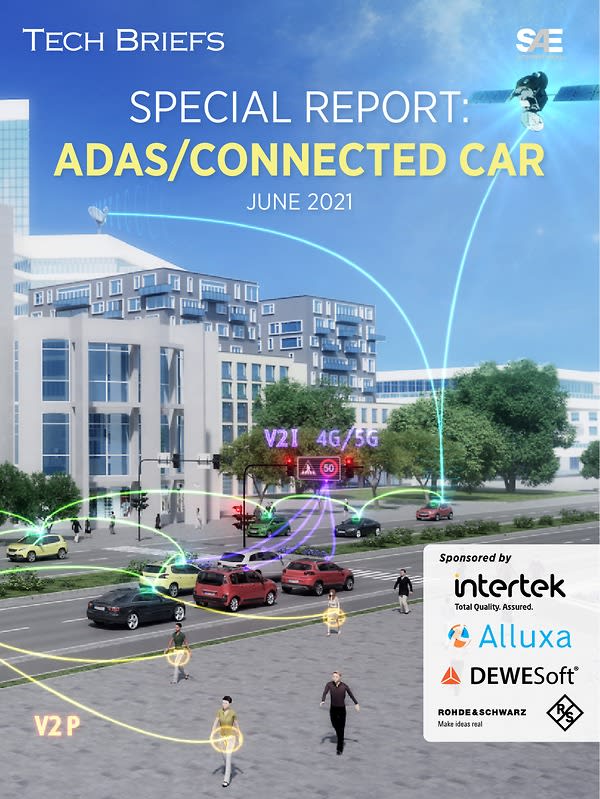
Today's Advanced Driver Assistance Systems (ADAS) and connected cars are paving the way for tomorrow's automated vehicles. To help you keep pace with the latest technology developments, we present this compendium of recent articles from the editors of Automotive Engineering, Autonomous Vehicle Engineering, and Truck & Off-Highway Engineering.
Don't have an account?
Overview
The June 2021 Special Report on ADAS (Advanced Driver Assistance Systems) and connected cars provides a comprehensive overview of the evolving landscape of automotive technology, particularly focusing on the transition from Dedicated Short Range Communications (DSRC) to cellular vehicle-to-everything (C V2X) communications. This shift is largely influenced by a significant ruling from the Federal Communications Commission (FCC) in November 2020, which reallocated a portion of the 5.9GHz Safety Spectrum, traditionally reserved for transportation communications, to unlicensed uses like WiFi. This decision effectively sidelined DSRC, which had seen limited adoption among automakers, with only a small number of vehicles equipped with this technology.
The report emphasizes the implications of the FCC's ruling, noting that it has created a new standard for automotive safety communications, with C V2X emerging as the primary technology for future developments. Experts express concerns about the potential interference from other radio signals now permitted near the Safety Spectrum, which could impact the performance and reliability of C V2X communications. Despite these concerns, the FCC and various industry stakeholders argue that the ruling will enhance automotive safety and promote innovation in the connected vehicle ecosystem.
In addition to the regulatory landscape, the report discusses best practices for testing ADAS and connected vehicle technologies. It highlights the importance of flexibility, cost-effectiveness, and speed in testing approaches, advocating for partnerships with experienced companies to optimize resource utilization. The report suggests that automakers should focus on improving their products and accelerating their market entry rather than attempting to develop all technologies in-house, which can be inefficient.
The report also underscores the significance of data diversity in training datasets for ADAS systems. It stresses the need for clear metrics to evaluate data quality and the importance of tools that allow for effective exploration and analysis of collected data. This is crucial for ensuring that the systems developed are robust and capable of handling real-world scenarios.
Furthermore, the report touches on the future of automotive technology, emphasizing the need for a future-proof toolchain that adheres to industry standards such as Open Drive, Open Scenario, and Open Label. This approach ensures interoperability with other systems and facilitates collaboration with new partners.
Overall, the Special Report provides valuable insights into the current state and future direction of ADAS and connected car technologies. It highlights the critical role of regulatory decisions, the importance of effective testing and data management practices, and the need for collaboration within the industry to drive innovation and enhance vehicle safety. As the automotive sector continues to evolve, the transition to C V2X communications represents a significant step towards a more connected and safer transportation environment.