

Space Technology - October 2021
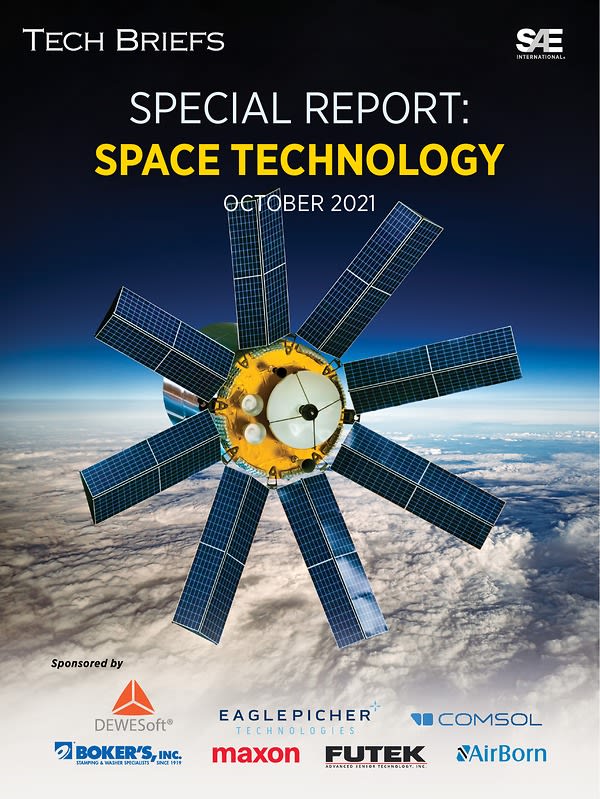
A new era of space exploration is set to begin with Artemis 1, the first in a series of increasingly complex NASA missions that will take humans back to the moon and then on to Mars. Read all about it in this report highlighting advances in space science and technology, from the editors of Tech Briefs and Aerospace & Defense Technology magazines.
Don't have an account?
Overview
The Space Technology Special Report from October 2021 presents a comprehensive overview of advancements and innovations in space technology, focusing on the Artemis program and its implications for future lunar exploration and beyond.
Artemis I Mission: The report highlights NASA's Artemis I mission, which marks a significant step in returning humans to the Moon. This mission aims to land the first woman and the first person of color on the lunar surface, showcasing a commitment to diversity and inclusion in space exploration. The Artemis program is designed to establish a sustainable human presence on the Moon by the end of the decade, serving as a stepping stone for future missions to Mars.
Technological Innovations: The report discusses various technological advancements critical to space exploration. It covers topics such as plasma nitride surface hardening of titanium, which enhances the durability of materials used in aerospace applications. Additionally, it evaluates low- and ultra-low-outgassing silicones, which are essential for maintaining the integrity of spacecraft in the harsh space environment.
Space Weather Monitoring: A significant focus of the report is on the need for improved space weather monitoring. The U.S. national security is increasingly reliant on space systems, yet the ability to observe and predict space weather remains limited. The report emphasizes the importance of incorporating low-impact, inexpensive targeted space environment sensors on national security spacecraft. These sensors can provide real-time data on the space environment, helping to mitigate risks associated with energetic particles and plasma that can affect spacecraft operations.
Spacecraft Design and Resilience: The report outlines the challenges faced in integrating these sensors into existing spacecraft designs. It suggests a low- to no-cost schedule impact integration plan to facilitate the immediate benefits of enhanced space weather data. By improving the understanding of space radiation and plasma environments, spacecraft designers can create more resilient systems capable of withstanding adverse conditions, ultimately enhancing operational availability and reducing costs.
Future of Space Exploration: The report concludes with a vision for the future of space exploration, emphasizing the need for a comprehensive approach to understanding the space environment. By integrating targeted sensors, the U.S. can improve its space weather forecasting capabilities and differentiate between natural space weather effects and potential adversarial actions. This proactive approach will not only enhance the safety and effectiveness of national security spacecraft but also contribute to the broader goals of space exploration.
In summary, the Space Technology Special Report underscores the critical role of technological innovation in advancing space exploration. With the Artemis program as a focal point, the report highlights the importance of collaboration, diversity, and resilience in overcoming the challenges of space travel. As humanity prepares to return to the Moon and venture to Mars, these advancements will be pivotal in ensuring the success and safety of future missions.











