

Unmanned Systems - March 2022
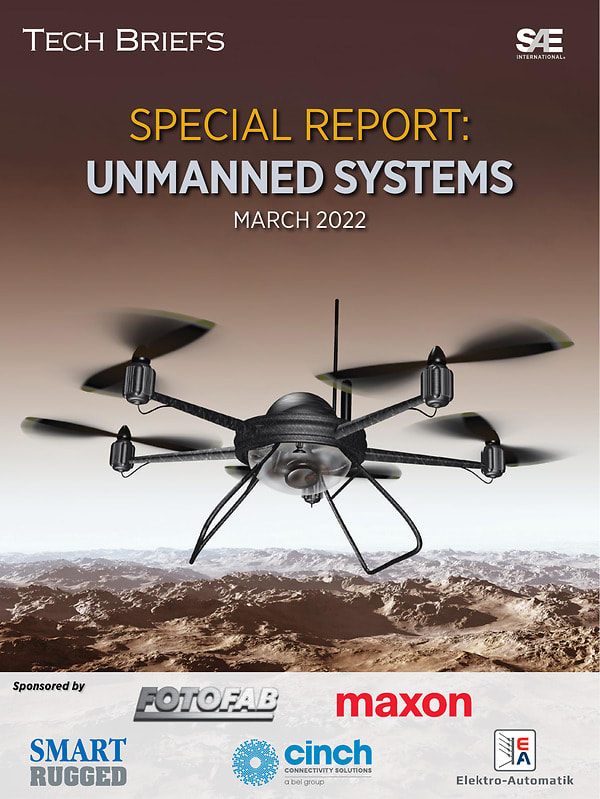
Powering better battlefield drones...autonomous quadcopters that fly aerobatic maneuvers...a breakthrough in compact UAV satellite communications technology. Read about these and other advances in air, ground, and underwater unmanned vehicles in this report from the editors of Aerospace & Defense Technology and Tech Briefs.
Don't have an account?
Overview
The Unmanned Systems Special Report from March 2022 highlights the rapid advancements and increasing applications of unmanned aerial vehicles (UAVs), commonly known as drones, across various mission-critical defense operations. The report emphasizes the growing reliance on drones for tasks such as battlefield information gathering, surveillance, reconnaissance, targeting, package delivery, and even attack missions. Drones offer significant advantages, including remote operation capabilities, minimal supervision requirements, and access to challenging environments that may pose risks to human personnel.
AeroVironment, a key player in the UAV market, is noted for its extensive portfolio of tactical unmanned aircraft systems (UAS) that dominate the U.S. Department of Defense inventory and are gaining traction among international allies. Their systems, such as the JUMP® 20, T-20™, and Puma™ series, are designed for multi-mission capabilities, providing tactical units with enhanced situational awareness and operational flexibility. These systems are characterized by their small footprint and runway-independent operation, making them suitable for a variety of missions.
The report also discusses the technological advancements necessary for modern UAVs to meet the demands of contemporary warfare. This includes the need for improved speed, agility, reliability, and robustness. Drones must integrate advanced vision platforms, strong propulsion systems, and efficient artificial intelligence (AI) to enable automated operations, thereby maximizing precision and productivity in the field.
Curtiss-Wright Defense Solutions is highlighted for its contributions to tactical data link (TDL) software and hardware, particularly in supporting the integration of unmanned systems with naval operations. A notable demonstration involved the successful exchange of Link 16 TDL data between unmanned aircraft and U.S. Navy surface ships, showcasing the potential for enhanced communication and coordination in maritime operations.
The report also touches on the challenges faced in drone design and operation, including the need for effective thermal management in avionics cooling and the development of object detection systems for autonomous underwater vehicles. Innovations in navigation algorithms are enabling drones to perform complex maneuvers, further expanding their operational capabilities.
In summary, the Unmanned Systems Special Report underscores the transformative role of UAVs in modern military operations, highlighting the need for continuous technological advancements to enhance their effectiveness. As armed forces increasingly adopt these systems, the focus will remain on improving their performance, reliability, and integration into broader military strategies. The report serves as a comprehensive overview of the current state and future potential of unmanned systems in defense applications.







