

Aerospace & Defense Sensing - April 2022
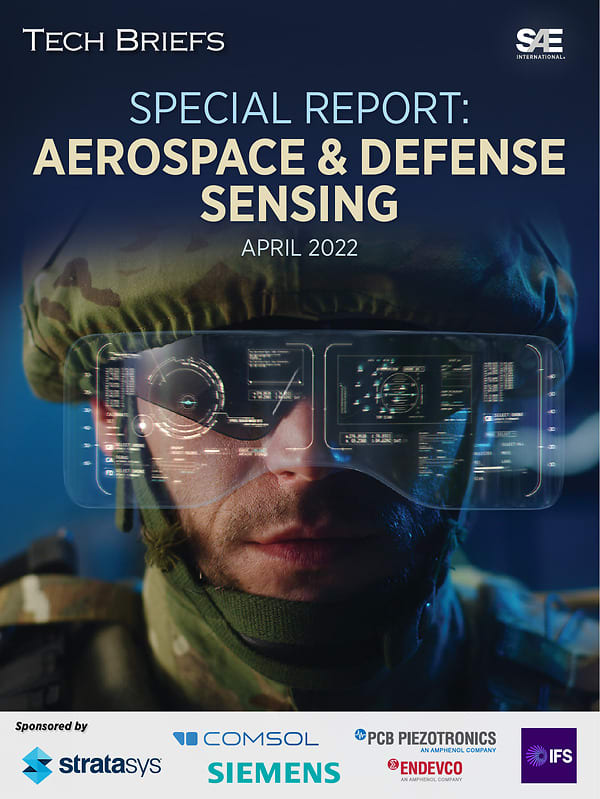
Designing the connected battlespace of the future...mobile robots that detect and alert soldiers to dangers in real time...'electronic skin' sensors capable of mimicking the dynamic process of human motion. These are just a few of the innovations you'll read about in this special report from the editors of Aerospace & Defense Technology and Tech Briefs magazines.
Don't have an account?
Overview
The Aerospace & Defense Sensing Special Report from April 2022 provides a comprehensive overview of the advancements and challenges in the field of military technology, particularly focusing on the integration of sensors and data systems in modern warfare. The report emphasizes the importance of real-time data access for soldiers operating in complex environments, highlighting how innovative technologies are transforming the battlefield.
One of the key features discussed is the development of wearable sensors, such as programmable fibers that can monitor physiological data. These fibers, embedded in clothing, can track body temperature and physical activity with high accuracy, alerting soldiers to health changes like respiratory issues or irregular heartbeats. This technology not only enhances individual soldier health monitoring but also has the potential to detect exposure to environmental toxins, providing critical data for health and safety.
The report also addresses the Connected Battlespace, which aims to provide warfighters with a variety of wireless sensors that facilitate instant access to information. This connectivity is crucial for overcoming legacy interoperability issues that have historically delayed or denied access to vital data. The integration of these sensors is expected to enhance decision-making capabilities in real-time, allowing for more effective responses to threats.
Another significant topic covered is the bandwidth challenges faced by military communications. The report cites concerns from industry experts about the congestion of communication frequencies due to the proliferation of electronic warfare technologies, such as jammers. These devices, while effective in preventing enemy actions, can also disrupt friendly communications, necessitating a coordinated approach to frequency management across different military branches and industries.
The report highlights the need for advancements in signal processing technology to address the growing limitations in chip-to-chip communications. Emerging technologies, such as carbon nanotubes, are being explored for their potential to improve high-speed electron transport, which is essential for maintaining system-level performance in increasingly compact electronic designs.
Additionally, the report discusses the advancements in 3D motion capture technology and its applications in recognizing and predicting human actions in real environments. The use of 3D depth cameras and structured light sensors is paving the way for breakthroughs in real-time data capture, which can significantly enhance situational awareness on the battlefield.
Overall, the report underscores the critical role of innovative sensing technologies in modern military operations. By providing soldiers with real-time data and enhancing communication capabilities, these advancements are set to transform the way military forces operate, making them more agile and responsive to dynamic threats. The ongoing development of these technologies will be essential for maintaining a strategic advantage in future conflicts, as the military continues to adapt to the complexities of modern warfare.










