

Advanced Materials & Coatings - May 2022
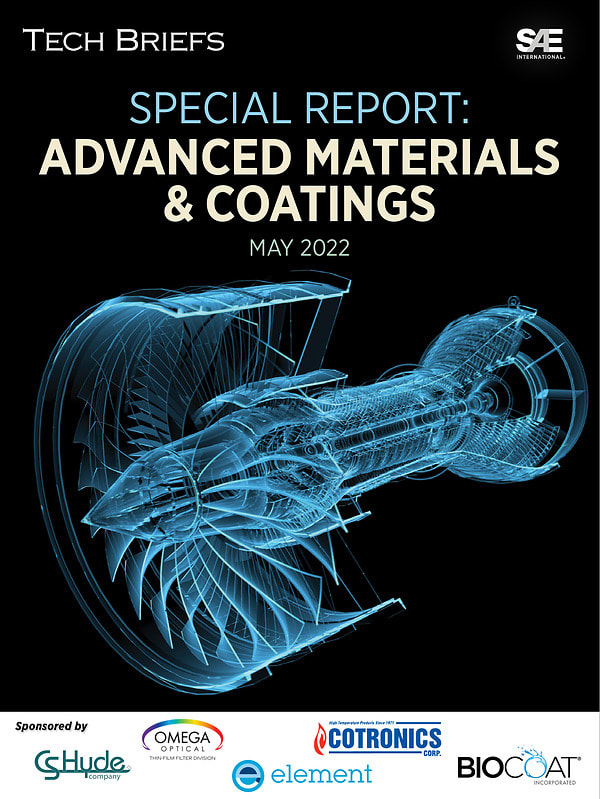
Breakthroughs in plastics, composites, metals, and other materials technologies are enabling exciting new applications in industries ranging from aerospace to automotive to medical. Read more in this compendium of recent articles from the editors of Tech Briefs, Aerospace & Defense Technology, and Medical Design Briefs magazines.
Don't have an account?
Overview
The May 2022 Special Report on Advanced Materials & Coatings presents a comprehensive overview of recent advancements in materials science, focusing on innovative solutions that enhance performance across various applications, including electronics, aerospace, and consumer products.
One of the key highlights is the development of carbon-fiber-based composite materials that combine high strength and lightweight properties with the ability to be repeatedly healed using heat. This breakthrough addresses the challenges of repairing and recycling traditional carbon fiber materials, which are often difficult to restore once damaged. The new materials can reverse fatigue damage and can be recycled at the end of their life cycle, significantly extending their usability and sustainability.
The report also discusses advancements in the field of conjugated polymers, which are essential for creating soft optoelectronics, such as wearable devices. Researchers have developed a new approach to study the mechanical and kinetic properties of these polymers during the polymerization process, allowing for a better understanding of their behavior in bulk. This knowledge is crucial for optimizing their performance in electronic applications.
Another significant focus is on light-emitting diodes (LEDs), which are widely used in smartphones, laptops, and lighting applications. The report details a novel method that achieves near 100% light emission efficiency at all brightness levels by manipulating the electronic structure of a thin semiconductor film through mechanical strain. This approach reduces energy loss as heat, enhancing the overall efficiency of LEDs and paving the way for brighter and more efficient lighting solutions.
The report emphasizes the importance of precise temperature control and uniform heat distribution in the manufacturing processes of advanced materials. Innovations in pulse plasma technology have improved the control of DC pulsing signals and chamber design, leading to better thermal management during material processing.
Additionally, the report highlights the role of analytical modeling in understanding the behavior of excitons—energetic particles created in semiconductors. By applying mechanical strain, researchers have been able to reduce the likelihood of exciton collisions that lead to energy loss as heat, thereby improving the efficiency of light emission in semiconductor materials.
Overall, the Special Report on Advanced Materials & Coatings showcases a range of cutting-edge research and development efforts aimed at enhancing material properties and performance. The advancements discussed not only promise to improve existing technologies but also open new avenues for innovation in various industries, from aerospace to consumer electronics. The findings underscore the critical role of advanced materials in driving technological progress and addressing contemporary challenges in sustainability and efficiency.







