

RF & Microwave Electronics - May 2022
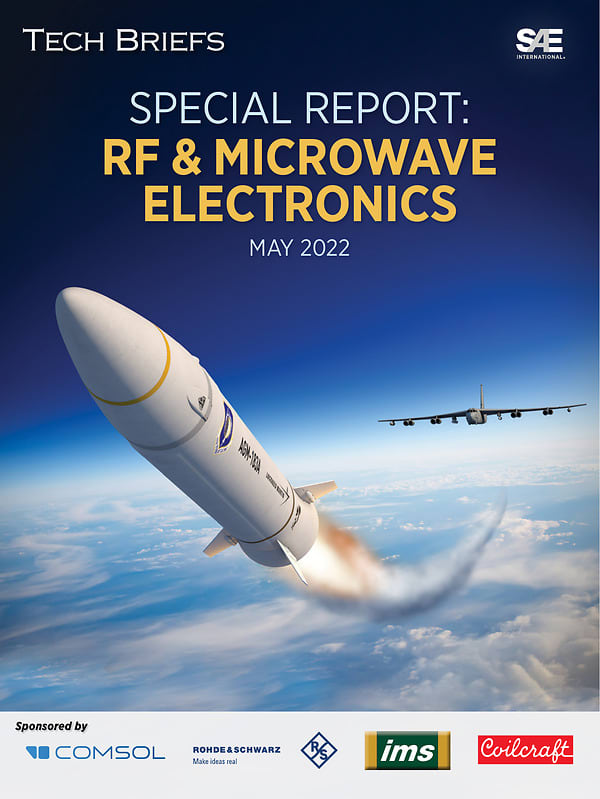
In this compendium of recent articles from the editors of Aerospace & Defense Technology and Tech Briefs, read about how advances in RF electronics are enabling new applications in avionics systems, weather and military satellites, drone detection, and much more.
Don't have an account?
Overview
The RF & Microwave Electronics Special Report from May 2022 presents a comprehensive overview of advancements in radio frequency (RF) technology and its applications across various fields, including avionics, storm tracking, and electronic warfare. The report emphasizes the critical role of RF and microwave technologies in enhancing communication systems, improving weather forecasting, and ensuring national security.
One of the key highlights is the development of microwave radiometers, specifically the TROPICS (Time-Resolved Observations of Precipitation structure and storm Intensity with a Constellation of Smallsats) instrument. This innovative technology utilizes six CubeSat nanosatellites to measure thermal radiation emitted by atmospheric gases like oxygen and water vapor. By operating in 12 microwave channels between 90 and 205 gigahertz, TROPICS captures signals from different altitudes in the troposphere, where most weather phenomena occur. The report notes that the miniaturization of microwave radiometers has been a significant achievement over the past decade, allowing for improved sensitivity, resolution, and reliability in weather observations. This advancement is expected to enhance storm tracking capabilities, leading to better forecasts and timely warnings for affected populations.
The report also addresses the importance of monitoring RF signals for potential threats. It discusses how advances in communication technologies can improve safety but also pose risks, such as health concerns from excessive RF exposure and vulnerabilities to critical systems from events like electromagnetic pulses (EMPs). An EMP could disrupt electronics and halt societal functions, highlighting the need for robust communication systems that can withstand such threats.
In addition to storm tracking and threat monitoring, the report covers the integration of RF technology in avionics systems. It notes that temperature extremes in avionics cable assemblies can be significant due to rapid altitude changes, necessitating reliable RF solutions to ensure performance and safety in aviation.
The report features various applications of RF technology, including the use of molded RF materials for hypersonic sensors and seekers, which optimize performance while reducing costs and manufacturing complexity. It also discusses the role of cognitive electronic warfare systems, which leverage advanced RF technologies to enhance military capabilities and situational awareness.
Overall, the RF & Microwave Electronics Special Report provides valuable insights into the current state of RF technology, its applications, and the ongoing innovations that are shaping the future of communication, weather forecasting, and defense systems. The report underscores the importance of continued research and development in this field to address emerging challenges and improve the reliability and effectiveness of RF systems across various sectors.







