Aerospace Manufacturing - May 2022
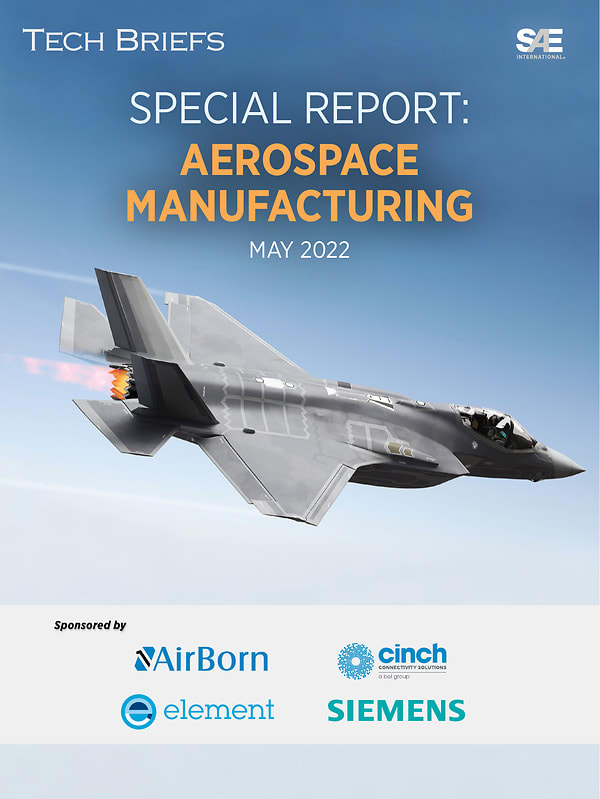
Demanding applications in the aerospace industry require products and systems that are manufactured using advanced technologies – in additive manufacturing, machining, metrology, and more. To help you keep pace with the latest developments, we present this compendium of articles from the editors of Tech Briefs and Aerospace & Defense Technology.
Don't have an account?
Overview
The May 2022 Special Report on Aerospace Manufacturing highlights significant advancements and innovations within the industry, focusing on various manufacturing techniques and technologies that enhance efficiency and performance.
One of the key features discussed is Directed Energy Deposition (DED), a process that offers advantages for efficient additive manufacturing. DED allows for the precise application of materials, enabling the creation of complex geometries and the repair of existing components. This technique is particularly beneficial in aerospace applications where weight reduction and material efficiency are critical.
The report also emphasizes the importance of advancing metrology at high speeds, which is essential for ensuring the accuracy and reliability of manufactured components. As aerospace manufacturing becomes increasingly automated, the need for rapid and precise measurement techniques grows, allowing manufacturers to maintain quality control while optimizing production times.
Another significant topic covered is the use of low distortion titanium in Laser Powder Bed Fusion systems. This material is crucial for aerospace applications due to its strength-to-weight ratio and resistance to corrosion. The report discusses how advancements in processing techniques can minimize distortion during manufacturing, leading to better performance and reliability of aerospace components.
Additionally, the report explores the fabrication of superconducting circuitry on both sides of an ultrathin silicon layer. This innovative methodology addresses the need for efficient, low-crosstalk circuitry, which is vital for modern aerospace applications that rely on advanced sensor technologies. The use of a minimalistic silicon wafer reduces space and increases efficiency, showcasing the potential for future developments in electronic components for aerospace systems.
The report also touches on the creation of a concrete-like material from space dust and astronaut blood, highlighting the potential for in-situ resource utilization in space missions. This innovative approach could significantly reduce the need for transporting materials from Earth, making long-duration space missions more feasible.
Furthermore, the report discusses abnormal grain growth suppression in aluminum alloys, which is crucial for maintaining the mechanical properties of materials used in aerospace applications. By controlling grain growth during processing, manufacturers can enhance the performance and durability of aluminum components.
The manufacturing techniques of fiber-metal laminates and cladding for coolant channel closeout are also examined. These methods contribute to the development of lightweight, strong materials that can withstand the demanding conditions of aerospace environments.
Lastly, the report features insights into the challenges faced by Lockheed Martin on the factory floor, particularly regarding the integration of robots and drones for inspections. The complexities of the assembly environment for the F-35 Lightning II fighter jets present unique obstacles that require innovative solutions to ensure efficiency and safety.
In summary, the May 2022 Special Report on Aerospace Manufacturing provides a comprehensive overview of the latest trends and technologies shaping the industry. From advanced additive manufacturing techniques to innovative material applications, the report underscores the ongoing evolution of aerospace manufacturing and its critical role in the future of aviation and space exploration.