

RF & Microwave Electronics - October 2022
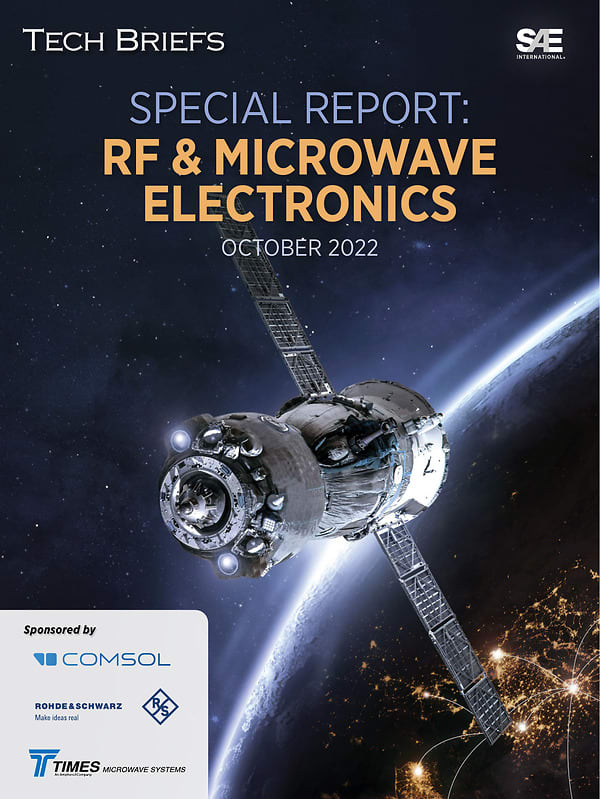
From battlespace communications to deep space missions, RF electronics are at the heart of new advances in a variety of fields. Read about the latest innovations in this compendium of articles from the editors of Aerospace & Defense Technology and Tech Briefs magazines.
Don't have an account?
Overview
The RF & Microwave Electronics Special Report from October 2022 provides a comprehensive overview of the current landscape and future directions in wireless communications, particularly focusing on the transition from 4G to 5G technology and the evolving role of satellite communications.
The report highlights the significant rebound in demand for satellite telecommunications services following the impacts of COVID-19, indicating a return to historical growth trajectories. This resurgence necessitates improvements in the performance and cost-effectiveness of telecommunications satellites, as providers aim to enhance service delivery and expand coverage.
A key theme throughout the report is the acceleration of wireless innovation, which is crucial for enabling faster, more responsive, and reliable connections globally. The wireless communications industry is on the brink of significant technological changes across various systems. As cellular communication transitions to 5G, it aims to achieve extreme data throughputs, which are essential for meeting the increasing demands of users and applications.
The report also discusses the development of non-terrestrial networks, where satellite communications providers are constructing networks in space to facilitate high-speed communications from virtually anywhere on the planet. This is particularly important as the need for robust and reliable connectivity continues to grow, driven by advancements in technology and the increasing reliance on digital communication.
In addition to the advancements in satellite and cellular technologies, the report addresses the challenges faced by 5G in military applications. It outlines three primary challenges that must be overcome for 5G to succeed in military contexts, emphasizing the need for tailored solutions that meet the unique requirements of defense operations.
The report features various articles that delve into specific topics, such as the importance of RF filters, the potential of additive manufacturing in enhancing RF passive hardware, and the role of hybrid circulators in millimeter-wave systems. These articles provide insights into the technical aspects of RF design and the innovations that are pushing the boundaries of what is possible in wireless communications.
Moreover, the report emphasizes the importance of multiphysics simulation in RF analysis, which is becoming increasingly vital for optimizing designs and ensuring performance in complex environments. This approach allows engineers to better understand the interactions between different physical phenomena, leading to more effective and efficient designs.
Overall, the RF & Microwave Electronics Special Report serves as a valuable resource for professionals in the wireless communications field, offering insights into current trends, challenges, and innovations. It underscores the critical role of both terrestrial and non-terrestrial networks in shaping the future of connectivity and highlights the ongoing efforts to enhance the performance and reliability of communication systems in an ever-evolving technological landscape.










