Space Technology - January 2023
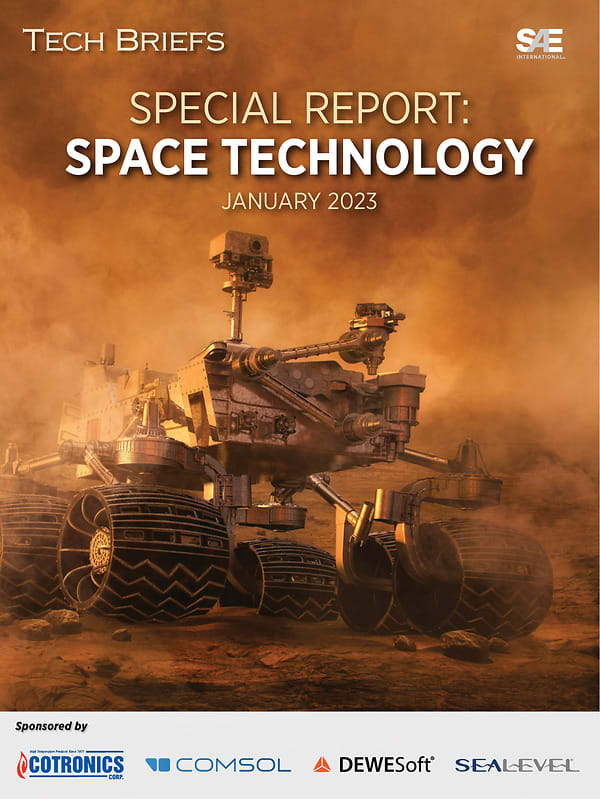
Read about robot construction workers on the moon, the first commercial space station, what's next for the James Webb Space Telescope, and much more in this compendium of recent articles from the editors of Tech Briefs and Aerospace & Defense Technology magazines.
Don't have an account?
Overview
The January 2023 Special Report on Space Technology highlights several advancements and projects in the realm of space exploration and technology, focusing on the Artemis missions, modular space stations, and innovative robotic systems.
One of the key features discussed is the Lunar Surface Manipulation System (LSMS), which is being developed to support upcoming Artemis missions. The LSMS is designed to operate on the Moon, Mars, or other planetary bodies, with a reach of about 25 feet and the capability to lift payloads of around one metric ton (approximately 2,200 pounds). This system will be essential for tasks such as offloading science instruments, technology demonstrations, and rovers. A smaller version, the mini-LSMS, is also in development, featuring a six-foot reach to assist smaller robotic landing missions that will precede human exploration.
The report also covers the development of advanced robotic systems known as Assemblers. These systems are designed for high-precision assembly tasks in space, utilizing a novel control system that allows for dynamic resilience to failures. The Assemblers can adapt to the loss of individual components, redistributing tasks among remaining units to maintain operational efficiency. This technology leverages advancements in lightweight materials, machine learning, and modern control theory, enabling the execution of complex structural assembly tasks with high accuracy.
In addition to robotic systems, the report discusses the future of commercial space stations. Northrop Grumman's Starlab is highlighted as a modular space station concept that will support continuous operations for up to four astronauts, with the potential for future expansion. Starlab is designed to be a versatile platform for scientific research, manufacturing, and commercial activities in low Earth orbit. It incorporates technology from existing spacecraft, minimizing initial costs while allowing for future upgrades based on market needs.
Blue Origin's Orbital Reef is another commercial space station initiative, developed in partnership with Sierra Space and supported by various industry players. This station aims to function as a mixed-use business park in orbit, facilitating new markets in space and supporting a range of activities from tourism to scientific research.
The report also touches on the importance of reliable power systems for long-term lunar operations, advancements in metal 3D printing for manufacturing in space, and the development of spacecraft designed to remove orbital debris. These innovations are crucial for ensuring sustainable operations in space and enhancing the reliability of scientific exploration.
Overall, the Special Report emphasizes the collaborative efforts of various organizations and the integration of cutting-edge technologies to advance space exploration. The developments in robotic systems, modular space stations, and sustainable practices are paving the way for a new era of exploration and commercial opportunities in space, aligning with NASA's goals for the Artemis missions and beyond.