ADAS/Connected Car - June 2023
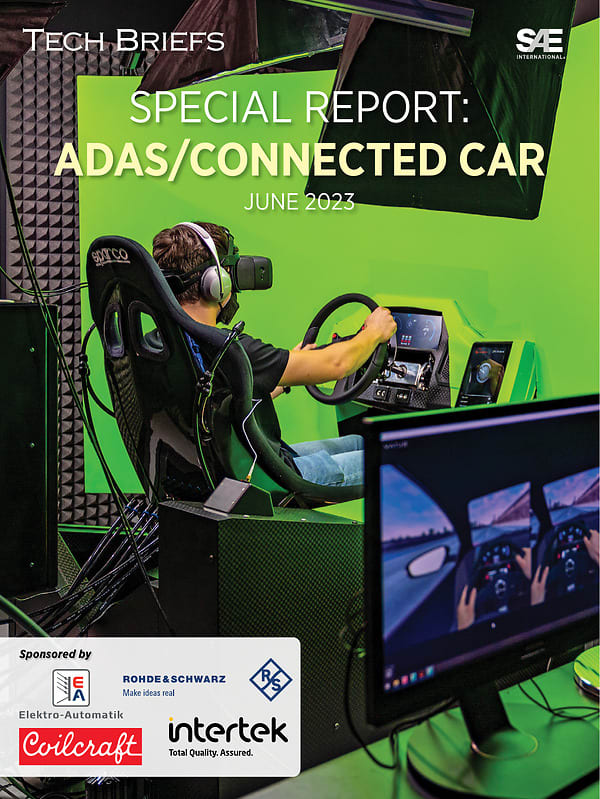
In this compendium of articles from the editors of Automotive Engineering and ADAS & Autonomous Vehicle Engineering magazines, see how advances in computer simulation, lidar/sensors, display technology, and robotics are driving the evolution of automated systems.
Don't have an account?
Overview
The ADAS/Connected Car Special Report from June 2023 provides an in-depth look at the advancements and integration of simulation technology in the automotive industry, particularly focusing on Advanced Driver Assistance Systems (ADAS) and autonomous vehicle development.
One of the key highlights of the report is the strategic adoption of simulation tools by Original Equipment Manufacturers (OEMs) to enhance vehicle development processes. For instance, Ford has recently commissioned a new driving simulator, the DiM250, at its Research and Engineering Center in Dearborn, and has also launched a VI-grade Compact Simulator in Nanjing, China. This simulator is equipped with a Virtual Test Tracks package, allowing Ford to integrate 3D virtual data to simulate its test tracks effectively. The report emphasizes that simulation has become essential not only for vehicle dynamics but also for the development of ADAS and autonomous vehicles.
Volvo is another notable example mentioned in the report, having achieved a remarkable 50% reduction in the development cycle for its latest SUV platform through the use of simulation technology. Ford claims that tasks that traditionally took a month at a proving ground can now be completed in just one week using simulation, significantly reducing the time and costs associated with building prototypes and conducting physical tests.
The report also touches on the advancements in Ultra-Wideband (UWB) technology, which is enhancing security and improving ranging accuracy for connected devices. A free poster from Rohde & Schwarz is offered, summarizing important details about the physical layer and positioning techniques related to UWB, making it a valuable resource for professionals in the field.
Additionally, the report discusses the role of lidar technology in the automotive sector. Lidar allows for more precise environmental sensing, enabling vehicles to make informed decisions about their surroundings. This technology is seen as a critical component in the development of safer autonomous driving systems, as it helps vehicles understand their environment better than traditional sensors.
Overall, the report underscores the importance of simulation and advanced sensor technologies in the evolution of connected and autonomous vehicles. It highlights how these innovations are not only streamlining development processes but also paving the way for safer and more efficient driving experiences. The integration of these technologies is crucial for OEMs as they navigate the complexities of modern vehicle design and the increasing demand for advanced safety features.
In conclusion, the ADAS/Connected Car Special Report serves as a comprehensive overview of the current trends and technologies shaping the future of the automotive industry, emphasizing the transformative impact of simulation and advanced sensor technologies on vehicle development and safety.