

Space Technology - July 2023
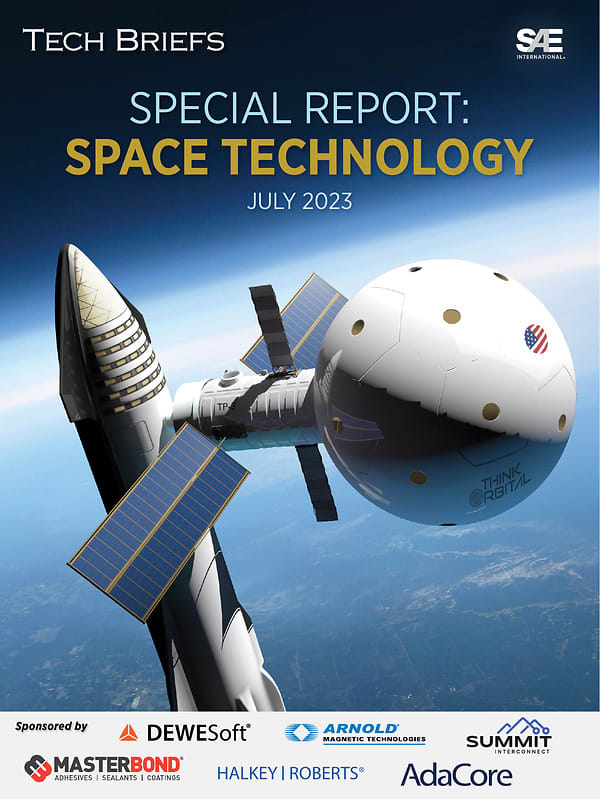
Read about ten surging space startups, robotic construction on the moon, metal 3D printing in orbit, and much more in this compendium of recent articles from the editors of Tech Briefs and Aerospace & Defense Technology magazines.
Don't have an account?
Overview
The July 2023 Special Report on Space Technology provides a comprehensive overview of the latest advancements and trends in the space industry, particularly focusing on the rise of innovative startups and technological developments that are shaping the future of space exploration and services.
One of the key highlights of the report is the commercialization of low-Earth orbit (LEO), which has spurred the emergence of numerous space startups. These companies are making significant strides in various areas, from launch services to in-space operations, and are introducing new innovations that have the potential to disrupt traditional space practices. The report features a spotlight on ten fast-growing startups that are leading the charge in this dynamic environment, showcasing their unique contributions and the technologies they are developing.
In addition to the focus on startups, the report delves into specific technological advancements. One notable feature is the discussion on thermal modeling for small satellites, which is crucial for ensuring the reliability and performance of these spacecraft in the harsh conditions of space. The report also covers the development of the "Adamant" flight software framework, which is designed to be mission-critical and is written in Ada, a programming language known for its reliability in high-stakes environments.
The report includes various application briefs that highlight practical technologies being developed for space applications. For instance, it discusses an adhesive designed for optical components used in laser and space applications, as well as advancements in manufacturing techniques such as leveraging metal 3D printing for space-related products. Another innovative concept presented is the use of inflatable space habitats equipped with sensors embedded in webbing for structural health monitoring, which could enhance the safety and functionality of living and working in space.
Furthermore, the report touches on the development of systems for lunar exploration, including a lunar surface navigation system and a compact flat metalens designed for imaging the moon's surface. These technologies are part of the broader effort to establish a sustainable human presence on the moon and beyond.
The report also addresses the challenges faced by engineers in developing flight software for space missions. For example, it describes the constraints of running software on a single Arm Cortex-M1 microprocessor within a radiation-tolerant FPGA, emphasizing the need for hard real-time performance and multitasking capabilities in a limited processing environment.
Overall, the July 2023 Special Report on Space Technology encapsulates the excitement and innovation within the space sector, highlighting how startups and new technologies are paving the way for future exploration and commercialization of space. The insights provided in this report reflect a rapidly evolving industry that is increasingly accessible and driven by creativity and technological advancement.










