Medical Manufacturing & Outsourcing - August 2023
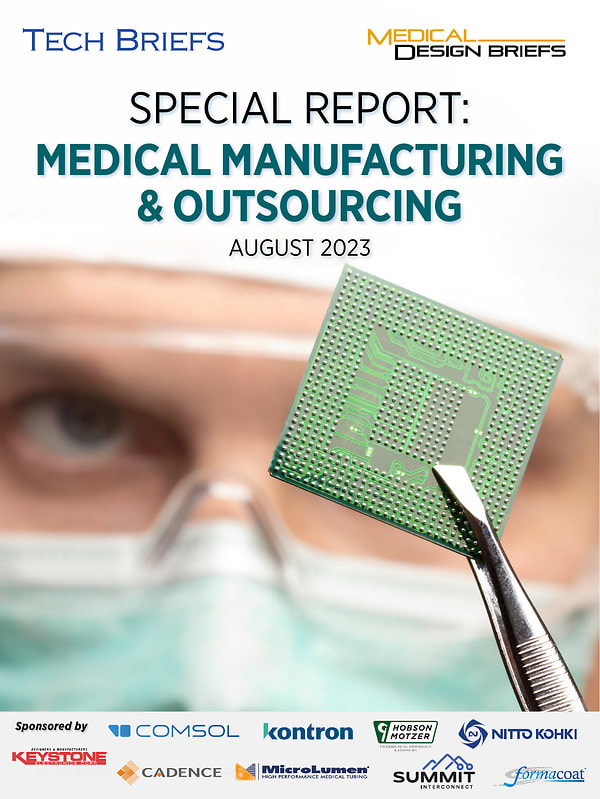
New 3D printing technique is a game-changer for medical device testing…automated 3D scanning speeds part inspection…how to eliminate PCB static in medical electronics. Read about these and other advances in this compendium of recent articles from the editors of Medical Design Briefs magazine.
Don't have an account?
Overview
The Medical Manufacturing & Outsourcing Special Report - August 2023 provides a comprehensive overview of current trends and challenges in the medical manufacturing sector, particularly focusing on the complexities of producing difficult-to-manufacture products and the evolving landscape of outsourcing.
One of the key themes of the report is the shift in outsourcing strategies among medical technology original equipment manufacturers (OEMs). Traditionally, many companies relied on a "lift-and-shift" model, which emphasized low-cost offshore staffing to manage mature products. However, there is a growing recognition of the benefits of integrated outsourcing. This new approach involves collaborating with trusted third-party providers who offer local support from expert teams in mature markets, alongside nearshore and offshore capabilities. This tailored model aims to enhance efficiency and quality in product management.
The report also highlights the importance of quality assurance in manufacturing processes. It discusses various organizational models for quality management, including umbrella, collaborative, and dispersed models. Each model has its own structure and responsibilities, depending on the specific needs of the organization. This flexibility allows companies to adapt their quality assurance processes to better meet market demands.
Another significant topic covered is the management of electrostatic discharge (ESD) during surface mount technology (SMT) production. While it is impossible to eliminate ESD entirely, the report outlines effective measures to mitigate its impact. Recommendations include environmental control strategies and the use of antistatic wrist and heel straps to protect sensitive components during manufacturing.
The report also delves into the technical aspects of manufacturing, such as ultrasonic welding (USW). Understanding the key parameters and material properties that influence USW outcomes is crucial for achieving optimal results. This section emphasizes the need for manufacturers to be well-versed in the technical requirements of their processes to ensure product quality and reliability.
Additionally, the report features a case study from Orchid Orthopedic Solutions, showcasing advancements in inspection technology. The company has improved its inspection efficiency by utilizing an ATOS ScanBox, which allows for the measurement of multiple features on parts in significantly less time compared to traditional coordinate measuring machines (CMM). This innovation not only saves time but also enhances the quality control process by enabling more comprehensive inspections.
Overall, the Medical Manufacturing & Outsourcing Special Report serves as a valuable resource for industry professionals seeking to navigate the complexities of medical manufacturing and outsourcing. It emphasizes the importance of adapting to new operational models, leveraging technology for quality assurance, and understanding the technical nuances of manufacturing processes. As the industry continues to evolve, staying informed about these trends will be essential for maintaining competitiveness and ensuring the successful management of medical products.