

Space Technology - November 2023
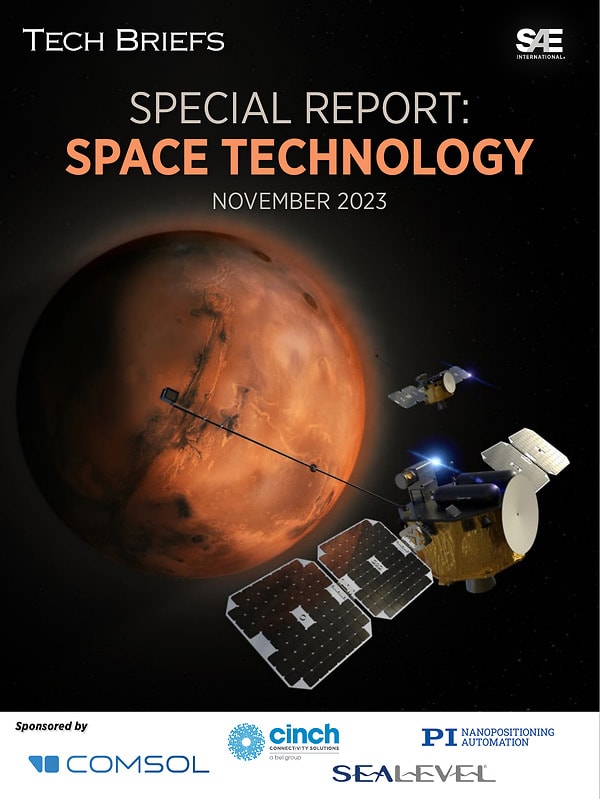
Read about NASA's plans for future Mars exploration, ultrafast laser-based space communications, new strategies for cleaning up orbital debris, and much more in this compendium of recent articles from the editors of Tech Briefs and Aerospace & Defense Technology magazines.
Don't have an account?
Overview
The November 2023 Special Report on Space Technology presents a comprehensive overview of recent advancements and ongoing projects in the field of aerospace engineering and space exploration. It highlights the evolution of missions to Mars, from the early flyby of NASA's Mariner 4 in 1964 to the sophisticated Perseverance rover launched in 2020. This historical context underscores humanity's enduring interest in exploring the Red Planet and the technological progress made over the decades.
A significant focus of the report is on the technological innovations that enhance space exploration capabilities. It discusses the importance of robust, reliable, and long-lasting technologies, particularly for human safety-critical systems used in extended missions. The report emphasizes that while traditional systems have relied on simple and dependable solutions, recent advancements in computing power and electronics reliability have shifted the focus toward digital and software controls. This transition allows for significant improvements in performance, size, weight, and power (SWaP), which are crucial for the success of modern space missions.
The report also delves into the challenges of imaging and tracking space debris, a growing concern in low Earth orbit (LEO). It describes a model that utilizes a cluster of reflectors and multiple radiation sources on Earth to detect and record signals reflected off space debris. The use of X-band frequencies (8 to 12 gigahertz) is highlighted for its potential to improve resolution, although it also presents challenges due to atmospheric distortions. The authors of the study propose a method to correlate data from different receivers to mitigate these distortions, showcasing the innovative approaches being developed to address the complexities of space surveillance.
Additionally, the report touches on NASA's ongoing efforts to launch satellites, rovers, and orbiters to investigate humanity's place in the Milky Way. These missions are critical for expanding our understanding of space and our own planet's environment. The integration of advanced technologies in these missions not only enhances scientific research but also contributes to the safety and efficiency of space operations.
Overall, the Special Report serves as a testament to the rapid advancements in space technology and the collaborative efforts of scientists and engineers to push the boundaries of exploration. It reflects a future where enhanced capabilities and innovative solutions will enable more ambitious missions, including potential human exploration of Mars and beyond. The report invites readers to consider the implications of these advancements for the future of humanity in space, emphasizing the importance of continued investment in research and development to ensure safe and successful exploration of the cosmos.











