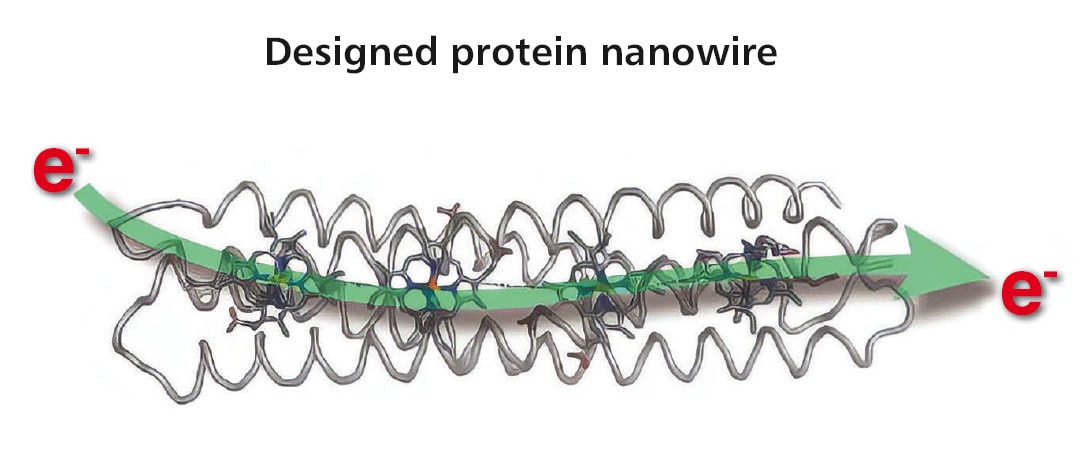
A University of Bristol-led study, published in The Proceedings of the National Academy of Sciences, demonstrates how to make conductive, biodegradable wires from designed proteins. These could be compatible with conventional electronic components made from copper or iron, as well as the biological machinery responsible for generating energy in all living organisms.
The miniscule wires — the size of transistors on silicon chips or one thousandth of the breadth of the finest human hair — are made completely of natural amino acids and heme molecules, found in proteins such as hemoglobin, which transports oxygen in red blood cells. Harmless bacteria were used for their manufacture, eliminating the need for potentially complex and environmentally damaging procedures commonly used in the production of synthetic molecules.
“While our designs take inspiration from the protein-based electronic circuits necessary for all life on Earth, they are free from much of the complexity and instability that can prevent the exploitation of their natural equivalents on our own terms,” said lead author Ross Anderson, Professor of Biological Chemistry at the University of Bristol. “We can also build these minute electronic components to order, specifying their properties in a way that is not possible with natural proteins.”
Leading experts in biomolecular engineering and simulation worked together to produce this unique new method of designing tailor-made proteins with tuneable electronic properties.
The multidisciplinary team used advanced computational tools to design simple building blocks that could be combined into longer, wire-like protein chains for conducting electrons. They were able to visualize the structures of these wires using protein X-ray crystallography and electron cryo-microscopy (cryo-EM) techniques, which allow structures to be viewed in the finest detail. Pushing the technical boundaries of cryo-EM, images of the smallest individual protein ever studied were obtained with this technique.
Ultimately, these nanoscale designer wires have the potential to be used in a wide range of applications, including biosensors for the diagnosis of diseases and detection of environmental pollutants. It is also hoped that this invention will form the foundation of new electrical circuits for creating tailor-made catalysts for green industrial biotechnology and artificial photosynthetic proteins for capturing solar energy.
The breakthrough was possible thanks to a £4.9 million (about $6.2 million) grant from the Biotechnology and Biological Science Research Council, resulting in a five-year project entitled ‘The Circuits of Life’ involving the Universities of Bristol, Portsmouth, East Anglia, and University College London.
The team harnessed its expertise in protein design, electron transfer, biomolecular simulation, structural biology, and spectroscopy to gain insight into how electrons flow through natural biological molecules, a fundamental process which underpins cellular respiration and photosynthesis.
Further advances are expected as the project, which began last year, progresses, presenting significant opportunities to help meet the transition to net zero and sustainable industrial processes.
“These proteins show how protein design is increasingly delivering practically useful tools,” said co-author Adrian Mulholland, Professor of Chemistry at the University of Bristol. “They offer exciting possibilities as components for engineering biology and also are great systems for investigating the fundamental mechanisms of biological electron transfer.”
For more information, contact the University of Bristol’s Press Office at