Space Technology - May 2024
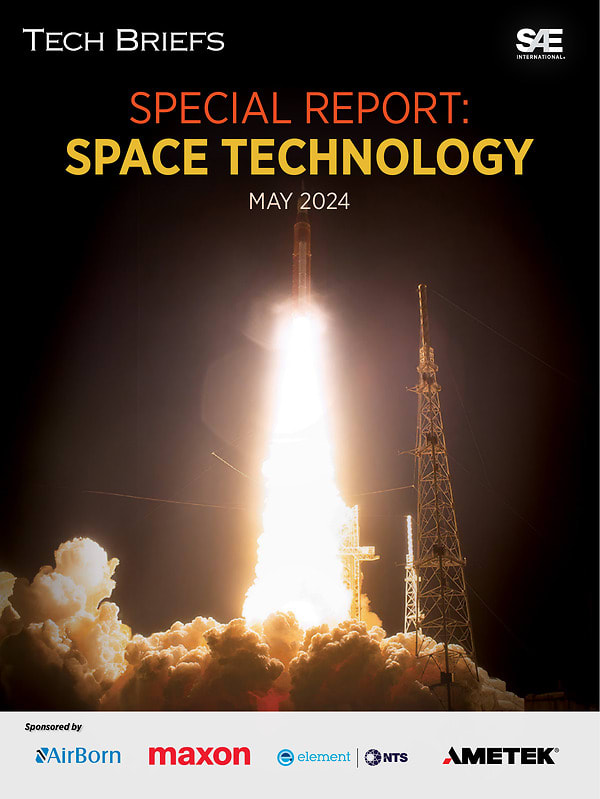
NASA's plan for building landing pads on the moon...the first 3D-printed rocket to reach orbit...MAPLE mission demonstrates wireless power transfer in space. Read about these and other exciting advances in this compendium of articles from the editors of Tech Briefs and Aerospace & Defense Technology.
Don't have an account?
Overview
The May 2024 Special Report on Space Technology presents a comprehensive overview of the latest advancements and innovations in the field of space exploration and technology. This edition highlights several key areas of development, focusing on the integration of cutting-edge technologies that are shaping the future of space missions.
One of the standout features of the report is the exploration of additive manufacturing, which is revolutionizing the way rockets and components are built. This technology significantly reduces build time and allows for more complex designs that were previously unattainable with traditional manufacturing methods. The report emphasizes how additive manufacturing can streamline production processes and enhance the efficiency of rocket construction.
The James Webb Space Telescope is also a focal point, showcasing its remarkable capabilities through stunning images of the universe. The telescope's 21-foot segmented mirror, which unfurled and assembled itself in space, is a testament to the advancements in optical technology and engineering that enable unprecedented observations of distant celestial bodies.
Another significant topic covered is the Space Solar Power Demonstrator (SSPD-1), which includes the innovative MAPLE (Microwave Array for Power-transfer Low-orbit Experiment). This project aims to harvest solar energy in space and transmit it wirelessly to Earth. The report details how MAPLE successfully demonstrated wireless power transfer using flexible, lightweight microwave transmitters, marking a milestone in energy transmission technology. This capability could potentially provide a continuous and abundant energy source, free from the limitations of terrestrial solar power, such as day-night cycles and weather conditions.
The report also discusses the importance of reliable components in the rapidly expanding commercial space market. It highlights the need for robust hermetic headers, connectors, and packages that can withstand the harsh conditions of space. As commercial space ventures grow, the demand for reliable and efficient technology becomes increasingly critical.
Additionally, the report touches on the Copernicus Earth Observation Program, which is being enhanced through the use of hyperspectral imaging. This technology allows for more detailed monitoring of the Earth's environment, providing valuable data for climate research and resource management.
The report concludes with insights into the future of space technology, emphasizing the role of innovation in driving progress. As new equipment and state-of-the-art advancements emerge, the landscape of space exploration is set to evolve dramatically. The integration of these technologies not only enhances mission capabilities but also opens up new possibilities for scientific discovery and commercial opportunities in space.
Overall, the May 2024 Special Report on Space Technology encapsulates the dynamic and rapidly advancing field of space exploration, showcasing how innovative technologies are paving the way for future missions and expanding our understanding of the universe.