

Originating Technology/NASA Contribution
The past, present, and future of NASA launch and space travel technologies are steeped in the icy realm of cryogenics. NASA employs cryogenics, the science of generating extremely low temperatures and the behavior of materials at those temperatures, in a variety of fluid management and low-temperature applications including vehicle propulsion, high-pressure gas supply, life support equipment, food preservation and packaging, pharmaceutical manufacturing, and imaging devices. Most prominently, cryogenic liquid hydrogen fuel is used by the space shuttle as its primary means of achieving orbit.

Cryogenic propellants have been favored for their high-energy, high-efficiency performance; however, cryogenic propellants have not been used in extended-duration space missions since they are difficult to maintain in their highly dense liquid form at the low temperatures common in space and on the Moon. Performance requirements for the Earth departure stage, as well as the lunar lander descent and ascent stages, point toward the use of cryogenic engines and propellants for missions of up to 210 days on the surface of the Moon.

Partnership
Big Horn Valve Inc. (BHVI), of Sheridan, Wyoming, won a series of Small Business Innovation Research (SBIR) and Small Business Technology Transfer (STTR) contracts to explore and develop a revolutionary valve technology based on cryogenically proven Venturi Off-Set Technology (VOST). In 2001, BHVI first worked with Kennedy on an SBIR contract, “New and Innovative Valving Technology for Cryogenic Applications.” In 2003, BHVI’s proposal, “Low-Mass VOST Valve,” was selected from a field of 2,696 other entries nationwide to receive a Phase I SBIR contract, sponsored by Marshall under the Next Generation Launch Technology Program. This project developed a low-mass, high-efficiency, leak-proof cryogenic valve using composites and exotic metals, and had no stem-actuator, few moving parts, with an overall cylindrical shape. The valve geometry reduces launch vehicle complexity and facilitates assembly and testing. This valve also enhances reliability and safety, due to the inherent simplicity and leak-proof characteristic of the design.
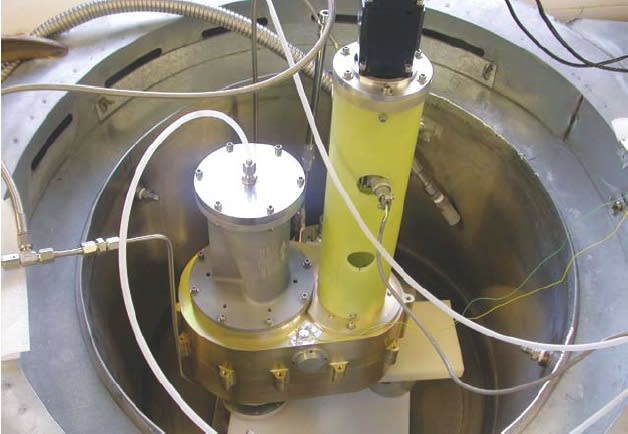
In 2005 and 2006, BHVI continued this work upon receipt of a Phase II SBIR award for “Low-Mass VOST Valve” from Marshall, and two Phase II SBIR awards from Johnson. These projects, “In-Space Cryogenic VOST Connect/Disconnect,” and “VOST Flow-Control Valve,” demonstrated that VOST cryogenic flow control offered precise linear flow control across the entire dynamic range, held its position without power, and required low actuation energy. This project paved the way for VOST valve application in future spaceport systems, advanced cryocoolers, launch vehicles, and high-pressure flow-control valves.
Product Outcome
The precise control, inherent simplicity and durability, and demonstrated abilities of the VOST system afford many commercial applications, including petroleum refining, specialty chemical and high-purity pharmaceutical production, and the manufacture of industrial flow-control valves and food processing equipment. The VOST design is a magnetically actuated system in which internal magnets are used to close, open, and throttle the valve. This innovative stemless design, the only one commercially available, is emission-free with no external leakage of vapors or fluid and allows for superior fluid handling features (such as throttling, low-pressure drop, and axial envelope) within a single device structure. The VOST system has potential application in all valving environments and represents a new concept for a tradition-bound industry.
In December 2003, BHVI was selected to exhibit the VOST technology at the 2004 World’s Best Technologies Showcase, in Dallas, Texas. The 75 exhibitors selected came from the Nation’s most advanced research facilities, top universities, and entrepreneurs. The technologies displayed are considered the best of the best.
The first commercial MagVOST was installed March 16, 2006, at Windsor Energy Inc.’s methane coal gas field, east of Kaycee, Wyoming. Future applications are expected to include in-flight refueling of military aircraft and high-volume gas delivery systems such as liquefied natural gas (LNG). Big Horn is also exploring opportunities that require extreme attention to safety, such as with hydrofluoric acid in the petroleum refining industry and in the nuclear industry, and received an SBIR contract from the U.S. Navy to develop a bi-directional VOST valve for use as an isolation valve on ships.
VOST™ and MagVOST™ are trademarks of Big Horn Valve Inc.