

The NASA Deep Space Network (DSN) requires a broadband VLBI (very long baseline interferometry) correlator to process data routinely taken as part of the VLBI source Catalogue Maintenance and Enhancement task (CAT M&E) and the Time and Earth Motion Precision Observations task (TEMPO). The data provided by these measurements are a crucial ingredient in the formation of precision deep-space navigation models. In addition, a VLBI correlator is needed to provide support for other VLBI related activities for both internal and external customers.
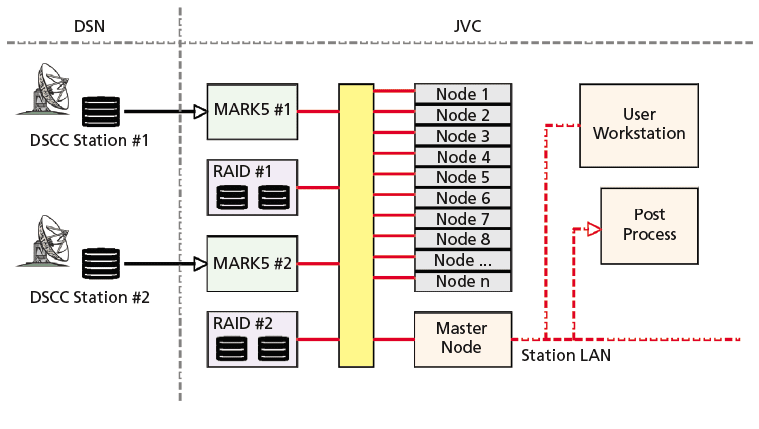
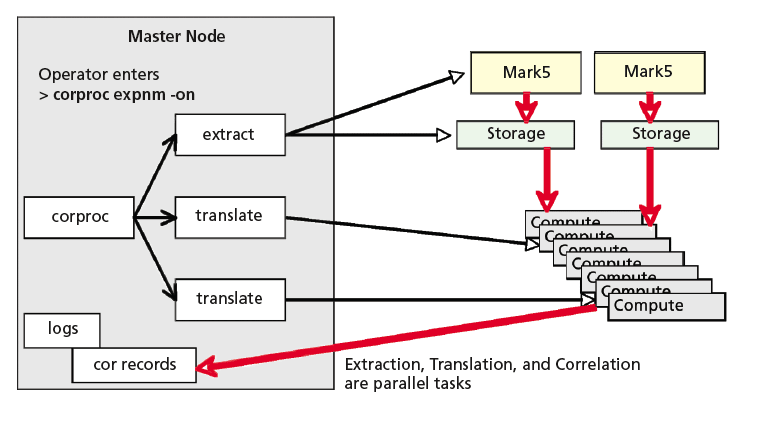
Mark5 data modules are loaded on Mark5 Data systems playback units, one per station. Data processing is started when the operator scans the Mark5 systems and runs a script that reads various configuration files and then creates an experiment-dependent status database used to delegate parallel tasks between nodes and storage areas (see Figure 2). This script forks into three processes: extract, translate, and correlate. Each of these processes iterates on available scan data and updates the status database as the work for each scan is completed.
The extract process coordinates and monitors the transfer of data from each of the Mark5s to the Beowulf RAID storage systems. The translate process monitors and executes the data conversion processes on available scan files, and writes the translated files to the slave nodes. The correlate process monitors the execution of SoftC correlation processes on the slave nodes for scans that have completed translation.
A comparison of the JVC and the legacy Block II correlator outputs reveals they are well within a formal error, and that the data are comparable with respect to their use in flight navigation. The processing speed of the JVC is improved over the Block II correlator by a factor of 4, largely due to the elimination of the reel-to-reel tape drives used in the Block II correlator.
This work was done by Stephen P. Rogstad, Andre P. Jongeling, Susan G. Finley, Leslie A. White, Gabor E. Lanyi, John E. Clark, and Charles E. Goodhart of Caltech for NASA’s Jet Propulsion Laboratory. For more information, contact











